


What Certifications & Testing Should You Require from an OEM Utility Trailer Wire Harness Supplier?
2026-10-28 10:07When evaluating an OEM utility trailer wire harness supplier, know what certifications and testing you should require. Ask any supplier for five things: ISO 9001, IATF 16949, UL, IPC/WHMA-A-620, and a clear electrical, mechanical, and environmental test plan backed by paperwork. A failed trailer wire harness kills your lights or brake signals and leaves your customer stuck on the shoulder. That makes supplier credentials a safety and liability decision, not just a paperwork exercise. This post gives you a quick-reference list, explains what each credential really proves, and shows you how to check every claim before you sign a purchase order. Use it as a checklist for your next China custom wire harness review.
Key Takeaways
Ask for five important credentials: ISO 9001, IATF 16949, UL, IPC/WHMA-A-620, and a test plan with records.
ISO 9001 shows a supplier has a quality system, but it does not promise zero defects.
IATF 16949 adds strict rules for the auto industry. Check that the certificate covers wire harness making at the correct site.
UL makes sure electrical products are safe. Check the UL file number in UL Product iQ before you trust the claim.
IPC/WHMA-A-620 sets the rules for good work quality; pick the class that fits how hard your trailer works and ask for inspection records.
Ask for test records for continuity, pull force, and environmental stress. These records show that the shipped part really works.
Certifications & Testing: The Five Core Requirements
Quick-Reference Comparison
The table below shows what each requirement proves and how firmly you should hold it. Treat the first four as basic demands for any serious trailer wire harness manufacturer. Treat the test protocol as non-negotiable for safety circuits.
How the Requirements Interlock
No single credential carries the full burden. ISO 9001 provides the quality system framework. IPC/WHMA-A-620 provides the concrete acceptance criteria that the system enforces. It defines what a properly crimped terminal or routed harness looks like. IATF 16949 adds automotive-specific rigor through tools such as FMEA, PPAP, and 8D problem solving. UL addresses electrical safety. Testing then verifies the finished assembly with objective, quantifiable results beyond visual inspection.
Think of the five as one chain. A quality system without workmanship criteria has nothing specific to inspect against. Workmanship standards without a quality system have no process to sustain them. Neither matters if the shipped part never faces a continuity or pull-force check. This is why you should ask what certifications and testing a China custom wire harness supplier can document as a complete set, not as isolated badges. A supplier holding ISO 9001 and IPC/WHMA-A-620, with test records to match, gives you a verifiable chain from process to product.
1. ISO 9001 Quality Management Certification
Scope and Limits
Begin with ISO 9001:2015, certified by an accredited body. This is the basic requirement for wire harness manufacturers. The standard checks how a plant plans, runs, watches, and improves its work. It covers document control, employee training, equipment calibration, internal audits, corrective actions, and recordkeeping. When a supplier follows these systems every time, it gets repeatable results and handles problems well.
An ISO 9001 audit does not test how a product performs. It confirms that written systems exist for managing quality, handling customer needs, controlling processes, and always improving. It does not certify individual products or promise that every assembly leaves the line with no defects.
ISO 9001 does not promise zero defects. Instead, it promises a structured system that cuts variation, improves accountability, and ensures steady execution.
Treat the certificate as one part of a wider supplier review. Weigh manufacturing experience, technical skill, inspection practices, and overall performance alongside it. When combined with 100% testing, IPC/WHMA-A-620 workmanship criteria, and application-specific engineering, ISO 9001 becomes a strong framework for high-reliability assemblies.
The Baseline for Every Supplier
ISO 9001 is the minimum, not something that sets a supplier apart. Any legitimate trailer wire harness manufacturer should hold it. A supplier without it shows no investment in basic quality infrastructure, and that is a big risk.
The certificate also proves less than many buyers think. It is not harness-specific, so it does not show process capability for crimping, splicing, or termination. Ask one direct question to test real capability: can the supplier trace a finished harness back to raw wire reel and terminal lot numbers? That traceability supports root-cause analysis and contains recalls before they spread across a production batch. A supplier that cannot answer this has a certificate but no working system behind it.
2. IATF 16949 Automotive Certification
Relevance to Trailer Harnesses
IATF 16949 is the quality management standard for the car industry. It builds on ISO 9001 and adds process discipline that helps trailer harness production. Risk management through FMEA makes the supplier study failure modes before parts ship. Traceability rules push lot-level records down to the component. Process validation confirms that crimp presses and test stations work as designed. A utility trailer harness has the same safety job as an automotive harness: it carries lighting and brake signals in rain, salt, and vibration. Suppliers who follow IATF discipline use proven methods on your program.
Reading the Certificate Scope
A certificate on the wall proves little until you read the scope line. Follow these steps before you approve any China custom wire harness supplier.
Get the full certificate and annexes. Write down the legal entity name, plant address, scope text, IATF certificate number, certification body, and expiry dates. Ask for the IATF Unique Site Identifier, a six-character code tied to each certified site. Keep the IATF number separate from the certification body's own reference number.
Match the scope wording and the manufacturing site. The scope must clearly cover harness or cable assembly manufacturing. A certificate for another product category does not support your purchase. Confirm the address matches the factory that will build your parts, and clarify any outsourced operations.
Cross-check through the IATF Customer Portal. Compare the official record against the supplier's copy, and contact the issuing body if details differ. IATF 16949 certifies specific sites, not whole companies. A supplier group may hold a valid certificate at one factory while building your harness at an uncertified site. Confirm the certificate address matches the factory named in your quote, and require written approval before any production transfer.
3. UL Product Safety Certification
Standards That Apply to Trailer Wiring
UL asks one main question: will this assembly stay electrically safe during real use? For cable assemblies, that means three things. First, the conductors and insulation must handle the rated voltage and current without breaking down. Second, the materials must resist flame. A harness that catches fire after a short circuit turns a small problem into a vehicle fire. Third, the insulation must hold up through flexing, rubbing, and heat, so the conductor never becomes exposed.
UL 62 covers flexible cords and cables, and UL 817 covers cord sets and power-supply cords. These standards test insulation thickness, dielectric strength, and flame resistance. A UL-recognized component carries a recognized component mark. That mark tells you the part passed UL's safety evaluation as a building block, not as a finished product.
When UL Listing Is Required
UL listing becomes mandatory when you sell into North American retail channels, regulated markets, or applications where a code authority or insurer demands it. Many large retailers will not stock a trailer product without UL-recognized wiring. Some insurers tie coverage to listed components. In those cases, treat UL as a hard gate.
For many utility trailer applications, UL listing is a negotiable extra rather than a legal requirement. Private-label trailers sold through independent dealers often face no UL mandate. Even so, UL-recognized wire and connectors lower your liability risk and strengthen your warranty position. A capable utility trailer wire harness OEM will tell you which components carry UL recognition and which do not. Ask for the UL file number and check it in UL Product iQ before you accept the claim.
4. IPC/WHMA-A-620 Workmanship Compliance
Crimp, Splice, and Termination Quality
IPC/WHMA-A-620 sets the rules for what counts as an acceptable crimp, splice, and termination. It turns vague quality goals into clear pass-or-fail limits. The standard defines three workmanship classes, and each class makes the requirements stricter.
Class 3 adds cross-section analysis to check conductor compression and confirm the termination has no voids. It also requires 100% inspection instead of sampling, plus full lot-level traceability of wire, terminals, and operators.
Matching Workmanship Class to Application
Match the class to how hard your trailer works and what warranty you promise. Class 1 fits low-cost, short-life uses with little vibration. Class 2 fits general utility trailer use. Class 3 makes sense for heavy-duty harnesses, safety circuits, and long warranty terms. A brake or lighting circuit that fails at highway speed is reason enough for the tighter crimp height tolerance and 100% pull-force checks.
Compliance must show up in real practice, not just on paper. A certificate means nothing without trained operators and inspection records. Ask any trailer wiring harness supplier for operator training logs, crimp height measurements, and pull-force records tied to your production lots. Request cross-section images for Class 3 work. These records show that the standard guides daily production, not just a sales brochure.
5. Electrical, Mechanical, and Environmental Testing
Core Test Protocol
Certifications show how a supplier works. Testing shows what the shipped part really does. Start with 100% electrical continuity testing on a computerized system such as Cirris. This catches opens, shorts, and wrong pinouts on every unit, not just a sample. Add a hi-pot (dielectric withstand) test to stress the insulation and confirm it holds. Pull-force testing then checks that each crimp can take the mechanical load of service.
Environmental tests copy the road. Vibration and shock confirm the connector stays seated during constant shaking and sudden jolts. Thermal cycling puts the harness through temperature extremes and fast changes. Moisture resistance and salt spray check corrosion protection, which matters most for heavy-duty harnesses on winter roads. Insertion and removal force checks also confirm the connector goes in easily and stays locked.
Documentation Buyers Should Demand
Test results mean nothing without records you can audit. Ask for a wiring harness test certificate or certificate of conformity. It should name the assembly, drawing revision, batch or job reference, tests completed, and the acceptance criteria used. Pair it with pull-force records, material and component traceability records, and calibration records for the tester.
A complete package also includes crimp height and cross-section data, electrical test data tied to a named program revision, and non-conformance records. Request these for your next custom trailer harness order and compare them against the drawing revision you approved.
Verifying an OEM Utility Trailer Wire Harness Supplier
Checking Registrars and Scopes
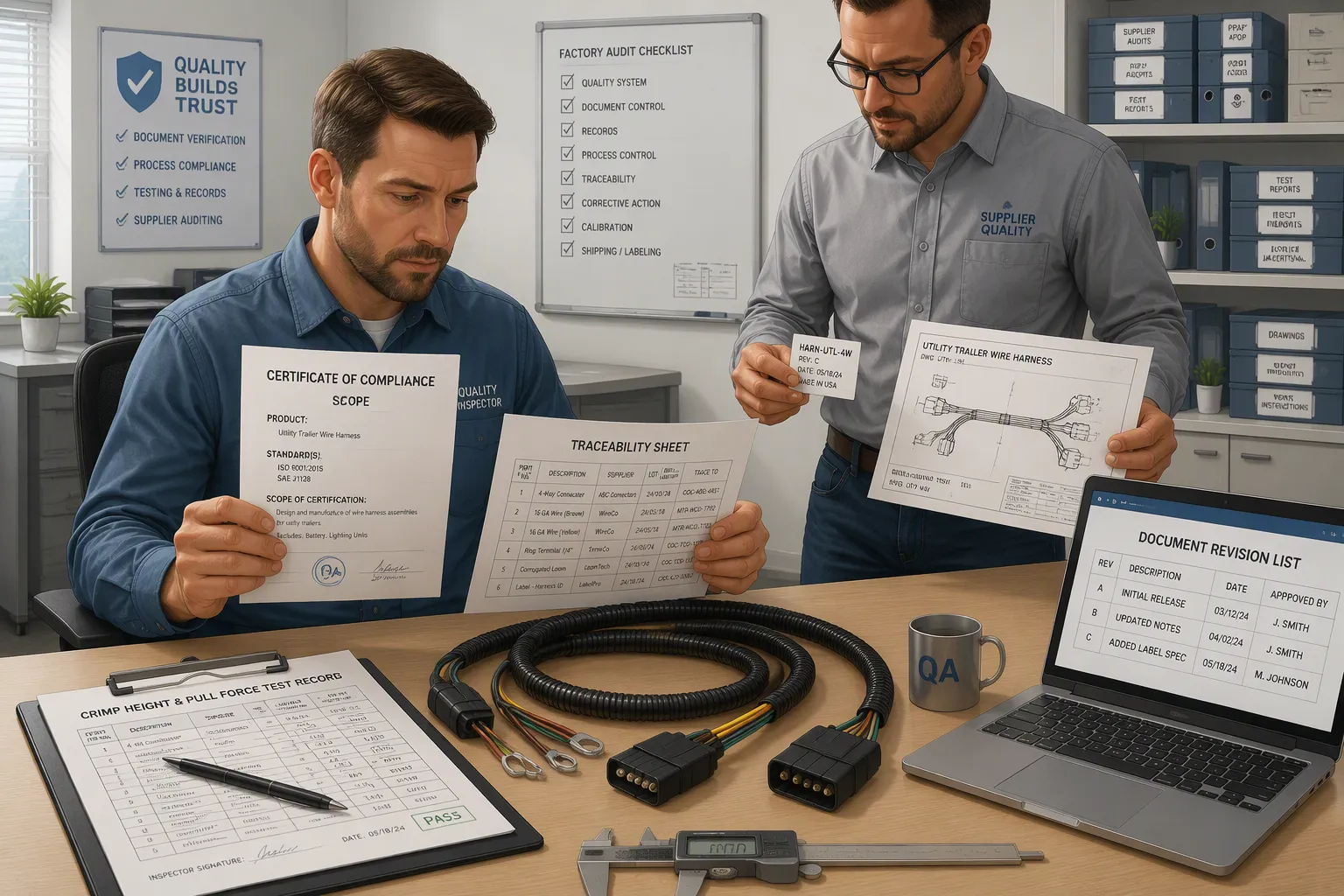
A logo on a website proves nothing. Ask for the certificate scope page, not just the badge. Follow these steps to confirm every claim.
Ask for the exact certificate number, the issuing body, and the scope wording. A certificate for "electronic cables" may not cover "wire harness" manufacturing.
Match the certification to your destination market. Use UL documents for North America and VDE for Germany or the EU.
Check the standard and edition. Certificates should name the standard that applies, such as UL 758 or DIN EN 50525-2-11. The edition must still satisfy your end customer or regulator.
Allow time for connector brand approval. Non-original replacement connectors need testing and approval before mass production.
Send certification documents to your quality department during sample approval. That way they face audit alongside the sample submission.
A strong answer names the standard, the issuer, the scope, and the current validity. A weak answer is a vague claim like "We have ISO certification." Ask follow-up questions: Does the scope specifically cover wire harness manufacturing? Can we review the audit report?
Auditing Test Data and Traceability
During a factory audit, ask for the records that expose a weak quality system fastest. These include crimp-height and pull-force records, tester file revisions, traceability sheets, deviation approvals, and corrective-action closure records. They show whether the process stays controlled shift by shift, not merely described in a manual.
Confirm document and revision control next. Ask who controls work instructions, then compare the released drawing, BOM, and ECN history against the sample label. Check material traceability from wire, terminal, seal, housing, sleeve, and label lots through to shipment. Review test control too, covering continuity, shorts, insulation resistance, hipot, and tester file revision. The right answer is always a controlled document or record, never a sales statement.
Xiamen Kehan Electronics Co., Ltd. serves as a working example. This trailer wire harness manufacturer furnishes certificates of conformity, pull-force records, traceability records, and calibration records on request. Apply the same document requests to any China custom wire harness supplier you shortlist.
Risks of Skipping Certifications and Testing
Warranty and Field Failure Costs
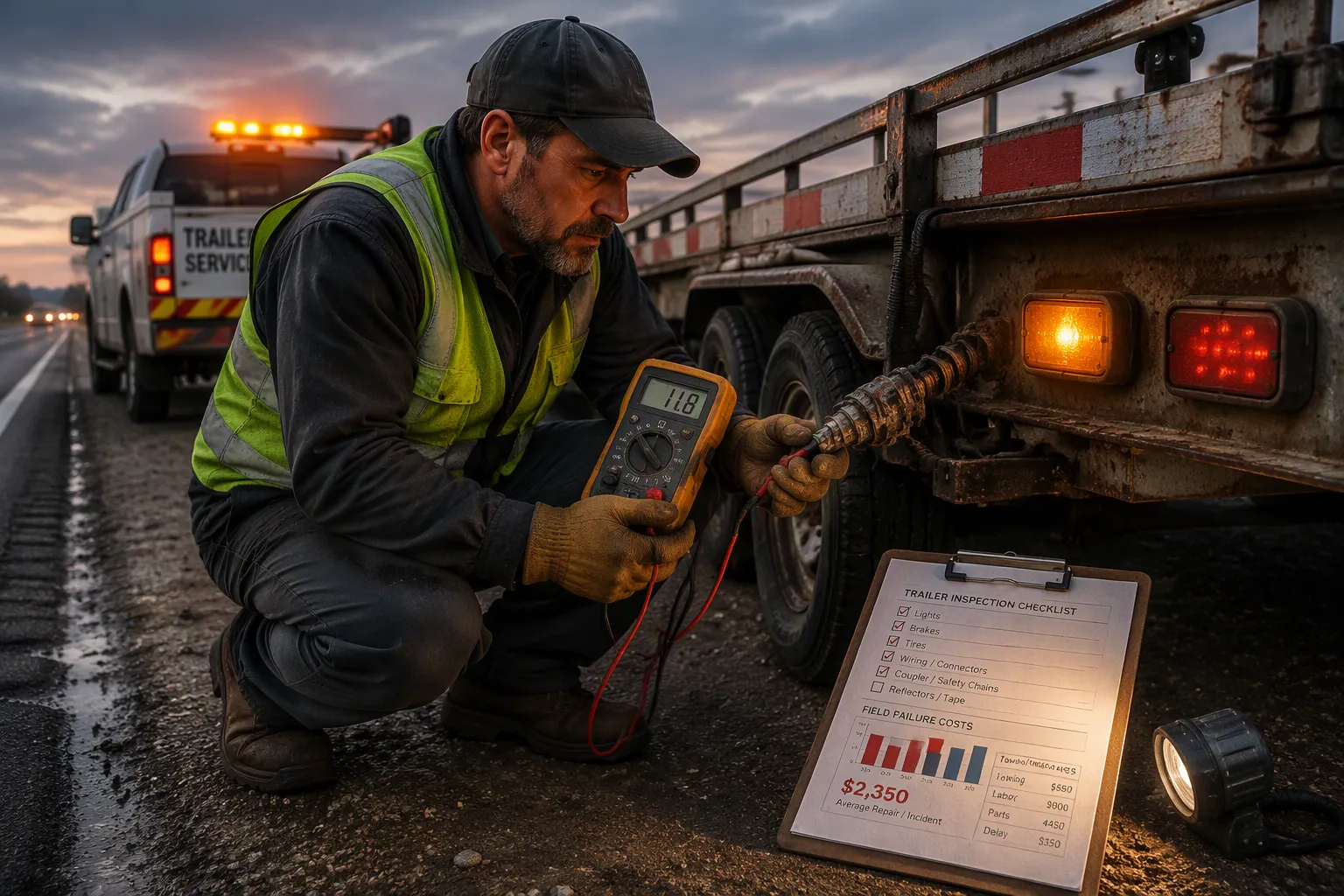
A broken harness costs much more than the part itself. A rusty connector stops the lights or brake signal, and the trailer pulls over to the side of the road. Fleets count the easy-to-see repair costs first: new parts, worker hours, and sending a service truck. The hidden costs often add up to more. Drivers wait around, deliveries arrive late, freight gets rescheduled, equipment sits unused, and old systems need repeat repairs. All of this adds to the bill.
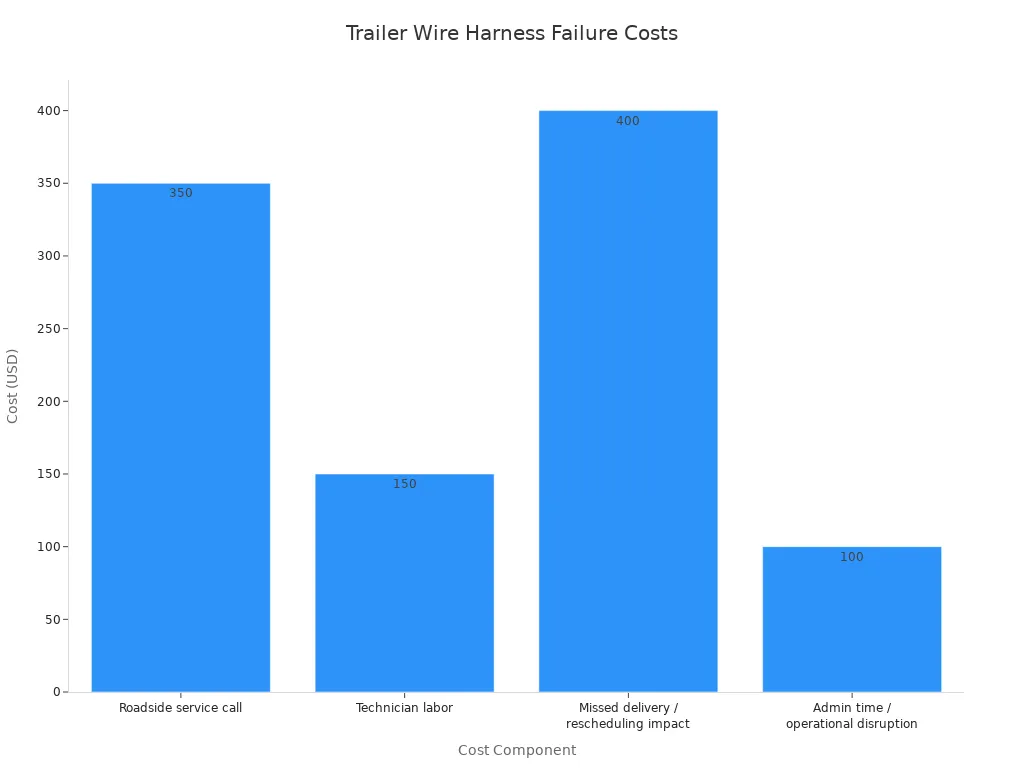
One rust failure you could have prevented shows the math. A roadside service call costs $350, technician labor adds $150, the missed delivery or rescheduling impact reaches $400, and admin time adds $100. That comes to $1,000 from just one event. A $150 repair can grow into a $1,000+ problem, and the total grows with each trailer over a year. A trailer wire harness manufacturer with written salt-spray and continuity testing keeps you safe from this problem.
Compliance and Liability Exposure
Missing paperwork creates a second layer of risk. Regulators and inspectors want proof that safety circuits meet the right standard. Without a certificate of conformity or test records, you cannot show you did your due diligence after a crash or injury claim. Blame then shifts toward you as the buyer.
Supply chain problems come right after. A China custom wire harness supplier that cannot produce traceability records leaves you unable to keep a recall to one lot. You face a full-batch quarantine instead. Insurers may also question coverage when listed components are missing. Pick a utility trailer wire harness OEM that keeps calibration and pull-force records ready, and treat every missing document as a warning sign before you sign.
Use this checklist for your next supplier review:
ISO 9001 certificate with a scope page
IATF 16949 site certificate, scope verified
UL file number checked in UL Product iQ
IPC/WHMA-A-620 class matched to duty cycle
Test reports with pull-force and calibration records
Put each item in your RFQ. Ask for scope pages, not badges. Require test data tied to your drawing revision, then plan a factory audit.
Xiamen Kehan Electronics Co., Ltd., a trailer wire harness manufacturer, gives these certificates and records when you ask. Use this checklist on your next supplier review and sign only when every box is checked.
FAQ
Which certification matters most for a trailer harness supplier?
Start with ISO 9001. It shows the supplier has a quality system that actually works. Add IPC/WHMA-A-620 for workmanship rules and a written test plan for how the shipped part performs. A trailer wire harness manufacturer with all three gives you a chain you can check from process to product.
Do I need IATF 16949 for a utility trailer program?
Not always. IATF 16949 is required for OEM automotive programs and can be negotiated in other cases. The process discipline still helps trailer production through risk management, traceability, and process validation. Make sure the certificate scope lists harness or cable assembly manufacturing at the site that builds your parts.
How do I confirm a UL claim is real?
Ask for the UL file number. Check it in UL Product iQ before you accept the claim. A capable utility trailer wire harness OEM will tell you which components carry UL recognition and which do not. Treat a vague answer as a warning sign.
What test records should I request with each shipment?
Ask for a certificate of conformity, pull-force records, material and component traceability records, and calibration records for the test equipment. Pair them with crimp height data and electrical test results tied to your approved drawing revision. A reliable China custom wire harness supplier produces these when you ask.
Can a smaller supplier meet these requirements?
Yes, if the supplier puts money into the right systems. Ask for scope pages, not badges. Request operator training logs and inspection records. A serious trailer wiring harness supplier will welcome the audit. Apply the same document requests to every custom trailer harness quote you review.