


What Actually Drives the Price of a Custom Wire Harness
2026-10-21 15:48What Actually Drives the Price of a Custom Wire Harness
A customer sent us two drawings in April. Same product family, same machine, same engineer. One was the 120 V North American variant, the other the 230 V European version. The harnesses were nearly identical — one different connector, a different wire colour scheme, and about 40 mm of extra length on two legs.
The quote came back at 4.10 USD for the first and 9.80 USD for the second.
The customer asked, reasonably, whether we had made a mistake. We had not. The 120 V version used a connector we buy 30,000 pcs of a year and keep in stock. The 230 V version used a sealed connector from a different series that we buy 400 pcs of a year, on a 14-week lead time, with a minimum buy of 1,000. Same copper. Same labour. Same test. More than double the price, because of one part number.
That is the whole subject of this article. Custom harness pricing is not mysterious and it is not arbitrary. It is a stack of about eight costs, and the cheapest quote you receive is almost never the one with the lowest costs — it is usually the one with the shortest stack, because some of it got left off.
What this article covers:
Why two quotes for the same drawing can differ by 40 percent, honestly
The eight cost blocks inside a harness price, and roughly how much each one weighs
Why connectors decide your price more often than anything else
What wire gauge and cable construction actually cost, and when they are being over-specified
How labour scales — and why a 30-wire harness is not three times a 10-wire harness
Testing: what each gate costs and what it buys you
Volume, setup, and why the price curve flattens when it does
The difference between unit price and landed cost, with the arithmetic
Ten places where a quote hides a cost you will pay later
Twelve legitimate ways to reduce the price without reducing the quality
The things you should not cut at any price
How to read a harness quote line by line
When the cheap quote is genuinely cheaper
Why work with us
Table of Contents
Two quotes, same drawing, 40 percent apart
Buyers are told that competition keeps suppliers honest. In harness work, competition mostly produces spread, and the spread is not a measure of anyone's honesty. Two factories can quote the same drawing at 6 USD and 9 USD and both be telling the truth about their own costs.
Here is where the spread comes from:
They are buying different components. One factory buys that connector 30,000 pcs a year and gets distributor pricing. Another buys it 300 pcs at a time and pays list plus freight. Same part number, twice the material cost, and nobody did anything wrong.
They are running different processes. One has an automated cut-and-crimp wire processor. Another cuts and strips by hand. The automated one has capital to recover; the manual one has labour. Which is cheaper depends entirely on your quantity.
They are pricing different scopes. One quote includes 100 % electrical test, the other includes a visual check. One includes test records, the other includes the harness. This is where the very large spreads come from, and a 40 percent gap usually means a scope gap rather than an efficiency gap.
They are at different points in their own cycle. A factory with a half-empty line in a slow month will quote aggressively to fill it. That is a real price and a real opportunity — and a real risk, because the same factory cannot hold that price when the line fills up.
They are amortizing differently. Setup, tooling, and engineering are fixed costs. Spread over 1,000 units they add 0.40 USD each. Spread over 100 they add 4.00 USD. Same factory, same process, different quantity, a price that looks like a different company.
They are carrying different overhead. Calibration programmes, an engineering department, an ERP that holds traceability — all real money, all landing in the unit price. A factory without those things can genuinely be cheaper. It is also genuinely offering less.
So when the quotes come in, the useful question is not "why is this one cheaper?" It is "what is different about what I am buying?" The answer is almost always in the BOM, the process, or the test scope. A supplier who cannot explain their own price structure does not understand it either.
The eight cost blocks in a harness price
Every quote is a sum of the blocks below. The percentages shift with the product — a simple 4-wire jumper is mostly material and labour, a shielded high-speed assembly is mostly cable and testing — but the structure never changes.
| Cost block | What is inside it | Typical share | What moves it up | What moves it down |
|---|---|---|---|---|
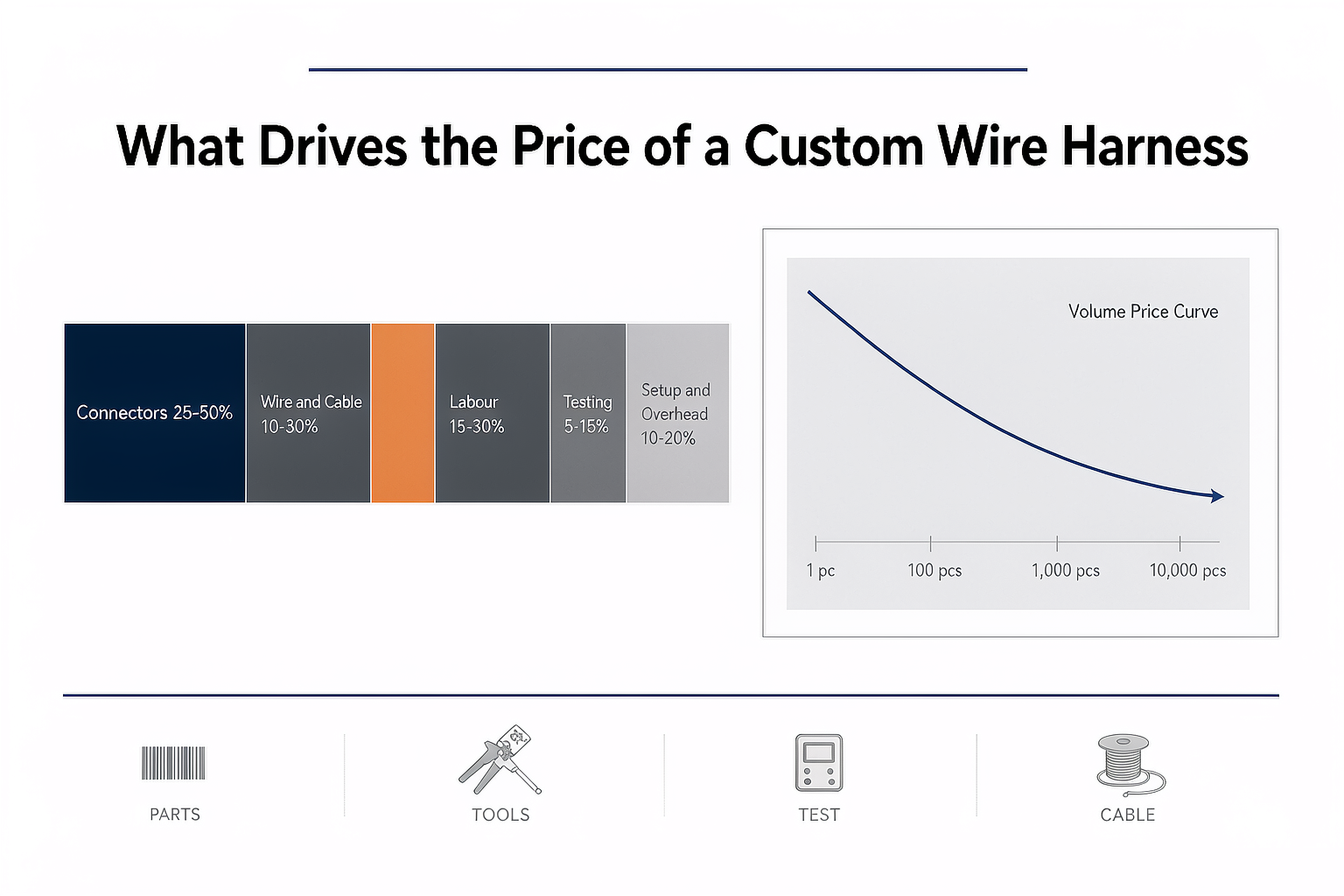
| 1. Connectors and terminals | Housings, contacts, seals, CPA locks, boots, splices, ferrules | 25–50 % | Sealed or automotive-grade series, brand-name parts, low purchase volume, long lead times, single-source parts | Standard series instead of premium, consolidating part numbers, a qualified alternative, forecast visibility |
| 2. Wire and cable | Conductor, insulation, shielding, jacket, fillers, drain wire | 10–30 % | Large gauge, specialty insulation (silicone, FEP, XLPE), shielding, drag-chain or high-flex construction, multi-pair cable | Right-sizing the gauge, dropping a shield you do not need, a standard jacket where the environment allows |
| 3. Labour | Cutting, stripping, crimping, inserting, splicing, taping, tying, labelling, packing | 15–30 % | High termination count, splices, tight tolerance, small wire, hand assembly, complex routing | Fewer terminations, welded splices instead of junction connectors, a design that suits automated processing |
| 4. Overmolding, potting, encapsulation | Tooling amortization, molding cycle, material, yield loss | 0–20 % | Custom tool, low volume, tight cosmetic requirements, multiple variants needing separate tools | Heat-shrink or booted construction where the environment permits, sharing tools across variants |
| 5. Testing and inspection | Continuity, hipot, pull test, dimensional check, visual inspection, test records | 5–15 % | 100 % test on complex assemblies, high circuit count, hipot on every unit, TDR, functional test on a fixture | Nothing — this is the block you should be protecting, not reducing |
| 6. Setup and NRE | Drawing review, DFM, programming, applicator setup, first article, fixture build | 0–15 %, falls with volume | New tooling, new test fixture, incomplete drawings, many variants | Higher quantity, reusing existing tooling, a complete drawing package on the first submission |
| 7. Documentation and traceability | Test records, material certificates, IMDS/PPAP if required, label data, batch traceability | 1–5 % | Full PPAP, IMDS entries, per-unit test records, material declarations | Agreeing on the document pack you actually need instead of the maximum available |
| 8. Overhead, margin, freight, risk | Factory overhead, certification upkeep, scrap allowance, margin, packaging, freight | 10–20 % | Export packaging, expedited freight, high-mix low-volume scheduling, tariff exposure | Planning freight with the production schedule instead of after it, consolidated shipments, realistic lead times |
Two things worth noticing. The shares overlap because the categories do — a sealed connector costs more and takes longer to crimp. And the only block where the correct answer to "how do I reduce this" is "you don't" is testing. Everything else has legitimate room. Testing has legitimate room in scope, which is a different conversation from price.
Connectors and terminals: usually the biggest line
If you want to understand a harness price, start at the connector BOM. In most assemblies it is the single largest cost, and it is also the line item with the widest legitimate price range.
The same circuit function can be served by four different connectors spanning a 10× price range:
| Connector class | Typical application | Relative cost | What you are paying for | What you give up |
|---|---|---|---|---|
| Commodity wire-to-board (basic 2.54 mm pitch series) | Internal signal wiring in a dry enclosure | 1× | Nothing but function | No sealing, limited mating cycles, no vibration retention |
| Industrial sealed circular (M8 / M12) | Sensors and actuators in a machine, washdown or dust | 3–5× | IP67–IP69K sealing, positive locking, 100+ mating cycles, field-installable | Money, and panel space |
| Automotive sealed (2.8 mm / 1.5 mm sealed series) | Vibration, temperature cycling, underhood or chassis | 4–8× | Vibration retention, wide temperature range, sealed cavities, high mating cycle life | Money, crimp tooling complexity, and often lead time |
| Heavy-duty industrial (rectangular multipole, high-current) | Panel-to-panel, power distribution, quick connect for service | 6–12× | High current, tool-free mating, robust mechanical protection, serviceability | Money, size, and the cost of a good crimp tool |
Three things drive the connector line more than the connector class:
Purchase volume, which is not yours. A factory buying 30,000 pcs a year and one buying 400 are not in the same market, even for the same part number. When you ask for a quote, ask what volume the supplier buys that part at. If the answer is "we will buy what you need," you are paying list price plus a margin.
Lead time. A part on 14-week lead time is either bought against a forecast and carried as inventory — which is capital the supplier is financing for you — or bought per order, which means you wait. Either way, the price reflects it. A connector that is in stock somewhere is always cheaper than one that is not.
Minimum buy. A 1,000 pcs minimum on a part you need 80 of a month is 12 months of inventory sitting in a warehouse. Somebody pays for that inventory. The question is whether it is visible on your quote or buried in the unit price.
The practical takeaway: if you want to reduce harness cost and you have design freedom, look at the connector BOM before you look anywhere else. Consolidating four similar connector series into one, or accepting a qualified alternative from the same manufacturer's family, often moves the price more than every other optimisation combined. We do this review on every RFQ, and we tell customers when a part is expensive because of a volume problem rather than a technical one — the technical ones we cannot fix, but the volume ones are usually solvable.
Wire, cable, and the cost of over-specifying
Wire looks like a commodity and is not. A reel of 22 AWG PVC hook-up wire and a metre of shielded drag-chain-rated cable with a PUR jacket are different products in every dimension, including price.
What drives the wire line:
Gauge. Larger conductor means more copper. The cost is close to linear with cross-section once you get past small sizes, and the jump from 22 AWG to 18 AWG is roughly double the copper.
Insulation material. PVC is the cheapest. TPE costs more. PUR, silicone, FEP, and XLPE cost considerably more, and each one exists for a specific reason — chemical resistance, temperature, flexibility, or abrasion.
Stranding. Fine-strand conductor for flex applications costs more to make and more to crimp. Class 6 stranding can add 20–40 percent to the wire cost versus a standard stranding of the same gauge.
Shielding. Braid, foil, or combination. Braid costs more than foil, spiral-wrap more than braid, and any shield adds a drain wire and a termination step.
Specialty constructions. Drag-chain rated, torsion rated, high-temperature, low-outgassing, oil-resistant, halogen-free. Each of these is a real engineering answer to a real problem — and each one has a price.
Where over-specification bites is here: buyers often specify the harshest environment they can imagine instead of the one the product actually lives in. A shielded, silicone-jacketed, fine-strand cable on an internal harness that never moves, never sees more than 60 °C, and lives inside a sealed enclosure is money spent for nothing. It is not harmful. It is just 3× the cost of the correct part, and it makes every subsequent quote look expensive because the cable cost is locked in.
The reverse failure is more expensive. A general-purpose PVC harness in a machine that sees oil mist and continuous flex will fail, and it will fail inside the warranty period. There is no version of that arithmetic where saving 2 USD on cable is a good decision.
So the question to ask yourself on every wire line is not "what is the best cable for this" but "what is the cheapest cable that will still be working in year five?" Those are different questions, and the second one is the one that determines your total cost.
Labour: how it actually scales
Labour is where buyers most often misjudge a quote, because intuition says a harness with twice the wires should cost twice as much. It does not. Labour scales with terminations, not with wire count, and the relationship is not linear in either direction.
| Assembly feature | Labour impact | Why it matters more than wire count |
|---|---|---|
| Each terminal crimp and insertion | Highest per-unit time | Every circuit has two ends. A 30-wire harness has 60 terminations plus any splices — that is where the time goes, not in cutting the wire. |
| Sealed connector assembly | 2–3× an unsealed connector, per cavity | Wire seals, cavity plugs, CPA lock, and insertion force. A sealed 12-cavity connector takes longer than four unsealed 3-cavity connectors. |
| Splices and junctions | High, and a quality risk | Each splice is a manual operation with a heat-shrink or boot step. A welded splice machine reduces it but requires tooling and volume. |
| Branching and breakout points | Moderate | Every branch needs a break-out, a tie, and often a label. Multi-branch harnesses are slower to assemble and much slower to inspect. |
| Looming, taping, and tie spacing | Low per metre, but adds up | A 2 m harness with 20 ties at a specified spacing is a different labour profile from a loose bundle. |
| Label placement | Low individually | Five labels per harness, heat-shrink printed and positioned — the time is real when the volume is high. |
| Process automation eligibility | Can cut labour 40–60 % | Automated wire processing needs consistent wire types, lengths within a range, and quantities that justify setup. Hand assembly is not always the expensive option at low volume. |
A worked comparison, using our own standard rates:
10-wire harness, unsealed connectors, 0.6 m: 20 terminations, no splices. Roughly 6–8 minutes of direct labour.
30-wire harness, sealed connectors, 1.8 m with three branches: 60 terminations, 4 splices, 3 break-outs, 8 labels. Roughly 35–45 minutes.
Three times the wire, five times the labour. That is the relationship you should expect, and any quote that scales linearly with wire count is a quote built on a spreadsheet instead of a process.
The other thing labour does is expose design decisions. Two designs that are electrically identical can differ by 40 percent in labour because one puts four circuits through a 12-cavity sealed connector and the other distributes them across three 4-cavity unsealed ones. Neither is wrong. One of them is cheaper, and it is worth knowing which before you freeze the design.
Testing: what each gate costs
Testing is usually 5 to 15 percent of the unit price, and it is the line where cheap quotes are made. Here is what each gate actually costs and what it prevents.
| Test gate | Cost per unit (typical) | Time per unit | What it catches | Cost of missing it |
|---|---|---|---|---|
| Automated continuity and short test | 0.10–0.50 USD | 20–60 s | Open circuit, short, wrong cavity, cross-wiring | One dead unit at the customer — a service call plus a return plus a reputation cost |
| Dielectric withstand (hipot) | 0.15–0.60 USD | 15–45 s | Insulation breakdown, nicked conductor inside a bundle | A safety failure, potentially a recall, potentially a liability claim |
| Pull force on crimps | 0.05–0.30 USD (destructive sample) | Batch level, not per unit | Under-crimped or over-crimped joints | Intermittent faults that no continuity test will find, appearing at cycle 200 |
| Dimensional check | 0.10–0.40 USD | 30–90 s | Length error, connector position error, mounting hole mismatch | A harness that will not fit, discovered at final assembly when the unit is otherwise complete |
| Visual inspection (trained operator) | 0.10–0.35 USD | 30–120 s | Crimp condition, insulation damage, wrong keying, label errors, tie spacing | Cosmetic and latent defects that pass every electrical test |
| TDR / impedance verification | 1.00–5.00 USD | 1–3 min | Impedance mismatch, return loss, connector termination quality on high-speed lines | A cable that passes continuity and fails the signal — the classic USB/Ethernet failure |
| Functional test on a bench fixture | 2.00–15.00 USD | 2–10 min | Everything that only appears when the harness meets the electronics | Discovering an integration problem at your assembly station instead of at ours |
Add the record-keeping. A test that runs but is not recorded is a test you cannot prove you did, which matters exactly once — when your customer audits you, or when a field failure forces you to identify which units to look at. The documentation block is 1–5 percent of the price and it is the cheapest insurance on the quote.
Our position is simple: 100 % electrical test and 100 % manual final inspection on every assembly, not sampled, and the records ship with the batch. On a 50-piece order that is maybe 15 USD of testing. On the same order, one escaped harness costs more than that in the phone call alone.
Volume, setup, and the price curve
Harness pricing is not linear in volume, and the shape of the curve surprises people. Fixed costs dominate at low volume, material discounts and automation take over at high volume, and the curve flattens somewhere in between.
| Quantity | What dominates the price | Process used | Relative unit price | What to expect |
|---|---|---|---|---|
| 1–10 (prototype) | Setup, engineering, hand assembly | Bench assembly, engineering attention on every unit | 4–8× | You are buying learning, not parts. The price is high and it should be — you are paying for the design conversation. |
| 10–100 (pilot) | Setup amortization, still largely hand assembly | Production tooling, small batch | 2–4× | The first point where the price tells you something about the production price. Ask for a curve at the same time. |
| 100–1,000 (low volume production) | Material and labour | Production tooling, semi-automated wire processing | 1.0× (reference) | This is where most of our customers live, and where the design decisions are still cheap to change. |
| 1,000–10,000 (volume production) | Material volume discounts, automation | Automated cut-and-crimp, dedicated setup | 0.70–0.90× | Material discounts become real. Component minimum buys stop being a constraint. |
| 10,000+ (high volume) | Material only, and process efficiency | Dedicated line, possible in-house tooling | 0.55–0.80× | The curve flattens. Further reductions come from design changes, not from squeezing the process. |
The practical move, and the one almost nobody does: ask for the price curve when you place the first order. Ask for a quote at your current quantity and at three future quantities. Two things happen. You find out whether the supplier's pricing is structurally sound — a proper factory can produce that curve without effort. And you find out where the big steps are, so you can plan a quantity that lands on the right side of one.
One warning about volume. There is a step change at the point where a part crosses a minimum buy, where automation becomes worthwhile, or where a tool gets amortized. If your annual volume is 900 pcs and the step is at 1,000, the honest answer may be that you should consolidate two orders into one. A supplier who tells you that is worth keeping, because they just cost themselves a purchase order.
Unit price vs landed cost
The number on the quote is not the number you pay. For an imported harness, the gap between unit price and landed cost is routinely 10 to 25 percent, and it is not evenly distributed across suppliers.
| Line item | Typical magnitude | Who usually forgets it | How to get it right |
|---|---|---|---|
| Unit price (EXW or FOB) | Reference | — | Ask which incoterm the quote uses. An EXW quote and a DDP quote are different products. |
| Export packaging | 0.5–3 % | Everyone | Harnesses need structure, not bags. Ask for a photo of a packed carton before you approve the first order. |
| Inland freight to port and origin charges | 1–3 % | First-time importers | Ask for the FOB price, then ask what the origin charges are on top. |
| Ocean or air freight | 2–12 % | Everyone, until the first invoice | Air freight on a 200 kg shipment can double the landed cost. Plan the schedule so you can use sea freight. |
| Duty and tariff | 0–15 % | Everyone underestimating origin rules | Duty depends on component origin, not assembly location. Get the HS code and the origin declaration from your supplier. |
| Brokerage, handling, port fees | 0.5–2 % | Everyone | Ask your freight forwarder for an all-in estimate before you approve the order, not after. |
| Incoming inspection and rework | 1–5 %, or much more | Everyone, and this is the expensive one | If you inspect incoming shipments because you do not trust the supplier, cost that labour and add it to the landed cost. Then compare suppliers again. |
| Inventory carrying cost | 1–3 % per month of stock held | Everyone | A 1,000 pc minimum buy for 80 pcs a month means a year of stock. That is capital, storage, and obsolescence risk. |
| Field failure cost | Wildly variable | Everyone, until it happens | The only honest way to estimate this is to ask the supplier for their escape rate. A supplier who tracks it can answer. One who cannot is not measuring. |
| Your own management time | Never counted | Everyone | Chasing a supplier costs an hour a week and four years of it is a lot of hours. It belongs in the comparison. |
Worked example, 500 pcs at a quoted 8.00 USD FOB:
Unit price: 4,000 USD
Packaging: 60 USD
Origin charges and inland: 90 USD
Sea freight: 180 USD
Duty at 5 %: 200 USD
Brokerage and port: 70 USD
Incoming inspection at 0.18 USD per unit: 90 USD
Landed: 4,690 USD, or 9.38 USD per unit
That is 17 percent above the quote, before anything goes wrong. A domestic supplier quoting 9.20 USD delivered is cheaper than the 8.00 USD quote, and the buyer who compared unit prices would have got that backwards.
Ten places where the quote hides a cost
A quote is not a lie when it omits these. It is a quote for a narrower scope than you assumed. These are the ten most common, in rough order of how much they cost when they surface.
| # | Hidden cost | How it surfaces | What to ask before you approve |
|---|---|---|---|
| 1 | Testing scope | "We need hipot records for the audit" — the price moves, and the timeline moves more | "Which tests are included per unit, and is the data recorded and supplied?" |
| 2 | Engineering change costs | Three changes in year one, each billed as a setup, each adding a week | "What does a post-production change cost, and what is the turnaround?" |
| 3 | Component minimum buys | A 1,000 pc reel for an 80 pc a month requirement, invoiced as inventory you did not plan | "Which line items are constrained by a minimum buy?" |
| 4 | Documentation pack | Certificates and declarations quoted as an option, then billed as NRE | "What documents come with every shipment as standard, and what costs extra?" |
| 5 | Freight and duty | The landed cost is 17 % above the quote, and nobody warned you | "Give me the incoterm and a landed-cost estimate for my country." |
| 6 | Packaging adequate for the trip | Harnesses arrive bent, connectors crushed, labels unreadable. You sort 500 units | "How is this packed, and can I see a photo of a packed carton?" |
| 7 | Sample cost recovery | The sample was cheap because it was not built on the production process, so the real setup shows up on the first production order | "Was this sample built on production tooling, and is the sample cost credited?" |
| 8 | End-of-life and last-time buy | A connector goes obsolete and the choice is 20,000 pcs or an emergency redesign | "Do you flag component lifecycle risk at design stage, and do you hold buffer stock on long-lead parts?" |
| 9 | Service parts after production | A customer needs one harness in year four, and the MOQ is 500 | "What is the MOQ on service parts after the program ends?" |
| 10 | Yield and rework charged back | A difficult assembly has a 12 % first-pass yield, and you are the one paying for the rework through a price increase at renewal | "What is the first-pass yield on this assembly, and how is rework handled?" |
None of these are tricks. They are the parts of a real production program that a supplier who is competing on the number alone has a structural incentive to leave out. The way to neutralise all ten is to ask for a quote with the scope spelled out — and to prefer the supplier who volunteers the awkward line items over the one who does not.
Twelve legitimate ways to reduce the price
There is a lot of room between "pay the first quote" and "buy the cheapest thing on the platform." These twelve moves are real, and none of them require you to accept a worse harness.
| # | Move | Typical saving | Risk or trade-off | Where it applies |
|---|---|---|---|---|
| 1 | Consolidate connector part numbers | 10–25 % | May need a small design change and a re-validation | Any harness with more than three connector series |
| 2 | Right-size the wire gauge | 5–15 % | Must be verified against current, drop, and temperature — never guess | Where a gauge was chosen "to be safe" |
| 3 | Drop shielding you do not need | 5–20 % on that circuit | Only where EMC testing confirms it. Do not guess on this one either. | Low-speed signals in a low-noise enclosure |
| 4 | Replace junction connectors with welded splices | 5–15 % | Not serviceable in the field, and requires tooling | Internal branches that never get disconnected |
| 5 | Standard jacket instead of specialty | 10–30 % on the cable line | Only if the environment genuinely allows it | Dry, temperature-controlled enclosures |
| 6 | Increase order quantity to the next price step | 10–30 % | Working capital and storage; obsolescence if the design changes | Stable products with predictable demand |
| 7 | Order in a schedule instead of ad hoc | 5–15 % | Requires a forecast you can actually commit to | Any repeat program. This is the easiest win and the least used. |
| 8 | Reuse existing tooling or fixtures | One-time NRE reduction | Requires the supplier to have a matching tool, or a modification | Second-source or variant programs |
| 9 | Accept a qualified alternative part | 5–20 % | Needs a real equivalence review, not a datasheet comparison | Long-lead or premium-priced connectors |
| 10 | Simplify the routing and branch count | 5–15 % | Product redesign, so it is only cheap at the prototype stage | Any new design, before freeze |
| 11 | Ship by sea instead of air | 5–10 % of landed cost | Longer transit, more inventory in the pipeline | Repeat orders with predictable demand |
| 12 | Send a complete drawing package the first time | Removes a whole round of cost and delay | Costs you an afternoon | Every program. This one is free. |
The two biggest savings on that list are not really about price at all. Consolidating connectors and sending a complete drawing both reduce the number of decisions the factory has to make on your behalf — and every decision a factory has to make for you is either a delay or a cost, usually both.
What you should never cut
There is a floor below which a cheaper harness stops being a harness and becomes a future problem. These are the things where the saving is small and the exposure is not.
100 % electrical test. Saves cents per unit. Converts a controlled defect rate into an uncontrolled one, at your customer's site.
Proper crimp tooling and crimp height verification. Saves the cost of an applicator. Produces joints that pass a pull test by hand and fail after 200 mating cycles — the hardest failure to diagnose and the most expensive to explain.
Correct wire gauge for the current. Cheap right up until the harness runs warm, the insulation ages, and the failure happens at the worst possible ambient temperature.
Genuine, traceable components. Counterfeit connectors and terminals are a real market, and the price difference is exactly the size of the temptation. They look identical. They are not.
Sealing integrity on any outdoor or washdown assembly. A seal that fails at year two costs more than the sealed connector ever did.
Strain relief on any harness that gets handled. The number one mechanical failure in the field is not the wire — it is the transition where the wire meets the connector.
Documentation and traceability. Two percent of the unit price buys the answer to the question your customer will ask in an audit.
Change control. The cheapest possible process is the one that lets the workshop substitute a part to keep a schedule. That is not a process, it is a surprise with a delay on it.
Every item on this list is one or two percent of the unit price. Together they are maybe eight percent. There is no volume at which accepting the failure mode instead is the better trade — and we have watched customers try, more than once.
How to read a harness quote line by line
Most harness quotes are a number and a lead time. That is not enough information to make a decision, and you are entitled to ask for more. This is the structure we use, and what each line is for.
| Quote line | What it should contain | What its absence tells you |
|---|---|---|
| Part number and revision | Your drawing number and revision, quoted back to you | The revision was not read. Ask which one they priced. |
| Component BOM | Part numbers, manufacturer, quantity per unit, unit cost for each | The price cannot be verified or compared, and substitutions become invisible |
| Wire schedule | Gauge, insulation, colour, length, per circuit | Gauge substitution is the most common silent change in the industry |
| Labour and process | A stated process (hand, semi-automatic, automatic) and the labour basis | The supplier does not know, or does not want you to know |
| Test scope | Exactly which tests, on what percentage of units, with records or not | "Inspection included" means nothing and is designed to mean nothing |
| Packaging | Inner and outer packaging, quantity per carton, protection method | Bulk bags, and a sorting job on arrival |
| Tooling and NRE | Separate line, with what it covers and whether it is one-time | Hidden in the unit price, so you cannot compare at another quantity |
| Quantity breaks | Price at three quantities | No structural pricing — the supplier is quoting a number, not a cost model |
| Lead time | Sample lead time and production lead time, stated separately, with the long-lead components named | A single optimistic number that will not survive contact with a component shortage |
| Incoterm and validity | EXW/FOB/DDP stated, and how long the quote holds | You will discover the freight later, and the price will "change" when you order |
| Payment terms | Deposit and balance, or net terms | Unclear cash flow on a first order is a bad sign on both sides |
| Change policy | ECO turnaround and cost, and what counts as a change | Every small change will become a negotiation |
You do not need all twelve lines on the first email. You need them before you place the order, and any factory that builds harnesses for a living can produce them without effort. The ones who cannot are telling you how the next four years will go.
When the cheap quote is genuinely cheaper
It would be convenient if the expensive quote were always the better one. It is not. Sometimes the cheaper supplier is simply better at the thing you are buying, and paying more is just paying more.
The cheap quote is genuinely cheaper when:
The supplier buys your components at real volume. A factory that already consumes 50,000 pcs a year of your connector has a structural advantage that no amount of negotiation will close. If they can show you the purchase volume, the price is real.
Your design fits their process. A factory that specialises in exactly your assembly type — say, sealed circular connectors on fine-strand cable — will beat a generalist on both price and quality, because their tooling and their habits are already pointed at your problem.
The scope is the same. Compare the two quotes line by line. If both include 100 % test, both include records, both include the same component BOM, and one is 20 percent cheaper, that is an efficiency difference and you should take it.
You have verified the factory. Not the website. A video call from the production floor, a test record from a previous shipment, and a first article you inspected yourself. Cheap and verified is the best outcome available.
You are buying a simple assembly. A short jumper with two crimped terminals and no sealing has a low technical ceiling. There is less for a bad supplier to get wrong, and the value of a quality system is proportionally smaller.
And the cheap quote is not cheaper when the difference is in a scope line you did not read, when the supplier cannot answer a technical question, when the components are a substitution you did not approve, or when the price has an expiry date that arrives before your production date.
The practical test: ask the cheaper supplier to explain why they are cheaper. A good one will tell you — volume, process, tooling, geography, their own idle capacity. A bad one will say "we are more efficient" and change the subject. The explanation is the product.
Why work with us
We are a custom wire harness and cable assembly factory in Xiamen. We quote with the structure shown above — component BOM, wire schedule, test scope, packaging, tooling as a separate line, and prices at three quantities — because a quote you cannot read is a quote you cannot compare.
What you get on a price conversation:
A DFM review before the price, free, in 48 hours. If we think a wire is oversized, a connector is unnecessary, or a shield is doing nothing, we will say so and show you the saving. That happens before you order, when you can still act on it.
Component BOM shown line by line. Part number, manufacturer, quantity, unit cost. You can check it against your own distributor pricing and see exactly where the money goes. If a component forces a minimum buy, we will name it.
Prices at three quantities plus the cost curve. So you can see where the steps are and plan around them instead of guessing.
100 % electrical test and 100 % manual final inspection on every assembly, with records shipped with the batch. Not sampled, not optional, and not a line we will remove to win a price comparison. Our test equipment list includes an automated harness tester, hipot tester, terminal pull tester, crimp height gauges, optical measurement, and a microscope for cross-section work.
Build to print from whatever you have. Complete drawing, partial schematic, Excel BOM, photo of a competitor's assembly, or a sketch with dimensions. Reconstructing the document set with you is part of the job and we do it at no charge on a new program.
5-day ECO turnaround. The changes that most affect your cost later are the ones you make in year one. We keep that cheap and fast on purpose.
Low-volume realistic. MOQ 100 pcs for a new program, pilots of 10–50 pcs priced honestly with the setup visible. We will not invent a minimum to avoid small orders, and we will not hide one in the unit price.
Multi-variant BOM management. If your product ships in voltage, regional, or trim variants, we hold the variant matrix and ship the right harness for the right build — which is also how you avoid paying for a universal harness nobody needs.
A supplier who will tell you to buy less. Twice this year we have told a customer their harness was over-specified and quoted them a cheaper one. It costs us a little on the order and it is the reason they are still customers.
We will not be the cheapest quote you receive. We will be the one you can read line by line, the one that still answers your email in year four, and the one whose test records are on file when your customer audits you.
Frequently Asked Questions
Q1: Why is my custom wire harness quote so much higher than a catalogue cable assembly?
Because it is a different product. A catalogue assembly is built in volume, on a fixed design, with a known BOM and no engineering. Your harness has a drawing review, component sourcing at your volume, a setup, a first article, a test programme, and documentation. On a 100 pc order, the setup and engineering are a large fraction of the price and they are all one-time. Ask for the same harness priced at 1,000 pcs — that number, not the first one, is what your product's cost structure will look like.
Q2: What is the single biggest lever on harness cost?
The connector BOM, in most assemblies. It is typically 25 to 50 percent of the unit price and it has the widest legitimate range — the same electrical function can be served by parts spanning a 10× price difference. If you have design freedom, look there first. Consolidating four similar connector series into one, or accepting a qualified alternative for a long-lead premium part, routinely moves the price more than every other optimisation combined. Wire gauge is second. Labour is third, and it scales with terminations rather than with wire count.
Q3: Can you give me a price before you review the drawing?
We can, but it will be a guess and it is not the number you should plan around. A price without a DFM review assumes the drawing is complete, correct, and buildable as drawn. In our experience about half of incoming drawings have at least one thing worth changing — a gauge that is marginal, a connector that carries 16 weeks of lead time, a bend radius the routing cannot provide. We would rather spend a day on the review and quote you once than quote you fast and re-quote after the sample.
Q4: How much does 100 % testing actually add to the price?
Typically 5 to 15 percent of the unit price, depending on circuit count and which gates apply. Automated continuity is cents per unit. Hipot is a little more. Pull force and dimensional checks are batch-level and cheap. On a 50-piece order the total is usually under 20 USD for the whole batch. For comparison, one escaped harness at your customer's site — a service visit, a replaced unit, and the email you have to write — costs more than the testing on that entire order. This is the one line we will not remove to match a competitor's price.
Q5: Do you offer volume discounts, and at what quantity do they start?
Yes, and they are structural rather than negotiated — they follow the fixed-cost and material-discount curve. Broadly, the reference price is at 100–1,000 pcs; 1,000–10,000 pcs is typically 10 to 30 percent lower; above 10,000 pcs it flattens out because there is nothing left to squeeze from the process and further reductions come from design. We quote three quantities as standard so you can see the actual steps. If your annual volume is just under a step, it is sometimes worth consolidating two orders into one, and we will tell you when that is the case.
Q6: What is the difference between your price and my landed cost?
For an imported harness, expect 10 to 25 percent on top of the FOB price, covering export packaging, origin charges, freight, duty, brokerage, and incoming inspection. Duty depends on component origin rather than assembly location, so the origin declaration matters as much as the HS code. Ask for an incoterm on every quote, and ask for a landed-cost estimate for your country — a domestic supplier quoting 15 percent more than an overseas FOB price is often the cheaper option once everything is counted.
Q7: Can you help me reduce the cost of a harness that is already in production?
Yes, and it is one of the more useful conversations we have. Send the current drawing, the current quote with its BOM, the annual volume, and any field failure history. We will look at the component BOM first, then gauge, then process, then volume structure, and come back with a list of options — what each one saves, what it costs in re-validation, and what risk it carries. Some of those options will be things we can do without any change to your drawing. Some will need a design change and we will tell you which ones are not worth it. Typical turnaround on that review is three to five working days.
Get a Quote You Can Actually Read
Send us the drawing — or the schematic, the BOM spreadsheet, the photo, or the sketch — and tell us the annual volume you expect and when you need the first units. You will get a DFM review, a component-level quote, prices at three quantities, and a landed-cost estimate if you tell us the destination country. Normally within 48 hours.
If you are currently paying a price you do not understand, send us the quote as well as the drawing. Comparing the two documents is usually where the savings are.
Email: [sales5@xmkehan.com]
Typical response time: 24 hours, Monday to Friday
SEO Keywords: custom wire harness price, wire harness cost, cable assembly cost, wire harness pricing, how much does a wire harness cost, wire harness price per unit, custom cable assembly quote, wire harness quotation, harness cost breakdown, connector cost wire harness, terminal cost cable assembly, wire gauge cost, AWG price difference, cable assembly labour cost, harness assembly time, crimp labour cost, wire harness testing cost, hipot test cost, 100% electrical test cost, harness NRE, harness tooling cost, overmolding tooling cost, wire harness MOQ, low volume wire harness price, wire harness volume discount, price curve cable assembly, landed cost wire harness, wire harness duty rate, HS code wire harness, wire harness FOB price, DDP wire harness, wire harness freight cost, harness packaging cost, cost reduction wire harness, design to cost harness, connector consolidation saving, over-specified cable harness, wire harness total cost of ownership, cheap wire harness supplier, wire harness price comparison, how to read a wire harness quote, wire harness quote template, wire harness supplier China price, Xiamen wire harness factory price.