


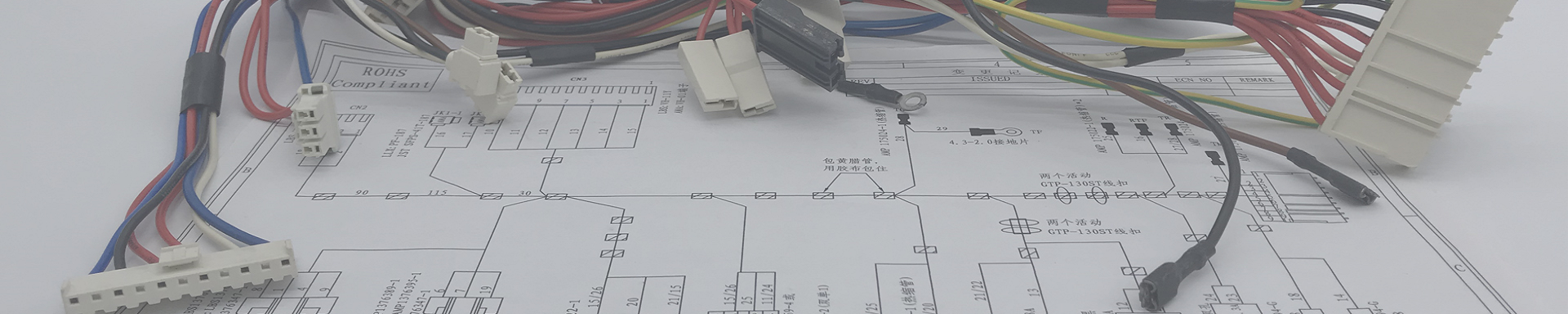
Custom RC Car Wiring Harnesses — Because the Off-the-Shelf Stuff Never Fits Right
2026-07-30 16:31Custom RC Car Wiring Harnesses — Because the Off-the-Shelf Stuff Never Fits Right
We build wiring harnesses for RC enthusiasts and small-batch RC manufacturers. Custom lengths, connectors you actually want, and wire that doesn't melt when you push the throttle.
ISO 9001:2015 | UL/CE/RoHS compliant | Silicone wire specialist | Free DFM review on every project | 5-day ECO turnaround
1. You know the problem already
You take apart your RC car for the third time this month. The wires are a mess. The ESC leads are 4 inches too long, coiled up with zip ties. The servo wire barely reaches and is pinched between the chassis plate and the gearbox. The battery connector cable is stiff as rebar and pushing against the body shell. And that cheap LED harness you bought online? Two of the JST connectors were intermittent right out of the bag.
If you race, every gram of extra wire is weight you're carrying. If you crawl, every loose wire is something that's going to snag on a rock. If you bash, every poorly crimped terminal is a failure waiting to happen at the worst possible moment — usually 20 minutes into a session.
We have been building custom wire harnesses for over a decade. Most of our work is industrial — medical devices, factory automation, test equipment. But about four years ago, one of our engineers got into 1/10 scale off-road racing. He brought his truck into the shop. We looked at the wiring. We said "we can do better than this." And we did.
Now we build harnesses for individual hobbyists, race teams, and small-batch RC manufacturers who don't want to set up their own crimping operation. If you know exactly what connectors and lengths you need, we can build it. If you are not sure what you need, we can help you figure it out.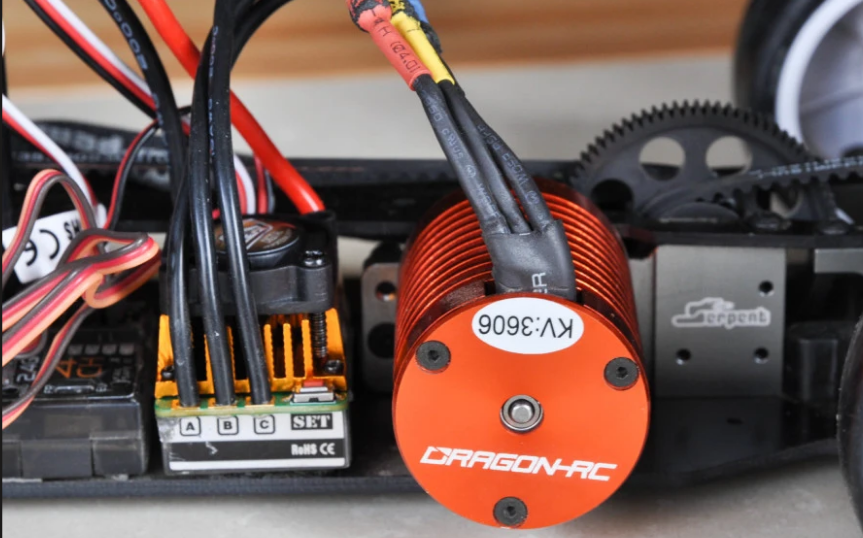
2. The wiring inside an RC car — what most people don't think about
A typical 1/10 scale RC vehicle has 6 to 15 separate electrical connections, not counting the radio link. Here is what we see when we open one up:
Power system
The main battery leads — from your LiPo pack to the ESC — carry 30 to 150 amps. On a 3S or 4S setup, that is a lot of current through a pair of 12 AWG wires. The wire needs to be silicone-insulated. PVC will melt or harden under the heat cycling. We use pure silicone-jacketed copper wire for all power leads. Chinese-sourced "silicone" wire often has a silicone outer layer over PVC insulation underneath — it looks fine until you solder a connector and the inner layer shrinks back. When we buy wire, we cut a cross-section on every new spool to verify it is silicone all the way through.
The motor leads — three wires from ESC to brushless motor, or two to a brushed motor — see the same current levels, plus vibration from the motor can. If the bullets are not fully seated, or if the solder joint on the connector is cold, resistance goes up. Resistance means heat. Heat means things unsolder themselves. We crimp or solder motor bullet connectors with a fixture, not freehand, and we pull-test every single one.
Signal wiring
The three leads from your receiver to the servo and ESC (signal, positive, ground) are thin. AWG 26 or 28, typically. They carry almost no current but they are the most sensitive to electrical noise. If you run a servo wire parallel to a motor phase wire inside the chassis, the magnetic field from the phase wire can induce voltage on the signal line. Your steering twitches. You chase a "bad servo" for weeks. We twist signal wires and route them away from power leads inside every harness we assemble.
Sensor and accessory lines
On sensored brushless motors, there is a flat ribbon cable carrying Hall-effect position data from the motor to the ESC. On some crawlers, there are telemetry leads for temperature, voltage, and RPM. These are fragile — thin wires, tiny connector pins. A cold solder joint on a sensor cable, or a pin that was partially pushed out of the housing during assembly, will cause intermittent sensor faults that are nearly impossible to diagnose on the bench.
3. Wire types we keep on hand — and which one makes sense for your build
| Wire type | AWG range | Best for | Why it matters |
|---|---|---|---|
| Pure silicone, ultra-flexible | 8 AWG – 18 AWG | Battery leads, motor phase wires, ESC power | Stays flexible in cold weather. Won't melt at 200°C. The only choice for high-current RC applications. |
| Silicone, thin-wall | 20 AWG – 28 AWG | Servo extension leads, RX signal wires, sensor harnesses | Flexible enough to route through tight chassis spaces. We stock solid colors and striped patterns for easy identification. |
| PTFE/Teflon jacketed | 24 AWG – 30 AWG | Sensor ribbon cables, transponder wiring | Extremely thin wall, high dielectric strength. Used when space is extremely tight. More expensive but worth it for precision routing. |
| Shielded twisted pair | 24 AWG – 26 AWG | Telemetry leads, long servo runs (crawlers with remote-mounted RX) | Shield drain wire grounded at RX end only. Cuts down electrical noise that causes jitter on digital servos. |
4. Connectors — you have opinions, and so do we
Every RC builder has a connector preference. We have assembled harnesses with pretty much every connector in the hobby:
| Connector | Typical use | Current rating | Our notes from building thousands |
|---|---|---|---|
| XT90 / XT60 | Battery to ESC | 60A continuous (XT90: 90A+) | Our default recommendation. Easy to solder, solid connection. Anti-spark versions available. |
| EC5 / EC8 | Battery, high-current applications | 120A+ | Preferred by many 1/8 scale racers. Bullet connectors inside a housing. Harder to assemble correctly but excellent contact area. |
| Deans / T-Plug | Legacy battery connector | 40–60A | We will build with these if you ask, but most customers have moved on. The contact surface area is small for modern LiPo currents. |
| JR / Futaba / Universal servo connector | Servo, ESC signal, RX | Signal only (low current) | We crimp these with the correct die — not with pliers. A bad crimp here causes glitching. We test every one. |
| JST-XH / JST-PH / JST-SH | Balance leads, LEDs, fans, accessories | 2–5A | The most commonly mis-crimped connector in the hobby. We use genuine JST terminals, not generic copies. The difference in retention force is significant. |
| Bullet connectors (3.5mm / 4mm / 5mm / 6mm / 8mm) | Motor to ESC phase wires | Varies by diameter | We solder these in a fixture with controlled heat. Freehand soldering with a torch gun creates cold joints that fail under sustained load. This is probably the #1 field failure we see in hobby RC wiring. |
| Traxxas / proprietary | Traxxas vehicles (battery, motor) | Per OEM spec | We stock genuine Traxxas connectors for customers who want drop-in replacements. Not a problem. |
5. Why cheap harnesses fail — and what we do differently
We have taken apart harnesses from half a dozen online hobby suppliers. Here is what we consistently find wrong, and how our process avoids each one:
Bad solder joints on high-current connectors. When you solder an XT90 or EC5 connector, the wire and the solder cup need to reach the same temperature simultaneously. If the iron is too small or the dwell time is too short, the solder wets the connector cup but not the wire strands inside. It looks fine — shiny fillet, good coverage — but under load, the core of the wire bundle never bonded. The joint heats up, resistance climbs, and eventually the connector desolders itself mid-run. We use temperature-controlled soldering stations with the correct tip mass for each connector size, and we check every joint under magnification.
Undersized wire on battery leads. Some builders use 14 AWG where 12 AWG is needed, or 12 AWG where 10 AWG is needed. It works on the bench. It works for the first few runs. Then summer comes, ambient temperature goes up 15 degrees, and the wire insulation softens. The conductor heats up. Resistance increases — which causes more heating — which causes more resistance. It is a runaway cycle. We size wire for worst-case current draw plus a 25% safety margin, and we verify the ampacity rating of every spool we receive.
Wires too long, coiled and zip-tied. Excess wire bundled up inside the chassis adds weight, blocks airflow, and looks unprofessional. We build to your measured length — not "close enough." If you send us the routing paths (photos with a ruler, a sketch, a CAD model), we match them to within ±2 mm on the cut length.
Generic JST terminals instead of genuine ones. A genuine JST terminal has a precise spring-contact geometry and a locking lance that clicks into the housing. Generic copies have looser tolerances. The terminal backs out of the housing after 10 or 20 connect-disconnect cycles. On a balance lead, that means one cell stops charging — or worse, shorts to the adjacent pin. We buy JST terminals directly from JST or authorized distributors, not from the gray market. It costs more. It works.
No strain relief at connector exits. The most common field failure in any wire harness — automotive, industrial, or RC — is a broken wire right where it enters the connector backshell. Constant flexing during battery swaps, body removal, or maintenance bends the wire at a sharp angle until the strands fatigue. We add a short length of adhesive-lined heat-shrink tubing over the wire-to-connector junction on every harness. It costs pennies and prevents the #1 failure mode.
6. Harness types we build for RC platforms
These are the assemblies we have done for RC customers over the past few years. If your setup does not fit neatly into a category, send us a sketch — we have built plenty of one-off hybrids.
| Harness type | Typical vehicle | What it includes | We recommend if... |
|---|---|---|---|
| Race-spec minimalist harness | 1/10 & 1/8 buggy, touring car, on-road pan car | Battery leads (XT60/XT90), motor phase wires, servo extension, transponder lead. All wires cut to minimum length, no extra loops. | You weigh your car in grams. Every extra wire is a disadvantage. You want clean, predictable routing that does not interfere with suspension travel. |
| Crawler / trail truck harness | 1/10 & 1/24 rock crawler, scaler, trail rig | Primary battery leads, ESC-to-motor, servo (front & optional rear steer), LED light bar harness, winch control lead, remote-mounted RX extension. | You run a lot of accessories. Water and mud are real threats. You want weather-sealed connectors (we can do IP65 overmolded junctions) and wire routing that won't snag. |
| Basher / monster truck harness | 1/8 & 1/10 monster truck, truggy, short course | Heavy-gauge battery leads (10–12 AWG), motor bullets, servo lead, ESC fan lead. Extra strain relief at every connector for impact survivability. | You jump your truck 20 feet in the air and it lands hard. Connectors need to stay connected. Wires need to survive repeated shock loading. |
| Drift / on-road show harness | 1/10 RC drift, JDM-style builds, scale garage queens | Braided sleeving over all wires, color-matched connectors, custom-length routing for display-quality engine-bay realism. | Looks matter as much as function. You want carbon-fiber-pattern sleeving, color-coded heat-shrink, and wire routing that mirrors a real car's engine harness. |
| 12V / dual-battery BEC harness | Large-scale (1/5 & 1/6), competition crawlers | Dual battery inputs, external BEC wiring, high-voltage servo power leads, isolated RX power bus. | You run a separate battery for accessories or a high-voltage servo setup. You need clean power isolation so that a servo stall does not brown out the RX. |
| OEM / small-batch production harness | Custom RC brand, kit manufacturer, conversion-kit maker | Full vehicle harness kit: battery to ESC, motor leads, servo leads, fan leads, on/off switch harness, LED harness. Pre-cut, pre-terminated, labeled in individual bags. | You sell RC kits or conversion packages and you want a plug-and-play wiring kit that your customers can install without soldering. We handle BOM management, version control, and consistent quality across batches. |
7. How we build your harness — the actual steps
When you contact us for a custom RC harness, here is what happens. No hidden fees, no surprises:
Step 1: You tell us what you need. Send us a message with the following: vehicle type, connector preferences (XT60? EC5? Deans? Traxxas?), measured wire lengths for each run (battery to ESC, ESC to motor, servo to RX, and anything else), any special requirements like waterproof connectors or braided sleeving. A photo of the chassis with a ruler next to the wire routing path is extremely helpful. A napkin sketch with dimensions works too — we are not picky about format.
Step 2: We do a design review — for free. Our engineer looks at your specs. If something looks off — a wire gauge that seems undersized for the current you are pulling, a connector that will be hard to assemble in the space you described, a routing that will interfere with suspension — we flag it. We send you feedback. You approve or adjust. This step catches problems before any material is cut. It usually takes 1–2 business days.
Step 3: You get a quote. No obligation. We break down material cost (wire, connectors, heat-shrink, sleeving), labor, and any tooling if we need a new crimp die. MOQ is low — we will do as few as 5–10 pieces for prototypes.
Step 4: We build a prototype sample. Before committing to a full batch, we build one or two samples. We ship them to you. You test-fit in your chassis. If something is off — length is 5 mm too short, connector orientation is awkward — we adjust. We do not proceed to production until you sign off on the sample.
Step 5: Production. Once you are happy with the prototype, we run the full batch. Every single harness goes through 100% continuity testing on a custom pin-map fixture, plus a visual inspection under magnification. Crimped terminals are pull-force-tested on first-piece and hourly samples. Solder joints are checked at 3x–5x magnification. A human looks at every single harness before it goes into the bag.
Step 6: Pack and ship. Each harness is individually bagged with a label showing part number and date. Multi-harness kits are packed with a checklist so you know exactly what is in the box before you start installing. We ship worldwide.
8. Quality stuff we don't skip
We are an ISO 9001-certified factory. That sounds corporate but here is what it means for your RC harness: we have documented processes. Every operator follows the same soldering procedure. Every crimp die is calibrated. Every test result is recorded. When we build 100 harnesses for you, harness #1 and harness #100 are identical.
Specifically for RC harnesses, these are the checks we never skip:
Continuity test on every wire, every harness. Not a sample — every single one. We have custom test fixtures that mate with your chosen connectors and verify every pin path in one go. If a crimp terminal is not fully seated or a solder joint is cracked, it gets caught here.
Crimp pull-force test. On every new batch, and every hour during production, we pull a sample crimp to failure on a digital force gauge. It has to exceed the IPC/WHMA-A-620 minimum for that wire gauge. If it does not, we stop the line, adjust the tooling, and re-test until it passes.
Solder joint visual inspection. Every solder connection — every bullet, every XT-series cup, every Deans tab — is checked under 3x–5x magnification. We are looking for full wetting around the entire wire bundle, no cold spots, no excessive solder wicking up the wire (which creates a brittle stress point), and proper insulation clearance.
Connector retention test. We mate and unmate every connector at least 3 times before shipping, checking that the contact retention is consistent. A connector that is too loose on the first insertion will only get worse.
Dimensional check. Random samples from each batch are laid flat on a calibrated measuring board and compared to the drawing. Branch points, overall length, and connector-to-connector distances are verified.
Quality data from our factory: first-pass electrical test yield on RC harnesses consistently runs above 99.9%. The few failures we catch are almost always a connector terminal that did not fully lock into the housing — which is exactly why we test 100% of units.
9. Frequently asked questions from RC customers
Is your silicone wire actually silicone, or is it PVC with a silicone-looking jacket?
Real silicone. We verify by cutting a cross-section of every new spool. PVC-under-silicone wire is common in the hobby supply chain because it is cheaper to manufacture, but it does not handle soldering heat correctly and the inner layer hardens over time. We only use genuine full-silicone wire for power and motor leads.
Can you match the wire colors on my existing build?
Yes. We stock silicone wire in black, red, blue, yellow, white, green, orange, and purple. Striped-color wire is available for signal leads (red/black, white/black, etc.). If you have a specific color scheme, let us know.
I need a harness for a Traxxas / Arrma / Axial / Losi / Team Associated. Do you make drop-in replacements?
We build custom harnesses to your specifications. We are not a replacement-parts catalog — we do not stock pre-made harnesses for specific models. However, if you measure the wire lengths and connector types on your vehicle and send us the specs, we can build something that fits perfectly. If you want a harness that is better than the stock wiring — higher-gauge power leads, genuine connectors, better strain relief — that is exactly what we do.
What does a typical RC harness cost?
It depends on the number of branches, connectors, and wire gauge. A simple battery-to-ESC lead set (two wires, XT60/XT90 connectors, 12 AWG) is in the $8–15 range for small batches. A full vehicle harness with 6–8 branches, multiple connector types, and braided sleeving typically runs $35–80 depending on complexity. Prototypes and samples are priced the same as production — no inflated one-off fees. We will send you a detailed quote before you commit to anything.
How fast can you ship?
Prototype samples usually ship within 5–10 business days from order confirmation. Production batches of 50–200 pieces typically ship within 2–3 weeks. We offer express shipping via DHL/FedEx/UPS (typically 3–5 business days worldwide) and economy options for larger orders.
Can you do waterproof connectors for crawler harnesses?
Yes. We can overmold connector junctions with IP65-rated PVC or TPE. For fully submersible setups, we use sealed circular connectors (M8/M12 style, IP67 rated) for critical connections like the battery-to-ESC interface. These add cost and bulk — they make sense for dedicated water-running rigs, not for casual puddle splashing. We will tell you honestly whether it is worth it for your application.
I want to sell RC wiring kits under my own brand. Can you white-label manufacture?
Yes. We provide OEM/ODM production with your branding on labels, packaging, and documentation. We can manage the full BOM, handle engineering changes, and ship directly to your warehouse or fulfillment center. Several small RC brands currently use us for their wiring-kit production. Minimum order quantity for white-label runs is typically 100 pieces per SKU.
10. Ready to sort out your RC wiring?
Send us your specs. A message with the wire lengths, connector preferences, and a couple of photos of your chassis is enough to start. We respond within 1–2 business days with a DFM review and a quote.
What to include in your first message:
Vehicle make/model and scale (e.g., "Traxxas Slash 4x4 1/10" or "custom crawler build with Hobbywing AXE system")
Connector types you want (XT90, EC5, Deans, bullets — whatever you prefer)
Measured wire lengths for each run (battery to ESC, ESC to motor, servo to RX, and any accessory leads)
Any special requests: braided sleeving color, waterproofing, custom labels, multiple-unit quantity
Not sure about something? Ask. We have been building wire harnesses for over a decade. We will help you figure out the right setup.
Ready for a harness that actually fits your chassis?
Send us your specs. We'll do a free DFM review and send you a quote within 2 business days.
Send Your RC Wiring Specswww.xmkehan.com | ISO 9001:2015 | UL/CE/RoHS | OEM/ODM | Worldwide shipping