


Custom Wire Harness Solutions for Washing Machine Manufacturers
2026-07-02 10:07Custom Wire Harness Solutions for Washing Machine Manufacturers
High-Reliability Harnesses Engineered for Water, Vibration, and Continuous Duty Cycles
✓ ISO 9001:2015 Certified | ✓ IP65/IP67 Waterproof Connectors | ✓ 100% Electrical + Hi-Pot Tested | ✓ Full Custom & OEM/ODM | ✓ UL / CE / RoHS Compliant
 Table of Contents
1. Why Washing Machine Wire Harnesses Demand Specialized Manufacturing
A washing machine is one of the most electrically demanding home appliances on the market. Inside a single unit, you'll find motor drives pulling 10–15A, high-temperature heating elements, water inlet solenoid valves, drain pumps, electronic control modules, and safety interlock switches — all packed into an enclosure that subjects every component to water spray, high humidity, detergent vapor, and constant mechanical vibration.
Off-the-shelf wire harnesses simply don't survive here. Every harness inside a washer must be engineered for the specific environmental challenge it faces — whether that's a motor control harness that flexes with the drum suspension, a door interlock assembly that must maintain a gas-tight seal against steam, or a control panel ribbon cable that routes through a hinge rated for 100,000+ open/close cycles.
Did you know? The global washing machine market is projected to exceed 140 million units annually by 2027, with front-load and smart Wi-Fi-connected models driving the fastest growth. Every unit contains 5–12 distinct wiring harness assemblies — creating massive demand for OEMs who can produce at scale without quality drift.
We supply wire harness assemblies to several washing machine OEMs and aftermarket service parts distributors across North America, Europe, and Southeast Asia. Our customers order from 5,000 to 50,000+ units per production run, and they come back because we solve the problems that generic harness suppliers can't.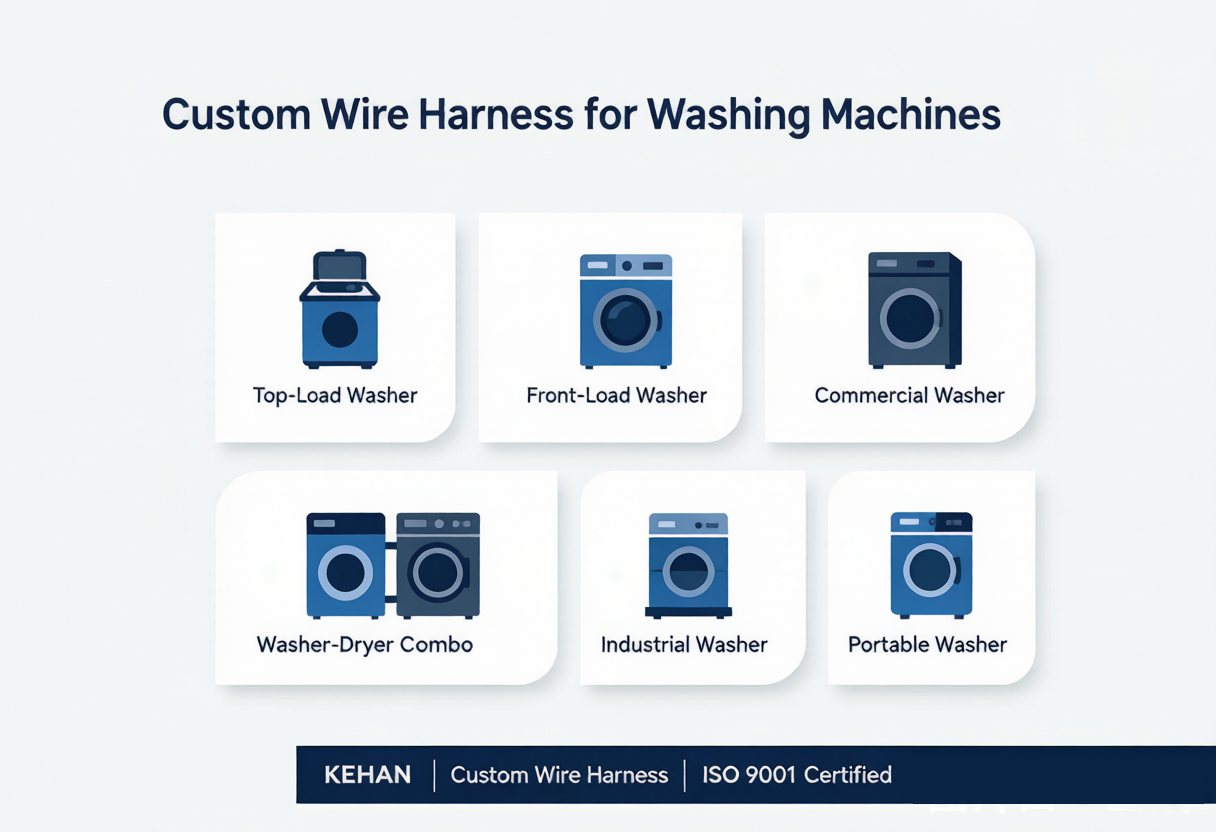
2. Types of Wire Harnesses Inside a Washing Machine
A modern washing machine contains up to a dozen distinct harness assemblies, each with different electrical and environmental requirements. Here is the complete harness breakdown for a typical front-load washer:
| Harness Type | Connects To | Key Requirements |
|---|---|---|
| Motor Control Harness | BLDC/Universal motor → Inverter PCB | 10–15A rated, vibration-resistant crimps, silicone or XLPE insulation for heat tolerance |
| Control Panel UI Harness | Touch panel / LCD display → Main control board | Thin-gauge (AWG 26–30), ribbon or FFC-style, EMC shielding for touch sensitivity |
| Water Inlet Valve Harness (Cold + Hot) | Solenoid valves → Main PCB | IP65 sealed connectors, moisture-resistant terminals, double-insulated wire |
| Drain Pump Harness | Drain pump motor → Main PCB | Submersion-resistant connectors, 5–8A rated, strain relief at pump body |
| Door Interlock / Safety Switch Harness | Door lock mechanism → Main PCB | High-cycle endurance, gas-tight seal at connector (steam/vapor barrier), UL-approved wire |
| Heating Element Harness | Heating element (1.5–3 kW) → Relay/PCB | High-temperature wire (150°C+ rated), reinforced terminals for thermal cycling |
| Sensor Harness (Temperature, Water Level, Turbidity) | NTC thermistor / pressure sensor / turbidity sensor → MCU | Low-noise shielded signal cable, AWG 24–28, 3-pin to 5-pin micro connectors |
| Dispenser / Detergent Drawer Harness | Dispenser actuator motor(s) → Main PCB | Compact routing, chemical-resistant sleeving, snap-fit connector housings |
| Inverter / Power Input Harness | AC mains terminal block → Noise filter → Inverter PCB | UL 1015 or equivalent, AWG 14–16, 600V rated, ferrite bead for EMI suppression |
| Internal Wiring Harness (Main Trunk) | Central wire routing backbone connecting all subsystems | Multi-branch harness tree, color-coded for assembly, labeled at every connector, corrugated conduit protection |
Common mistake: Many generic harness suppliers use PVC insulation throughout the entire washer. Near the heating element and motor, PVC can soften and degrade at temperatures as low as 80°C — well within normal operating range. We spec silicone, XLPE, or PTFE insulation for every high-temperature zone, matched to measured thermal profiles.
3. Application Scenarios: 9 Washer Categories We Support
Not all washing machines are the same. Each category has distinct harness requirements — and we've designed solutions for all of them:
| Category | Typical Harness Count | Key Design Challenge | Our Solution |
|---|---|---|---|
| Top-Load Washer (US Market) | 5–7 harnesses | Agitator motor and transmission wiring in a wet, high-torque environment | Sealed connectors at motor mount + corrugated conduit for mechanical protection |
| Front-Load Washer (EU/Asia Market) | 8–12 harnesses | High component density, door hinge flex zone, internal heating element | Modular harness tree with serviceable breakpoints + high-flex cable at door hinge |
| Commercial Coin-Op / Laundromat | 8–12 harnesses | Heavy-duty cycle count (5–10 cycles/day), 24/7 operation, payment system integration | Oversized conductors (de-rated 125%), extra strain relief at all connectors, industrial-grade terminals |
| Industrial Laundry Machine | 10–15 harnesses | 30–80 kg load, steam injection, high-temperature wash (90°C+), chemical exposure | PTFE/silicone wiring in hot zones, IP68 connectors at all wet interfaces, stainless steel hardware |
| Washer-Dryer Combo | 12–16 harnesses | Dryer heating element (2–3 kW) + blower motor + condensation system in a single chassis | Unified harness architecture with thermal isolation zones, separate power and signal branches |
| Portable / Mini Washer | 3–5 harnesses | Ultra-compact routing, cost sensitivity, minimal connector count | Value-engineered design: reduce connectors via direct-solder options where applicable |
| Smart / Wi-Fi Washer | 10–14 harnesses | EMC from Wi-Fi/BLE module interfering with touch panel and sensor circuits | Shielded signal cables + ferrite chokes + grounded cable routing per EMC pre-compliance testing |
| Twin-Tub / Semi-Auto Washer | 4–6 harnesses | Separate wash and spin motors, mechanical timer interface | Simplified connector system; high-current terminals at motor side |
| Pet / Special-Purpose Washer | 6–9 harnesses | Low-volume, niche product; unique sensor and water management requirements | Full custom starting from 500 pcs MOQ; rapid DFM + prototype within 2–3 weeks |
4. Technical Specifications & Standards
Every washing machine harness we produce meets or exceeds the following technical standards:
| Parameter | Standard | Notes |
|---|---|---|
| Wire Gauge Range | AWG 30 (signal) to AWG 14 (power) | De-rated to 125% of continuous load current per NEC guidelines |
| Insulation Material | PVC (UL 1007/1015), XLPE (UL 3266), Silicone (UL 3071), PTFE | Selected per zone: PVC for ambient, silicone/XLPE for hot zones, PTFE for chemical exposure |
| Temperature Rating | -40°C to +150°C (wire-dependent) | Continuous operating temp; short-term peaks handled by insulation spec |
| Voltage Rating | 300V (signal) / 600V (power) | Hi-pot tested at 2x rated voltage + 1000V for 1 second (100% of units) |
| Waterproof Connectors | IP65 (standard) / IP67 (pump/heater zones) | Molex MX150L, TE MATE-N-LOK sealed, JST JWPF, Deutsch DT series |
| Flame Rating | UL 94 V-0 (connectors), UL 94 VW-1 (wire) | Critical for internal chassis wiring near heating elements |
| EMC Shielding | Foil + braid shield, 85%+ coverage | Applied to UI panel and sensor harnesses for smart/Wi-Fi washer models |
| Regulatory Compliance | RoHS 3, REACH, UL Listed wire options, CE-compatible | Full material declarations and test reports provided with every shipment |
| Workmanship Standard | IPC/WHMA-A-620 Class 2 (default) / Class 3 (available) | Class 3 recommended for commercial/industrial washer applications |
5. Our Custom Wire Harness Capabilities for Washer OEMs
We are not a catalog supplier. Every harness is built to your exact specification, and we add value at every stage:
| Capability | What It Means for Your Washer Project |
|---|---|
| Free DFM Review | Our engineers review your drawing or sample before production and flag any thermal, waterproofing, vibration, or EMC concerns — no charge, no commitment. Typical turnaround: 24–48 hours. |
| ECO Response ≤ 5 Business Days | When your washer control board revision changes a connector pinout or wire length, we update tooling, re-qualify, and deliver first-article samples within 5 working days. No delays, no drama. |
| Multi-Variant BOM Management | Running multiple washer models? We manage your entire harness BOM under a single PO, with model-specific labeling and kitting. Mix-and-match SKU management at no extra charge. |
| Custom Color Coding | We implement your specified wire color scheme across all harness assemblies, reducing assembly errors at your production line. Want double-stripe, tracer, or custom jacket colors? No problem. |
| Pre-Terminated / Plug-and-Play | Every connector is fully terminated, tested, and labeled before it leaves our factory. Your assembly team plugs in, not strips and crimps. For complex washer assemblies, this can save 15–30 minutes per unit. |
| Protective Sleeving Options | Corrugated conduit (mechanical protection), braided PET (abrasion resistance), heat-shrink tubing (sealing), aluminum foil + braid (EMI shielding). Specified per harness zone, not as a blanket solution. |
| Overmolded Connectors | TPU/PA overmolding for connectors at high-moisture locations (pump, inlet valve). Provides integrated strain relief, IP67 seal, and eliminates connector-to-housing leak paths. |
| Traceability to Lot Level | Every harness is traceable to raw material batch, production date, operator, and test results. Records retained for 5 years. Supports your recall management and ISO audit requirements. |
| Buffer Stock / Safety Stock Program | We hold 4–6 weeks of finished inventory for production customers, eliminating lead time risk. Ship within 3–5 business days of your release order — no waiting for production slots. |
6. Common Field Failures & How We Prevent Them
Washing machine harness failures are expensive: they mean service calls, warranty claims, and damage to your brand reputation. Here are the 7 most common failure modes we've seen in the field — and how our engineering eliminates them:
| Failure Mode | Root Cause | Our Prevention Strategy |
|---|---|---|
| Connector Corrosion (Green Crud) | Unsealed connectors in pump or water valve area absorb moisture; copper terminals oxidize and increase resistance | IP67 sealed connectors at all wet locations; tin-plated or gold-plated terminals; dielectric grease fill at connector cavity (optional) |
| Wire Insulation Cracking Near Motor | PVC insulation exposed to continuous 80–100°C motor housing heat becomes brittle over time; vibration completes the crack | Silicone or XLPE insulation for all motor-zone wires; thermal imaging verification during prototype testing; additional heat-shrink sleeving at transition points |
| Intermittent Door Lock Circuit | Wire flex fatigue at door hinge after ~50,000 cycles; intermittent open circuit triggers error codes | High-flex cable (UL 20234 or equivalent) rated for 1M+ cycles at hinge zone; 10× bend radius spec; flex-life validation testing on pre-production samples |
| Heating Element Terminal Arcing | Thermal expansion/contraction loosens standard quick-connect terminals; loose connection arcs under 10–13A load | High-retention flagged terminals; crimp pull-force test on every tooling setup; hi-pot test at 2× rated voltage catches weak connections before shipment |
| Voltage Drop at Drain Pump | Undersized wire gauge for pump wire run length; pump operates below rated voltage, burns out prematurely | Wire gauge calculated per actual measured wire run length + load current (not just "AWG 18 per drawing"); voltage drop < 3% at full load verified |
| EMI Causing Touch Panel Ghosting | Motor PWM switching noise couples onto unshielded UI panel harness; touch panel registers false inputs | Shielded cable on UI panel harness with drain wire to chassis ground; ferrite core at PCB connector entry; EMC pre-compliance test available |
| Chafing Against Sheet Metal Edge | Wire bundle routes across a stamped sheet metal edge without protection; vibration wears through insulation over 2–3 years | DFM review identifies every chafe risk in the routing path; corrugated conduit, edge guard, or revised routing solves it before production |
 Real case: A washer OEM approached us after field returns of drain pump failures. Root cause: the existing supplier used a 600 mm AWG 20 wire for a pump drawing 7A — voltage drop was 0.7V at the pump terminal, operating it below spec. We recalculated to AWG 18 for the same run length, eliminating the undervoltage condition entirely. Zero pump failures after the switch.
7. Quality Testing & 100% Manual Inspection
Water and electricity don't mix — and neither does mass production with sampling inspection. Every single harness that ships from our factory undergoes full testing and manual visual inspection:
| Test / Inspection | Method | Coverage | What We Catch |
|---|---|---|---|
| Continuity Test | Automated test fixture (Cirris / DIT-MCO equivalent) | 100% of units | Open circuits, short circuits, miswires, intermittent connections |
| Hi-Pot (Dielectric Withstand) | Programmable hi-pot tester | 100% of units | Insulation breakdown, weak spots, creepage failures |
| Crimp Pull-Force Test | Digital force gauge (per UL 486A / IPC/WHMA-A-620) | Every tooling setup + hourly in-process sampling | Under-crimped or over-crimped terminals that could fail in service |
| Manual Visual Inspection (100%) | QC technician with magnification lamp + inspection checklist (9 points) | 100% of units | Incorrect wire color/gauges, damaged insulation, misaligned connectors, missing labels, improper sleeving position, loose connector locks, cut strands at crimp, wrong connector orientation, foreign material |
| Waterproof Seal Test | Pressure decay test (for IP67 connectors on pump/heater harnesses) | 100% of sealed connector assemblies | Missing or improperly seated seals that would fail in wet zones |
| Dimensional Check | Go/no-go fixture + calibrated ruler | First article + random in-process | Wire length deviation, connector placement error, branch point mislocation |
| First Article Inspection Report (FAIR) | Full dimensional, crimp cross-section micrograph, pull-force data, electrical test log, photos | Every new SKU or ECO revision | Any deviation from customer specification before production release |
Our quality data for washer harness production: First-pass electrical test yield: 99.96% | Customer incoming inspection reject rate: < 0.03% | Field failure rate (harness-related): < 0.01% across 500,000+ units delivered
8. How We Work: From Drawing to Delivery
Our process is designed to minimize your engineering overhead while ensuring every harness meets spec — first time, every batch:
Technical Intake (Day 1–2)
Send us your drawing, BOM, or a sample harness. Our engineering team reviews your design within 24–48 hours and returns a DFM report covering thermal, waterproofing, vibration, EMC, and manufacturability concerns. No charge. No commitment.Quotation (Day 2–3)
We deliver a detailed quote including: unit price at your target volume, NRE/tooling costs (if any), sample lead time, and production lead time. Typical turnaround: 48 hours from completed documentation.Prototype & First Article (Week 2–3)
5–20 prototype units, 100% tested, delivered with a complete FAIR package (crimp cross-section micrographs, pull-force data, dimensional report, electrical test log, photos). Design iterations incorporated at no additional tooling charge within the agreed design envelope.Customer Approval (Week 3–4)
You test the prototypes in your washer, confirm fit/function, and sign off. We document every process parameter for production repeatability.Qualification Batch (Week 4–5)
100–500 pcs qualification run with full in-process QC data. Catches process variation before it reaches your production line.Mass Production (Week 5+)
Standard lead time: 15–25 days for orders up to 50,000 pcs. Shipping via sea (FOB Xiamen) or air (DHL/FedEx/Freight). Includes full traceability documentation, lot records, and test reports.Ongoing Support
Dedicated account engineer assigned for life of project. ECOs processed with ≤ 5-day response on first-article samples. Buffer stock program available for JIT delivery.
9. Frequently Asked Questions
Q1: We currently use 4 different harness suppliers for our washer production. Can you consolidate all of them?
Yes — this is one of our core strengths. We've consolidated harness sourcing for multiple appliance OEMs, standardizing wire specs, connector families, and quality requirements across the entire product line. The result: fewer supplier relationships to manage, consistent quality, and typically 10–20% cost savings from volume consolidation. We manage multi-SKU BOMs under a single PO with model-specific labeling and kitting.
Q2: What's the smallest order quantity you accept?
Prototype phase: 10–50 pcs. Small batch / pilot production: 500–2,000 pcs. Mass production MOQ: typically 2,000–5,000 pcs per SKU, negotiable for customers with multiple SKUs or a defined ramp plan. We understand that new washer models start small and scale up — we structure pricing to support that.
Q3: Our washer needs to pass UL certification. Can your harnesses support that?
Absolutely. We can source UL Listed wire types (UL 1007, UL 1015, UL 3266, UL 3071, etc.) and UL Recognized connectors for your harness BOM. We provide full material traceability documentation, component UL file numbers, and test reports to support your UL certification submission. Several of our appliance customers have passed UL, CE, and CCC certification using our harness assemblies.
Q4: What if our drawing has a mistake — will you catch it?
Yes, and our customers tell us this is why they stay with us. Our DFM review is designed to catch exactly these issues: wire gauge undersized for load current, connector not rated for the environment (e.g., unsealed connector specified for a pump zone), insulation type mismatched to temperature zone, routing path that creates a chafe point. We flag everything in the DFM report with our recommended fix. You decide what to implement, but at least you know before you cut tooling.
Q5: Can you handle quick-turn ECOs when we revise the washer control board?
Yes. For existing, qualified harness designs where the change is within the same connector family or wire spec, we can re-tool and deliver first-article samples within 5 business days. This is critical for appliance OEMs doing rapid hardware iteration. Rush production for approved ECOs typically ships within 10–12 business days.
Q6: Do you offer harness kitting — all harnesses for one washer in a single package?
Yes, this is a standard service. We kit all harness SKUs for one washer model into a single poly bag or box, labeled with your model number and production batch. This eliminates picking errors on your assembly floor and supports line-side delivery. Kitting is available at a modest per-set charge, typically $0.15–0.40 depending on harness count and packaging complexity.
Q7: We're based in Europe. How do you handle shipping, lead times, and CE documentation?
We ship from Xiamen, China via sea freight (25–35 days to major European ports) or air (5–7 days door-to-door via DHL/FedEx). For CE compliance, we provide RoHS/REACH declarations, material test reports, and can support EN 60335-1 (household appliance safety) documentation requirements. We also offer a buffer stock program: we hold 4–6 weeks of inventory in our warehouse and ship on your release order within 3–5 business days.
Ready to Upgrade Your Washer Wire Harness Supply Chain?
Whether you manufacture top-load washers for the US market, front-load smart washers for Europe, commercial machines for laundromats, or specialty washers for niche applications — if it has wiring inside, we can build it to your spec, test it to the harshest standard, and deliver it on time, every time.
Send us your drawing or sample and get a full quote + DFM review within 24–48 hours. No charge. No commitment. Just honest engineering feedback and competitive pricing from a partner who understands what your washer needs.
 Contact Us — Free Quote & Engineering Review
© 2026 Kehan Wire Harness | Custom Washing Machine Wire Harness | Washer Wiring Harness Manufacturer | Home Appliance Harness Supplier | ISO 9001 Certified | UL CE RoHS Compliant
Keywords: washing machine wire harness · washer wiring harness manufacturer · custom appliance harness · front-load washer harness · commercial laundry harness · IP67 washing machine connector · home appliance wire harness supplier · washer motor control harness · OEM washing machine harness