


Custom Wire Harness Solutions for Small & Medium Display Manufacturers
2026-06-30 15:50Custom Wire Harness Solutions for Small & Medium Display Manufacturers
Precision LVDS, eDP, MIPI, HDMI & Hybrid Display Cable Assemblies — From Prototype to Mass Production
✓ ISO 9001:2015 Certified | ✓ Signal Integrity Guaranteed | ✓ 10–100,000+ pcs Fulfilled | ✓ OEM / ODM Available
 Table of Contents
1. Why Display Harnesses Demand a Specialized Supplier
Small and medium displays — from 3.5-inch industrial HMI panels to 21.5-inch medical monitors — sit at the intersection of high-speed signal transmission, mechanical durability, and strict EMC compliance. The wire harness connecting your display to its driver board, backlight inverter, or system controller is not a passive cable; it is an active part of your signal chain.
Off-the-shelf FFC/FPC cables and generic LVDS assemblies routinely cause image noise, intermittent signal loss, backlight flicker, and EMC test failures — problems that only surface after your product is in customer hands. The root causes are almost always traceable to harness design: wrong impedance control, inadequate shielding, poor connector termination, or insufficient mechanical strain relief.
What makes display harnesses different? Unlike power harnesses, display cables carry differential signals at 100 MHz to 10 GHz (LVDS/eDP/MIPI DSI). At these frequencies, every millimeter of cable geometry, every connector pin assignment, and every grounding decision affects signal quality. A harness that "looks fine" electrically at DC can destroy your image quality at operating frequency.
We have supplied precision display cable assemblies to manufacturers across industrial HMI, medical imaging, POS terminals, in-vehicle infotainment, smart home devices, and digital signage — covering display sizes from 2.4 inches to 27 inches. Our engineering team designs for signal integrity from day one, not as an afterthought.
2. Display Interface Types & Cable Assembly Overview
| Interface Type | Typical Display Size | Data Rate | Typical Application | Key Harness Requirements |
|---|---|---|---|---|
| LVDS (Low-Voltage Differential Signaling) | 7″ – 21.5″ | Up to 1.5 Gbps/pair | Industrial HMI, medical monitors, POS displays | 100Ω differential impedance, twisted pair, shielded |
| eDP (Embedded DisplayPort) | 10.1″ – 27″ | Up to 8.1 Gbps/lane (eDP 1.4) | Laptop panels, embedded computing, industrial PCs | 100Ω impedance, ≤ 10 mil length matching, low-EMI shielding |
| MIPI DSI | 2.4″ – 10.1″ | Up to 4.5 Gbps/lane | Smart home panels, handheld devices, kiosk touchscreens | 100Ω differential, ultra-flexible, fine-pitch FPC to board |
| HDMI (Type A/D/E) | Any | Up to 48 Gbps (HDMI 2.1) | Digital signage, in-vehicle displays, industrial monitors | 100Ω TMDS pairs, quad-shielded, impedance-matched connectors |
| MIPI CSI-2 (Camera) | Camera modules | Up to 4.5 Gbps/lane | Medical imaging, machine vision, kiosk cameras | Matched-length differential pairs, shielded flex |
| Backlight / CCFL / LED | All sizes | Power + PWM signal | All display types requiring backlight control | Separated from signal conductors, shielded PWM line |
| Touch Interface (I²C / USB) | All sizes | Low speed | Touchscreen overlays, capacitive panels | Twisted pair for I²C, ferrite bead filtering for USB |
| Hybrid Display Harness | All sizes | Mixed | Systems combining video + touch + power + backlight | Signal isolation, separate ground planes, shielded zones |
3. Technical Specifications at a Glance
| Parameter | Our Capability | Why It Matters |
|---|---|---|
| Differential Impedance | 100Ω ± 10% (standard); ±5% on request | Prevents signal reflections and image artifacts |
| Wire Gauge Range | AWG 36 – AWG 22 (signal & power) | Covers fine-pitch display signals to backlight power |
| Conductor Material | Bare copper / silver-plated copper / OFC (oxygen-free) | Low resistance for high-frequency signal integrity |
| Insulation | FEP, PTFE, PVC (105°C), LSZH | Dielectric constant affects signal propagation speed |
| Shielding | Foil (Al/Mylar), braided (≥ 85% coverage), combination foil+braid, individual pair shielding | Critical for EMC — FCC Part 15 / CE EN 55032 |
| Connector Brands | Molex, JST, Hirose, TE Connectivity, I-PEX, JAE, Amphenol, Foxconn FPC connectors | Maintain your original BOM with certified components |
| Operating Temperature | −40°C to +105°C (standard); −55°C to +150°C (high-temp on request) | Covers automotive, industrial, and outdoor display apps |
| Flex Endurance | Standard: 5,000 cycles; High-flex (igus CF series compatible): 10,000,000+ cycles | Required for hinged panels, flip displays, robot-mounted cameras |
| Length Tolerance | ± 2 mm (standard); ± 0.5 mm on request | Eliminates slack and strain in tight display enclosures |
| IP Rating (with overmolding) | IP54 / IP67 / IP68 on connector ends | Medical washdown, outdoor digital signage, industrial splash zones |
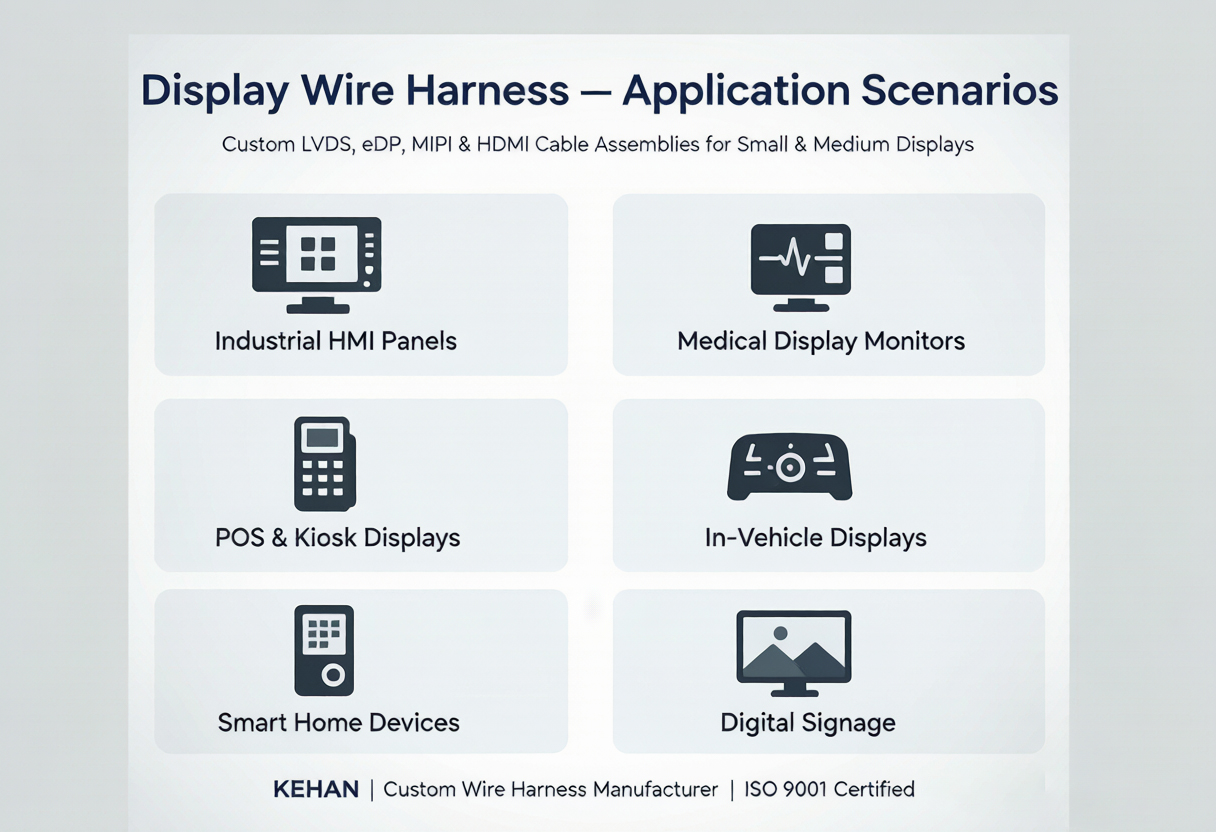
4. 6 Major Application Scenarios
| Application | Display Size Range | Interface | Key Harness Requirement | Our Typical Solution |
|---|---|---|---|---|
| Industrial HMI Panels | 5.6″ – 21.5″ | LVDS, eDP, HDMI | Vibration resistance, EMC, −40°C operation | Foil+braid shielded LVDS assembly, strain-relief boot, locking connectors |
| Medical Display Monitors | 10.1″ – 27″ | eDP, HDMI, LVDS | IEC 60601-1 leakage current, RoHS, traceability | Low-leakage construction, full material traceability, lot records 5 years |
| POS Terminals & Kiosks | 7″ – 15.6″ | LVDS, MIPI, USB touch | Compact routing, high assembly volume, FCC/CE | Pre-routed hybrid harness (video + touch + power), kitting service available |
| In-Vehicle Displays | 4.3″ – 12.3″ | LVDS, MIPI, HDMI Type E | −40°C to +85°C, vibration per ISO 16750, USCAR-2 connectors | Automotive-grade wire (FLRY/GXL), USCAR/FAKRA connectors, heat-shrink strain relief |
| Smart Home Devices | 2.4″ – 7″ | MIPI DSI, I²C touch, SPI | Ultra-thin, high-flex (lid open/close), FCC Wi-Fi coexistence | Micro-coax MIPI + I²C twisted pair in single ultra-thin jacket; ferrite beads on touch line |
| Digital Signage | 10.1″ – 21.5″ | HDMI, DisplayPort, LVDS | Long cable runs (up to 5 m), 24/7 duty cycle, outdoor IP rating | Active HDMI equalizer cable or HDMI 2.0 redrivers; IP67 overmolded connectors for outdoor units |
5. Common Failure Modes & How We Solve Them
Most display harness problems are predictable — and preventable if caught at design review. Here are the most common failure modes we encounter in first-time customer designs, and how our engineering process addresses them:
| Failure Mode | Root Cause | How We Prevent It |
|---|---|---|
| Image noise / sparkling pixels | Impedance mismatch on LVDS/eDP pairs; inadequate shielding; ground bounce | Impedance-controlled construction; 100% foil shielding + drain wire; separate signal ground |
| Intermittent signal loss | Poor connector termination; micro-fracture from flexing; connector fretting corrosion | Pull-force test on every crimp; flex life qualification; gold-plated contacts for high-flex applications |
| Backlight flicker | PWM signal noise coupled from adjacent power conductors | Separate PWM wire from power; twisted pair for PWM; ferrite bead at driver end |
| EMC test failures (radiated emissions) | Unshielded high-frequency lines acting as antennas; inadequate drain wire connection | 360° backshell termination; drain wire bonded to chassis at both ends; separate shield zones per interface |
| Connector mis-mating / wrong orientation | Identical connector housings for different signals; poor labeling | Keyed connector selection; heat-shrink label on every connector end (e.g., "LVDS-J3", "BL-PWR-IN") |
| Cable fatigue fracture | Standard PVC wire in continuous-flex application (hinged panel, robot arm) | High-flex cable (igus CF / UL20276 high-flex rated) specified at DFM stage; minimum bend radius enforced |
6. Our Custom Display Harness Capabilities
We are a dedicated custom harness manufacturer — not a distributor reselling stock cable. Every display harness we produce is engineered and built to your specific schematic, BOM, and mechanical drawing.
| Capability | Details | Benefit to Display OEMs |
|---|---|---|
| Impedance-Controlled Cables | 100Ω differential pairs; verified by TDR measurement on first articles | Eliminates signal integrity issues before production |
| Fine-Pitch Connector Assembly | FPC/FFC connectors down to 0.3 mm pitch; ZIF/LIF socket termination; micro-coax soldering | Handles the smallest display interfaces without outsourcing |
| Multi-Interface Hybrid Harness | LVDS + backlight + touch + power in a single routed harness tree | Reduces part count and simplifies your assembly process |
| Shielding Options | Overall foil, overall braid, individual pair foil, combination foil+braid, twisted pair isolation | EMC solution matched to your FCC/CE certification requirement |
| Overmolded Connectors | TPU/PA overmolding; IP54/IP67 seal; custom color-coding; strain relief geometries | Ruggedizes connectors for harsh-environment and medical applications |
| Labeling & Kitting | Heat-shrink labels, barcode/QR traceability, pre-kitted sets per board or per machine | Speeds up your assembly line; eliminates picking errors |
| Automotive-Grade Options | USCAR-2 / USCAR-25 compliant; FLRY / GXL wire; FAKRA / HSD connectors | Direct supply for in-vehicle display harness programs |
| MOQ Flexibility | Prototype: 10–50 pcs | NPI: 200–500 pcs | Mass production: 5,000–100,000+ pcs | Supports every stage from R&D through full-scale production |
| ECO Response | Engineering change orders acknowledged within 24 hr; first-article samples ≤ 5 business days | Keeps your development schedule when hardware revisions happen |
7. Quality Assurance: 100% Electrical Test + Manual Inspection
Display harnesses are one of the highest-consequence assembly categories in consumer and industrial electronics. A single bad harness in a shipped unit means a display that doesn't work at first power-on. Our quality system is designed to catch every defect before it leaves our factory:
| Test / Inspection Stage | Method | Coverage | Standard |
|---|---|---|---|
| 100% Continuity Test | Automated electrical tester with custom fixture | Every unit | IPC/WHMA-A-620 |
| Hi-Pot / Dielectric Withstand | AC 500V / DC 1000V applied between conductors and shield | Every unit (for shielded assemblies) | IEC 60068-2 |
| Impedance Verification (TDR) | Time-domain reflectometry on first-article samples | First article + process change | TIA-568 / customer spec |
| Crimp Pull-Force Test | Tensile tester per UL 486A / IPC-A-620 tables | Every tooling setup; periodic in-process sampling | UL 486A / IPC-A-620 |
| Manual Visual Inspection (100%) | Trained QC technicians inspect every harness under magnification | Every unit | IPC-A-620 Class 2/3 |
| Dimension Check | Cable length, branch lengths, connector seating depth per drawing | First article (100%) + in-process sampling | Customer drawing |
| Flex Endurance Test | Mechanical bending tester; continuity monitored throughout | Qualification testing for high-flex designs | Customer spec / IEC 60068-2-21 |
| First Article Inspection Report (FAIR) | Full documentation package: dimensions, test results, material certs | Every new part number and revision change | AS9102 inspired (customer-adapted) |
Factory Quality Data: First-pass electrical test yield ≥ 99.95% | Customer return rate < 0.05% | RoHS / REACH material declarations available for all product families | Lot records retained for 5 years
8. From Drawing to Delivery: Our 6-Step Process
Technical Intake & DFM Review (Day 1–2)
Send your schematic, connection diagram, or physical sample. Our engineer reviews your design for impedance control, shielding adequacy, connector selection, and mechanical routing — and returns a DFM report at no charge. Most first-time designs have one or two flagged items that are far cheaper to fix before tooling is cut.Quotation (Day 2–3)
We provide unit pricing at your target volume, NRE (tooling/fixtures) if required, sample lead time, and production lead time. For standard display harnesses, quotes are typically returned within 48 hours of receiving complete documentation.Prototype & First Article (Week 2–3)
We build 5–20 prototype units and deliver them with a First Article Inspection Report (FAIR) covering: continuity results, impedance measurements, pull-force data, dimensional verification, and visual inspection results. Revisions within the agreed design envelope are re-sampled at no additional tooling charge.Production Qualification (Week 3–4)
Once first articles are approved, we set up dedicated production fixtures and run a qualification batch (100–500 pcs) before full production release. This step validates process consistency — not just product quality.Mass Production (Lead Time: 15–25 Days)
Standard lead time is 15–25 days for orders up to 50,000 pcs. Every unit is 100% electrically tested and manually inspected before packing. Shipments include continuity test reports, lot traceability records, and material compliance documentation.Ongoing Support & ECO Management
A dedicated account engineer handles your account for the life of the project. Engineering changes are processed with ≤ 5-business-day turnaround on new first-article samples. We also offer buffer stock programs for high-volume accounts — holding 4–6 weeks of safety stock ready to ship on short notice.
9. Frequently Asked Questions
Q1: We use I-PEX CABLINE connectors on our LVDS harness. Can you source and terminate these?
Yes. We stock and work with I-PEX CABLINE-CA, CABLINE-VS II, and related series as well as JAE FI, Hirose DF, and other fine-pitch display connectors. We maintain qualified tooling for these connector families. If your BOM specifies an approved alternate, we can evaluate and qualify it for you.
Q2: Our display harness needs to pass CE EN 55032 radiated emissions. Can you help?
Yes. We design shielding architectures specifically for EMC compliance — 360° backshell termination, individual pair shielding, drain wire bonding at defined points, and ferrite suppression on power lines. Several of our customers have passed first-submission EN 55032 tests using our recommended shielding design. We can review your test setup and harness design together if you are experiencing failures.
Q3: What is the minimum order quantity for display wire harnesses?
For prototype and first-article runs, we accept orders from 10 pieces. For production orders, our typical MOQ is 200–500 pieces per SKU, with flexibility for customers managing multiple display variants or a confirmed production ramp. We understand that display product programs often require multiple NPI iterations before volume ramp.
Q4: Can you build a hybrid harness that combines LVDS video, LED backlight, USB touch, and 12V power in a single assembly?
Yes — this is one of our core strengths. We design multi-branch harness trees that route all display sub-circuits (video, backlight, touch, power) in a single pre-routed assembly. Each branch terminates in its correct connector. The harness ships as a single part number, simplifying your procurement and assembly BOM. We isolate signal and power conductors within the harness to prevent interference.
Q5: Our product is used in a medical device. Do you support IEC 60601-1 requirements?
We supply harnesses to several medical display OEMs. We can provide: full RoHS/REACH material declarations, lot traceability records (5-year retention), leakage-current-conscious construction, and quality documentation formatted for inclusion in your 510(k) or CE technical file. We do not hold FDA registration ourselves, but we provide the documentation and construction quality that your certification process requires.
Q6: We are in the US. How long does shipping take, and do you offer expedited options?
We ship from Xiamen, China. Air freight (DHL/FedEx) delivers to US addresses in 5–7 business days; sea freight takes 20–35 days depending on destination coast. For existing qualified designs (no new tooling), rush production can ship within 7–10 business days for orders up to 5,000 pcs (surcharge applies). We recommend establishing a buffer stock program for high-volume display programs to eliminate lead time risk entirely.
Q7: What information do I need to submit for a quote?
Ideally: (1) wiring diagram or schematic; (2) connector part numbers for both ends; (3) overall harness length and branch lengths; (4) target quantity and delivery schedule; (5) any applicable standards (CE, FCC, IEC 60601, etc.). If you only have a physical sample or rough sketch, we can work with that — our engineers will reverse-engineer the harness design and return a drawing for your approval before building.
Ready to Build a Display Harness That Delivers Perfect Image Quality?
Whether you make industrial HMI panels, medical monitors, POS terminals, in-vehicle displays, smart home devices, or digital signage — if it has a display inside, we can build the wiring harness that makes it work reliably, in volume, at the quality your customers expect.
Send us your drawing or sample and get a full quote + DFM review within 24 hours.
 Contact Us — Free Quote & Engineering Review
© 2026 Kehan Wire Harness | Custom Display Wire Harness | LVDS Cable Assembly | eDP Harness | MIPI DSI Cable | HDMI Display Harness | Industrial Display Harness | Medical Monitor Harness | ISO 9001 Certified
Keywords: display wire harness · LVDS cable assembly · eDP harness · MIPI DSI cable · custom display cable assembly · industrial HMI harness · medical display harness · POS display harness · in-vehicle display harness · digital signage harness · custom wire harness manufacturer
