


How to Choose a Wire Harness Manufacturer: 12 Questions to Ask Before You Send an RFQ
2026-10-16 16:53How to Choose a Wire Harness Manufacturer: 12 Questions to Ask Before You Send an RFQ
A founder of a smart lock company called us in the spring of 2024. His first product had just finished a crowdfunding campaign, 4,000 units committed, delivery date fixed and public. He had a supplier he found on a sourcing platform. Samples were fine. He had tested them himself, plugged them in, the lock worked.
Then the first production batch of 500 arrived. Eleven percent of the units developed intermittent faults — the lock would work, then stop responding, then work again. The harness looked perfect. Nothing was burned, nothing was loose to the eye. What had happened was simpler and more expensive: the supplier had built the production batch with 26 AWG wire where the sample used 24 AWG, because 26 AWG was what they had in stock that week. At the currents involved the voltage drop was fine on a bench and marginal in the field, and the crimp height on the thinner conductor was outside the tolerance the terminal was designed for. It worked when you tested it by hand. It failed after a hundred mating cycles.
"The samples were fine" is the most expensive sentence in hardware. It is also the most common one.
This article is the checklist we use when we quote. It is written for the person on the other side of the table — the small machine builder, the hardware startup shipping a first product, the OEM running a program someone else designed, the design house that has to hand a drawing to somebody and trust them with it. If you are buying tens of thousands of harnesses a year, you already have a supply chain department with a supplier scorecard. This is for everyone who does not.
What this article covers:
Why choosing a harness supplier is a different decision for a small company than for a large one
The five kinds of supplier you are actually choosing between, and where each one breaks
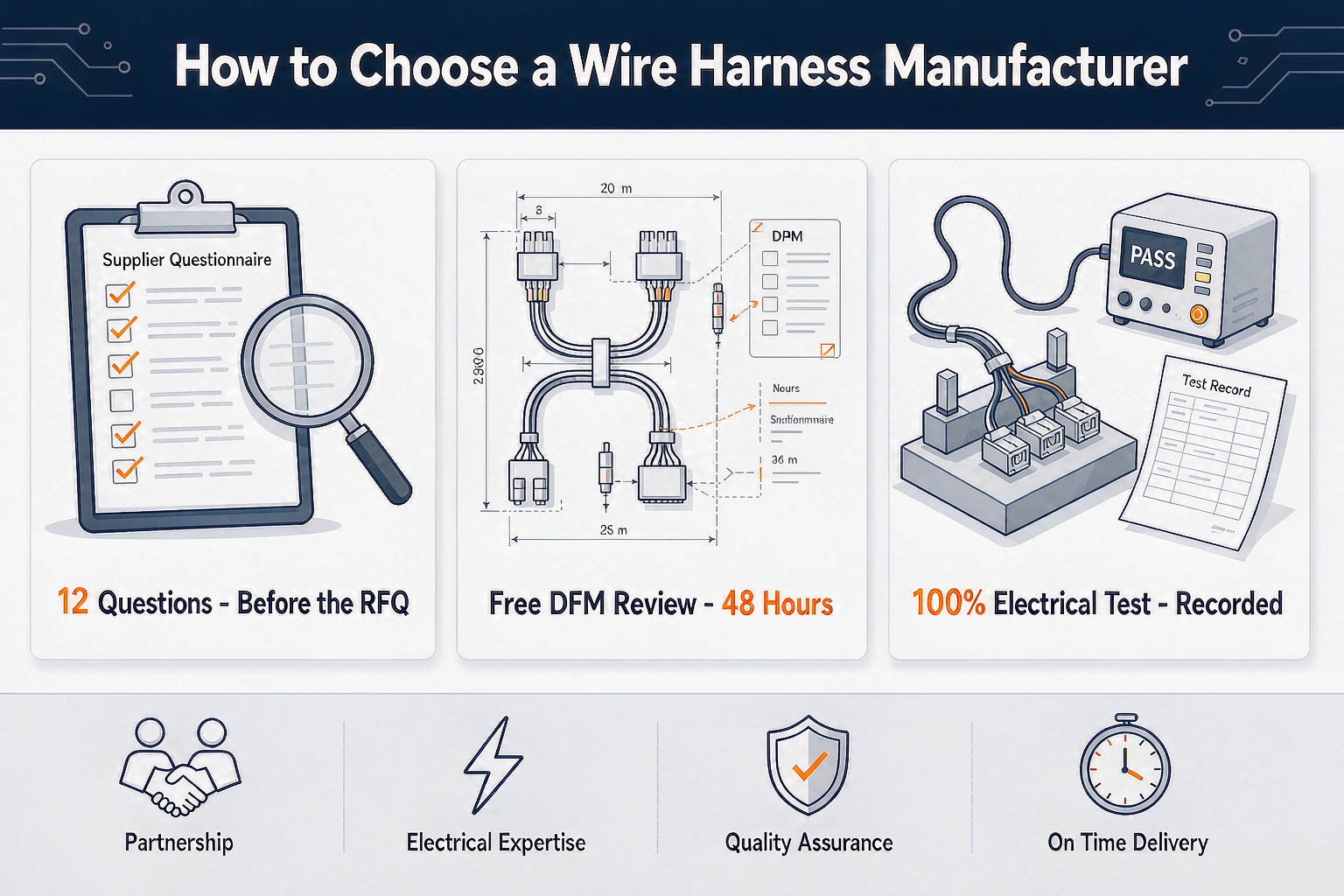
The 12 questions to ask before you send an RFQ, and what a good answer sounds like
What a real DFM review looks like versus a reply that says "no problem"
Quality systems: what gets checked, by whom, and with what equipment
The test equipment a supplier should own before they call themselves a factory
Prototyping and samples when your volumes are small
MOQ, tooling, and NRE — what is negotiable and what genuinely is not
Price: what actually drives it, and the line items that get left off the quote
How to measure responsiveness before you commit money
Drawings, IP, NDAs, and who owns the tooling
First article approval and the scale-up to production
The failures we get paid to fix
Why work with us
Table of Contents
Why this decision is harder for a small company
A large OEM has leverage that has nothing to do with engineering. They have volume, they have a quality department that visits suppliers, they have a scorecard that docks points and a contract that lets them walk. If a supplier ships them bad harnesses, there are consequences.
You probably do not have any of that. If you are building a machine, a medical device, a coffee roaster, a battery pack, a set of connected appliances, or a piece of lab equipment, your situation is usually this:
Your volumes are small. A few hundred units a year, maybe a few thousand. Not enough to make a big factory care, and that is exactly the problem — a supplier who does not care enough to answer your email will not care enough to keep your build frozen.
Your first order is your riskiest. You have no history. You cannot tell from a website whether the supplier is a factory or a trading office with a WeChat account.
You are the engineer, the buyer, and the quality department. In a company of eight people, the person who designed the harness is the person who will inspect the shipment. There is nobody to catch it if you miss something.
Your schedule has no slack. A delay is not a supply chain metric. It is a launch date, a distributor commitment, a demo to an investor, or a penalty clause you signed before you knew what a crimp height was.
You may not have a complete drawing. Plenty of our customers arrive with a partial schematic, a photo of a prototype, and a connector list in a spreadsheet. That is a normal starting point, and how a supplier handles it tells you a lot.
You have no second source, and no time to build one. Once the harness is specified into a product, changing suppliers means re-validating. You are effectively married to your first choice for the life of the program.
That last point is why this article exists. You are not buying a part. You are choosing the person who will still be answering your emails in year three, when your volumes are three times what they are now and you have a customer audit on Thursday.
The five supplier types you are choosing between
Almost every quote you receive comes from one of five kinds of business. They are not ranked worst to best — that depends entirely on your product. But they fail in different places, and knowing which one you are talking to changes what you should ask.
| Supplier type | What they actually do | Where they are strong | Where they fail | How to tell from the outside |
|---|---|---|---|---|
| Trading company / sourcing agent | Take your drawing, place it with an unknown third factory, add margin, handle shipping | Fast quotes, low MOQ, good English, easy to deal with on paperwork | No control over the build. When something goes wrong, they are negotiating with the factory on your behalf and they have no leverage either. Changes take twice as long. | They cannot answer a technical question without "let me check with the engineer." Ask for a photo of the crimp tooling or a test record — silence is the answer. |
| Small workshop / job shop | Cut, strip, crimp, assemble by hand. Often genuinely skilled at it | Very flexible, very low MOQ, cheap on simple assemblies, will do one-off work | No engineering function, minimal test equipment, no documentation, no process control. Fine for a lamp loom, dangerous for anything with a signal or a safety circuit. | Ask what test equipment they have. If the answer is "we test by looking at it," that is a workshop. |
| Integrated harness factory | In-house engineering, cutting, crimping, overmolding, potting, testing, and documentation. This is what we are. | Owns the whole process, so DFM feedback is real, changes are fast, quality is controlled at every step, and someone is accountable when there is a problem | May have a higher floor on price than a workshop, and will push back on specs they think are wrong — which is uncomfortable if you wanted a supplier who simply says yes | Ask for a DFM comment on your drawing before you ask for a price. A factory will find at least two things to ask about. |
| EMS / contract manufacturer | Builds the whole box, harness included, under one PO | One supplier, one invoice, one shipment, single-point accountability | Harnesses are a small fraction of their revenue and get treated that way. Low-volume harness work is often subcontracted anyway, and the markup appears without the engineering. | Ask where the harnesses are actually built and who owns that process. "We have a partner" means you have the trading-company problem with a bigger logo. |
| Overseas / nearshore assembler | Buys components from Asia, assembles closer to your market | Short lead time on simple builds, easier travel, sometimes tariff advantages | Component cost is high because they are buying the same cable and connectors you could buy direct, and they carry far less stock than a factory that buys by the reel. | Compare the BOM line by line. If their component pricing is the same as your distributor's, you are paying assembly labour on top of retail parts. |
There is one more question worth asking early, and it is not on the list above: who will actually build your harness? Ask for the address of the plant where your job will run, and ask for a video call from the production floor. It takes five minutes and it eliminates about half the surprises. Nobody minds the question. The people who dodge it are telling you something.
The 12 questions to ask before you send an RFQ
Send these in one email, before you send the drawing. Not as an interrogation — as a conversation. A good supplier will answer most of them from memory in one reply and will ask you two or three questions back, which is the single most reliable signal you will get at this stage.
| # | Question | Why it matters | What a good answer sounds like | Danger signal |
|---|---|---|---|---|
| 1 | Are you the factory, or do you subcontract the build? | Determines who controls quality, change speed, and accountability | A direct answer, a plant location, and an offer to show you the floor on a video call | Vague. "We have our own factory" with no address or floor visit |
| 2 | What is your minimum order quantity for a new program? | Your first order may be 50 pcs. You need to know now, not after you have designed around them | A number, plus what changes at higher volume. We say 100 pcs for a new program and routinely run 10–50 pcs pilots. | "No MOQ!" — they have not understood the question, or they are a trader who has never had to set up a line |
| 3 | Who reviews my drawing, and what format do you need? | Tells you whether engineering exists as a function or is just a job title | "A project engineer reviews it, send PDF for quoting and native CAD or a full BOM for build. If you only have a photo and a connector list, send that and we will help you write the spec." | "Any format is fine." Nothing is fine. That is a yes to get the drawing in the door. |
| 4 | What does your DFM review actually check? | This is the highest-value thing a supplier can do for you, and it is free | A specific list: current capacity vs gauge, crimp terminal compatibility, bend radius, strain relief, connector sourcing, test access | "We will build exactly what you send." You have just been told they will not catch your mistake. |
| 5 | What percentage of assemblies do you electrically test, and what do you record? | The single strongest quality question you can ask a harness supplier | "100 %. Continuity and hipot on every assembly, with records traceable to batch and operator." | "We sample test." On a harness, a fault is not a cosmetic defect. It is a dead unit on a customer's bench. |
| 6 | What test equipment do you own? | Equipment is the difference between a claim and a process | Names and models of a harness tester, hipot tester, pull tester, microscope, measurement equipment | "We send samples to a lab." Fine for a one-off. Not a production quality system. |
| 7 | How long does an ECO take once we are in production? | Your product will change. The supplier's change speed becomes your product's change speed | A number with a caveat. We commit to 5 working days and we tell you immediately if a component lead time makes that impossible. | "It depends." True, and useless. Ask them to name the last three changes they made and how long each took. |
| 8 | What is the sample lead time, and what does a sample cost? | Tells you how the first 30 days of your project will go | Concrete days, and whether the sample cost is credited against the first production order | "Two weeks" that becomes five. Ask for a date, not a duration. |
| 9 | Can I see a test report from a recent shipment to someone else? | Documents are the part of quality that customers forget to ask about and auditors always do | A redacted copy of a real continuity/hipot record and a first-article report | They describe their system but cannot produce a document. Systems that exist produce paper. |
| 10 | Who is my contact, and who is the backup? | A harness program runs for years. Personal relationships die and companies do not | A named engineer and a named account manager, with the engineer reachable directly | Every email comes from "sales" with no name attached |
| 11 | How do you handle a batch that fails your own test? | Every supplier eventually has a bad day. What they do next defines the relationship | "We stop the batch, tell you the same day, tell you the root cause, and tell you what we are changing." | "That never happens." It happens to everyone. The claim means they are not measuring. |
| 12 | What do you need from me that I have not given you? | The question that separates an engineer from a sales script | Two or three specific gaps: the environment, the flex requirement, the routing, the volume curve, the certification target | "Nothing, send the PO." You are about to find out what you forgot, at the worst possible time. |
One note on question 12. If a supplier answers everything with "yes, no problem," that is not responsiveness. That is a sales script. An engineer who has actually built harnesses will find something in your drawing to argue about — a gauge that is marginal, a connector that is on 16 weeks of lead time, a bend radius that will not survive the routing you sketched. The argument is the value. You are paying for it either way; the question is whether you pay for it in a conversation or in a recall.
What a real DFM review looks like
Design for Manufacturability gets used as a marketing word by everyone. Here is what it means when it is real: somebody technical reads your drawing and tells you, before you order anything, where the design will cost you money or cause a failure. Free, and inside two days, or it is not a process — it is a favor.
These are the ten things a genuine review covers. If your supplier's DFM feedback is one line saying "looks good," you have received a price, not a review.
| # | What gets reviewed | What we are looking for | Typical finding |
|---|---|---|---|
| 1 | Wire gauge vs current and voltage drop | Current per circuit, run length, allowable drop, ambient temperature, bundling derating | "Your 24 AWG run at 3 A over 1.2 m is inside the ampacity table but outside your own 3 % drop budget." |
| 2 | Terminal and crimp compatibility | Whether the terminal's wire range actually covers your conductor, and whether the insulation diameter fits the crimp barrel | Thin-wall insulation that does not seal in the terminal, or a wire range where the crimp height is at the edge of the specification |
| 3 | Connector sourcing and cross-reference | Availability, minimum buy, lead time, and whether a listed alternative is truly interchangeable | "Your connector has a 16-week lead time. There is a functional equivalent in the same family, but the mating half has a different keying — you need to decide, not us." |
| 4 | Bend radius and routing | Minimum bend radius against your actual routing, especially at the connector exit and any 90° turn | "The drawing shows a 6 mm radius at the connector exit; the cable needs 18 mm. That is where it will fail." |
| 5 | Strain relief and pull-out loads | What the assembly sees in assembly, service, and use, and whether the termination can take it | "Your harness pulls out of the housing during service. Add a service loop or a strain-relief tie point." |
| 6 | Shielding and grounding strategy | Whether shielding is required at all, and if so, where the shield terminates | "Shielding on this sensor pair is doing nothing — both ends are floating. Either terminate at the controller end or drop the shield and save the cost." |
| 7 | Splices, junctions, and tap points | Every place the harness branches, and whether it can be made without an unreliable joint | "This branch can be made with a welded splice and a sealed boot instead of a 3-way connector, which saves cost and a failure mode." |
| 8 | Test access | How the assembly will be electrically tested, and whether the design allows it | "We cannot reach these pins with the connector mated. Add a test point or we test that circuit before final assembly and record it separately." |
| 9 | Label and identification scheme | Whether every harness is uniquely identified, and whether the label survives your environment | "Laser-printed heat-shrink will not survive your washdown. Switch to a printed sleeve or a metal tag." |
| 10 | Volume and build strategy | Whether the design is buildable at your quantity, and what changes when you scale | "At 200 pcs this is hand-assembled. If you reach 5,000 a year, overmolding the junction pays for itself." |
There is a version of DFM that saves the supplier money at your expense — swapping a part for a cheaper one and telling you it is equivalent. Watch for the difference. Real DFM gives you options and the trade-offs behind them. "We changed it, it's the same" is not DFM, and a supplier who does that once will do it again on the batch you are not inspecting.
Quality: what actually gets checked, and by whom
Ask ten harness suppliers what their quality system is and nine will say "100 % inspection." Ask them what the inspection consists of and you will get a range from a full electrical test with recorded data to a technician squinting at the connectors and counting them.
Here is what we do on every assembly, and why each step exists. Use it as the comparison list when you talk to anybody else.
Incoming material verification. Wire gauge and insulation measured against the drawing, not trusted from the label. This is the check that would have caught the smart lock failure at the top of this article. Reels are logged against the batch.
First-piece inspection at setup. The first assembly off a new setup is fully inspected and held until the run is finished and matched back to it. If the run drifts, we know which part of it is suspect.
100 % electrical continuity test on every assembly. Not sampled. A bench test on every unit, against the circuit list, using an automated harness tester. Open, short, and mis-wire all show up here.
100 % dielectric withstand (hipot) test on assemblies where the specification calls for it, at the voltage the applicable standard requires, with the result recorded per unit.
100 % pull-force test on crimp terminations for high-current and safety-relevant circuits. Crimp height and pull force are verified at setup and monitored through the run, and the destructive tests are logged daily.
Visual inspection of every assembly by a trained operator — crimp condition, insulation damage, correct connector and keying, label placement and legibility, routing and tie spacing. Electric test catches the wire that is wrong. Eyes catch the harness that is ugly in a way that will fail in three months.
100 % dimensional and fit check on the assemblies where length and mounting hole position matter. A harness that is 8 mm long drops onto the chassis; one that is 8 mm too long will not, and nobody discovers it until final assembly.
Recording and traceability. Test data is stored against the work order, so a shipment can be traced to the batch of wire and terminals and the operator who built it. When you need to answer "which units should we look at," this is the document that answers it.
Why all of this on a 50-piece order? Because the arithmetic is the same at every volume. A single escaped harness costs you far more at your customer's site — a service call, a returned unit, a delay, an email you have to write — than every test on the order combined. We inspect every unit because the failure cost is yours, not ours, and because it is cheaper to build quality in than to argue about it afterwards.
The equipment a real harness factory owns
When you ask a supplier what test equipment they have, you are not collecting a list. You are checking whether quality is a process or an intention. This is the equipment that sits on our floor and what each item actually finds.
| Equipment | What it tests | What it catches that eyes do not | When it runs |
|---|---|---|---|
| Automated harness / cable tester | Continuity, shorts, mis-wiring, intermittent connections against the circuit list | A wire in the wrong cavity that still reads as continuity under a simple buzz test | 100 % of assemblies |
| Hipot / dielectric withstand tester | Insulation breakdown between circuits and to ground at test voltage | Nicked insulation inside a bundle that will arc when the machine gets damp | 100 % where specified; all mains and safety circuits |
| Insulation resistance meter | Leakage resistance, particularly after environmental exposure | Contamination and moisture paths that only show up in service | Per specification, and on environmental test samples |
| Terminal pull-force tester | Actual tensile strength of the crimped joint | A crimp that looks right and holds a fraction of the required load | Setup verification plus destructive tests through the run |
| Crimp height gauge / crimp micrometer | Crimp height and width against the terminal manufacturer's specification | Over-crimped or under-crimped joints that pass today and fail at cycle 200 | Every setup, monitored through the run |
| Optical measurement / profile projector | Harness dimensions, connector position, mounting hole locations | Accumulated length error in a multi-branch harness | First article and per-shipment sample |
| Microscope / magnification station | Crimp cross-section, solder joints, strand damage, insulation nicks | Strand breakage at the crimp that reduces current capacity invisibly | First article, plus investigation of any field return |
| Time-domain reflectometer (TDR) | Impedance, reflections, and return loss on high-speed and RF assemblies | A cable that passes continuity and fails the signal — the classic USB, HDMI, and Ethernet problem | Per specification on controlled-impedance assemblies |
| Environmental chambers | Thermal cycling, humidity, cold bend, heat soak | Failures that need a hundred temperature cycles to appear | Qualification samples and new material approvals |
| Flex and torsion test rig | Cycle life of a moving harness at the machine's real stroke, speed, and radius | The cable that meets its "1 million cycle" datasheet at a radius your machine cannot provide | New designs, and whenever a customer's field life does not match the claim |
| Salt spray / immersion capability | Corrosion resistance of shells, terminals, and platings | Connector corrosion that kills assemblies in coastal and marine installations | Per specification, and on new connector approvals |
| Bench test fixture built to your control panel | The harness installed and functional in the actual control architecture | Everything that only shows up when the harness meets the real electronics | First article, and every ECO |
One observation after ten years of quoting against other factories. The equipment list is not what separates suppliers — plenty of factories own a hipot tester and never calibrate it. What separates them is whether the test results are recorded, whether the records can be found six months later, and whether anybody looks at the trends. Ask for a test report. Then ask how you would get one for a shipment from eight months ago. The second question is the real one.
Samples and prototyping when your volume is small
Small companies get treated badly at this stage, and it costs them the most. You need three prototypes to prove a design, and the factory that will happily build you 20,000 pieces a year cannot be bothered with three. You end up either paying prototype-shop prices for something you cannot scale, or accepting a sample process that does not resemble production at all.
What you should be able to get, at any volume:
Pre-build review before the sample is made. The DFM conversation from section 4, before anyone cuts wire. Fixing a design on paper costs nothing. Fixing it after the tooling is made, or after you have shown the product to a customer, costs everything.
A sample built on the production process, not a bench mock-up. Same terminals, same tooling, same crimp specification, same test procedure. A sample that is hand-soldered by the engineer who designed it tells you nothing about what you will receive at volume.
Test data with the sample. Continuity and hipot records, and the crimp verification results. You should be able to see that the sample passed the same gate your production order will pass.
Small quantities, honestly priced. We build pilots from 10 to 50 pcs routinely. It costs more per unit than production and it should — you are paying for setup, engineering time, and the fact that the line stops to serve a small order. What should not happen is a 4× markup justified by nothing but your size.
Direct access to the engineer. During a prototype phase, the question you need answered is technical and it needs to reach a person who knows the answer. Being routed through a sales inbox costs you a week per question.
Willingness to work from less than a complete drawing. A schematic on a napkin, a photo of the current assembly, a connector list in Excel, a competitor's part cut open on a bench — all of these are viable starting points. Rebuilding the drawing with you is engineering work, and it is the work we actually like doing, because it is where the expensive mistakes get caught.
If your supplier's sample process and their production process are different processes, you have not tested anything. That is the quiet problem with a lot of low-volume prototype work, and it is why the first production batch is where small companies get hurt.
MOQ, tooling, and NRE
Three numbers come up in every first conversation, and they are treated as if they were fixed laws. They are not. Here is what each one really is, and where there is room to move.
| Item | What it actually represents | Where the flexibility is | What is genuinely not negotiable |
|---|---|---|---|
| MOQ (minimum order quantity) | Setup cost recovery. A new program needs a drawing review, a build plan, tooling setup, an operator training cycle, and a first-article inspection. All of that is the same at 50 pcs and at 5,000. | Almost everything, if you are prepared to pay a realistic unit price at low volume. We set 100 pcs for a new program and run pilots of 10–50 with the setup cost visible. Ask for a price at three quantities and the structure becomes obvious. | Component minimum buys. If your connector comes in a 1,000 pc reel, somebody is buying 1,000 pc. A good supplier will tell you which line item forces the quantity instead of hiding it in a blanket MOQ. |
| Tooling / NRE | Overmold tooling, test fixtures, crimp applicators, potting molds, and the engineering hours to design them | Whether it is charged up front or amortized into unit price — both are fine and it is a cash-flow question, not a cost question. Tooling that already exists for a similar part can often be modified instead of rebuilt. | Who can use the tooling and who owns it. This needs to be in writing. See section 11. |
| Engineering time | Drawing reconstruction, DFM review, material selection, test development | This is where a good factory invests instead of charging. Our DFM review is free on every program including the ones we do not win, because it is the cheapest customer acquisition we have and it is the right way to do business. | NRE on genuinely custom work — a bespoke test fixture, a new overmold, a validation program. Asking a supplier to absorb real engineering cost on a 50-piece order is asking them to lose money, and the supplier who agrees is planning to recover it somewhere you will not see. |
| Payment terms | The supplier's working capital exposure on your order | Terms improve with history. A first order on deposit plus balance is normal; after a few cycles, net terms are a reasonable conversation, and they should be the reward for being a reliable customer. | Asking a first-time supplier to carry the whole order. It is not a negotiating position, it is a signal that the relationship will be difficult. |
The practical advice: ask for a quote at three quantities — say 100, 500, and 2,000 — with the setup and tooling shown as separate lines. You learn more from that one document than from any amount of discussion. When setup is hidden in the unit price, you cannot see what you are actually being charged for, and you cannot tell whether the supplier is efficient or just cheap at one specific volume.
What drives the price, and what the quote leaves out
Two quotes can differ by 40 % for the same drawing and both can be honest. Here is what creates that spread, and — more useful — the cost items that do not appear on the quote and arrive later as a surprise.
What genuinely drives harness cost, in rough order of impact:
Connector and terminal cost. Usually the largest single line. Premium sealed connectors from a major brand can be ten times the cost of a commodity alternative, and the difference between genuine and counterfeit parts is invisible until a field failure rate appears.
Wire and cable. Gauge, insulation material, shielding, and whether it is a specialty cable. A drag-chain-rated shielded cable and a general-purpose PVC hook-up wire are not the same product and never will be priced the same.
Labour content. The number of terminations, splices, and branches. A 30-wire harness with 12 connectors is a different labour profile from a 4-wire jumper.
Testing depth. Continuity only, or continuity plus hipot plus pull tests plus TDR. Each gate costs time per unit, and it is the first thing a low quote quietly removes.
Documentation and traceability. Recorded test data, material certificates, and traceability to batch are real work. If it is not priced, it is not being done.
Volume and amortization. The same NRE spread over 100 units or over 10,000 is a different number per unit.
Process selection. Hand assembly with cable ties versus overmolding or potting. At low volume, hand assembly wins on cost. Above a certain quantity the economics flip, and a supplier who only knows one process cannot tell you when.
Now the part that hurts. These items are frequently missing from a quote and appear later as a change order, a delay, or a line of inventory you cannot use.
| Cost item often left out | How it shows up later | What to ask up front |
|---|---|---|
| Testing beyond continuity | You need hipot and pull test records for a customer audit, and the price suddenly moves | "Is hipot included per unit, and is the test data recorded and supplied?" |
| Packaging that survives the trip | Harnesses arrive crushed, connectors bent, labels smeared. Bulk bags are cheap until you sort the shipment | "How is this packed, and can I see a photo of a packed carton from a previous shipment?" |
| Documentation pack | Certificates, declarations, and test reports get quoted as an option, then billed as NRE | "What documents come with each shipment as standard, and what costs extra?" |
| Sample and tooling cost recovery | Sample was cheap because it was not built on the production process, so the real setup appears on the first production order | "Is the sample cost credited against the first production order?" |
| Freight, duty, and the origin of the BOM | The landed cost is 12 % above the quoted unit price, and the duty rate depends on component origin, not assembly location | "Quote the BOM origin and the incoterm, and give me the landed cost for my country." |
| Engineering changes after the first build | Three small changes in the first year, each billed as a setup, each adding a week | "What does a post-production change cost, and what is the turnaround?" |
| End-of-life and last-time-buy | A connector goes obsolete and you buy 20,000 of them or redesign under pressure | "Do you flag component lifecycle risk at design stage, and do you hold buffer stock on long-lead parts?" |
| Field failure cost | Never appears on a quote. Appears on your P&L as returns, service calls, and a customer conversation | "What is your escape rate, and what have the last three field failures been?" |
| Spares and service parts | Your customer needs one harness in year four and the supplier's minimum is 500 | "What is the MOQ on service parts after production ends?" |
| Your own time | Chasing answers, re-explaining the spec, managing a supplier who does not respond. The most expensive line item and the one nobody measures | Count how many emails it takes to get your first quote. That number predicts the next four years. |
The cheapest quote in a set of five is usually the one with the most of these missing. Not always — sometimes a supplier is simply more efficient. But when the spread is large, the difference is almost never productivity. It is scope.
Responsiveness: how to measure it before you commit
You can measure a supplier's responsiveness before you spend a dollar, and it is the single best predictor of how the next three years will go. Not their speed at the sales stage — everybody is fast when they want the order. What you want to observe:
Time to first substantive reply. Not an acknowledgment. An answer to a technical question. This is what we mean by a 24-hour response commitment: a real reply, from a person who read your drawing, not a template.
Whether they ask questions back. A supplier who sends a price without asking anything about the environment, the routing, the volume, or the certification target has quoted a drawing, not an application. The questions are the engineering.
Whether the replies change tone across the day. If the messages about technical content read like they were written by a different person than the ones about price, you are talking to a trading company. Engineers do not hand off to sales mid-thread.
Whether they tell you something you did not want to hear. "This connector has a 16-week lead time" or "this gauge is marginal for your current" is not an obstacle to the sale. It is the product. A supplier who only ever says yes has nothing technical to contribute.
Whether they say no. Someone who will not build something badly, will not promise a date they cannot hit, and will not accept a spec they think is wrong is worth more than the one who agrees to everything and delivers a compromise.
Who you are actually talking to. Ask directly: "Will I talk to you after I place the order?" The answer matters more than the price. Structural handoff from a pre-sales contact to a post-sales contact is where most supplier problems are born.
One more, and it is the test most buyers never run: ask a question you already know the answer to. Something specific about crimp specification, or the difference between two connector series, or what happens to a PVC jacket in a chlorinated washdown. You will learn within one reply whether there is an engineer at the other end or a salesperson with a search engine. It is not a trick. It is the fastest way to find out what you are buying.
Drawings, IP, NDAs, and tooling ownership
You are about to send your design to a company you met last week, in a country you may never visit, and trust them not to sell it to your competitor. This deserves more than a paragraph in an email footer, and it is worth getting right on the first order rather than after the first success.
NDA before the drawing, not after the quote. A supplier who resists signing a mutual NDA on a first project is telling you something about how they treat everything else. Ours is a standard mutual document and we sign it before we see the drawing, not as a formality at the PO stage.
Drawings stay yours. Your drawing is your property. A supplier building to print does not acquire any right to it, to the tooling made for it, or to the design of the assembly. This should be stated explicitly, not assumed.
Tooling ownership in writing. If you pay for the overmold tool or the test fixture, it is yours. That means you can take it to another supplier if you need to. Ask for the clause. A supplier who refuses to let paid-for tooling leave has just explained your switching cost, permanently.
No box builds for competitors. The specific risk to raise: will the supplier build the same or a closely derivative product for a competitor while your program is active? A clear answer is better than a vague non-compete. Ours is that we will not, and we will say so in the agreement.
Your data stays off the shelf. No stock builds of your part, no marketing photographs of your assembly, no samples shown to other customers. Ask what happens to surplus and to rejected units — the answer should be "returned, scrapped, or held to your instruction," not "used as samples."
A mutual exit that is spelled out. What happens if either party ends the relationship? Reasonable notice, spares, tooling disposition, and a final shipment of the parts you already committed to. Suppliers who plan for an orderly exit are usually the ones who do not need one.
None of this requires a difficult negotiation. It requires asking once, in writing, early. The suppliers worth working with will agree without much discussion. The ones who will not are exactly the ones this section is protecting you from.
First article approval and scale-up
The gap between a good sample and a good production run is where most small companies lose money. What you need is a documented gate between the two, and it should be built into the supplier's process rather than negotiated by you every time.
| Stage | What the supplier does | What you receive | What you should check before saying go |
|---|---|---|---|
| Design freeze | Drawings, BOM, and spec locked; DFM comments closed out | Revised drawing set with the final gauge, connector, and routing | That every DFM comment was either implemented or consciously rejected. There should be no unread notes. |
| First article (FAI) | One or a few units built on production tooling and production process, fully inspected | Test report, dimensional report, crimp verification, photos of the assembly and of the connectors | That the numbers, not just the looks, are inside tolerance. Photograph it next to your reference part. |
| Fit and function validation | Built assembly installed in the actual product or bench fixture | Confirmation that it fits and works in the real assembly | Do it yourself. A supplier's bench test cannot see your chassis, your cable management, or your assembler's hands. |
| Pilot run | Small batch — 20 to 100 pcs — through the complete process | Batch with full test records and traceability | The yield, the actual lead time achieved, and any deviation the supplier had to work around. Ask what was hard to build. |
| Production ramp | Volume builds against a frozen process, with monitoring through the run | Shipments with per-unit test data and certificates | First shipment against the FAI, not against the sample. The most common quality escape is between sample and first volume batch. |
| Change control | Every change — component, process, source — routed through an ECO with your approval | ECO document with the change, reason, effect on form-fit-function, and effective date | That unannounced substitution is not happening. This is the single most common hidden problem in offshore harness supply. |
| Annual revalidation | Periodic re-verification of the process, gauges, and tooling condition | Current calibration and revalidation records | Calibration dates. Equipment that is not calibrated is generating numbers, not measurements. |
If you build one habit from this article, make it this: compare the first production shipment against the first article, not against the sample. The sample you approved was probably built with more attention than any subsequent unit will ever receive. The FAI, built on production tooling, is the version you will actually be receiving for the next three years. Approve that one, in writing, with the numbers attached.
Red flags and the failures we get paid to fix
A meaningful share of our work started as somebody else's problem. These are the failure modes we see most often, the warning signs that came before them, and what it costs to recover.
Silent substitution. A wire gauge, a terminal, an insulation material, or a connector brand changed without notice to protect a schedule or a price. This is the smart lock failure from the first page, and it is the most common cause of an in-service failure rate between 5 % and 15 %. The warning sign: samples that are better finished than anything you receive later. Recovery takes a full re-verification and, sometimes, a product recall.
Sampling instead of 100 % testing. A supplier testing one piece in fifty, because each electrical test costs a minute of labour. The warning sign: they cannot produce a per-unit test record for a previous shipment. Recovery is straightforward once discovered, but discovery usually happens in the field.
Crimp height out of specification. Crimp applied with the wrong applicator or the wrong setting, producing a joint that holds at hand pull and fails at 200 mating cycles. Warning sign: the supplier cannot show crimp height measurement results. This one almost never appears in incoming inspection because the crimp looks perfect.
Drawing reconstructed from memory. A supplier who loses the revision history and rebuilds from the last physical part. Warning sign: your drawing revision number does not appear on the shipment label. Recovery means re-verifying every length and cavity assignment, because there is nothing left to trust.
One engineer, no backup. The person who understood your program leaves, and the knowledge leaves with them. Warning sign: nobody else at the supplier can answer a technical question about your part. Recovery is a new FAI at your expense.
No ECO discipline. Changes get made in the workshop to solve a same-day problem — a slightly different heat-shrink, a different tie point, a substitute terminal — and never reach the drawing. Warning sign: units that differ from each other within the same shipment. Recovery is expensive because the scope of the drift is unknown.
Communication decay after the first order. Fast replies before the PO, silence after. Warning sign: your contact's replies stop containing sentences an engineer would write. Recovery is usually a new supplier, because the underlying cause is that you were never talking to the factory.
Packaging and handling damage. Crushed assemblies, bent connector pins, unreadable labels, and — the worst version — units packed while still wet or contaminated. Warning sign: the first shipment arrives with no inner packaging structure. Recovery is sorting, re-testing, and occasionally scrapping a batch.
All of these are cheap to prevent at the design stage and expensive to fix after the first shipment. That asymmetry is the whole argument for spending an afternoon asking annoying questions before you place an order, rather than a month reacting after one.
Why work with us
We are a custom wire harness and cable assembly factory in Xiamen. We build for machine builders, hardware startups, OEM and ODM companies, electronics companies, design and engineering houses, and small appliance manufacturers — and the companies we do best with are the ones whose first order is between 50 and 1,000 pcs and whose volume grows from there.
What you get when you send us a drawing:
Free DFM review in 48 hours, on every program, including the ones we lose. Somebody technical reads your drawing and tells you where we think the risk is. If we think your jacket choice, your gauge, or your connector is wrong, we will say so before you spend money. That review is the reason a fair number of our customers came to us after their first supplier built the drawing exactly as sent.
Build to print, from whatever you have. A complete drawing package, a partial schematic, a connector list in a spreadsheet, a photo of a competitor's assembly, or a napkin sketch with dimensions. We are comfortable with all of it, and reconstructing the document set with you is a normal part of how we start. Send CAD, PDF, Excel, or a photograph. We will come back with the questions that matter.
100 % electrical testing and 100 % manual final inspection on every assembly. Not sampled. Continuity, and hipot where specified, on every unit, with records traceable to the batch of wire, the terminals, and the operator. Plus pull-force verification on high-current and safety circuits, and dimensional checks where fit matters. Our inspection equipment list is in section 6 — ask us for the calibration dates, we will send them.
Low-volume friendly, without the low-volume contempt. MOQ for a new program is 100 pcs. Pilot and prototype batches of 10 to 50 pcs are routine and priced honestly. We will not treat a first order as a nuisance, because a first order is how every one of our long-term programs started.
5-day engineering change turnaround. Connector change, wire change, length change, label change, routing change. Five working days, or a same-day explanation of exactly what is blocking it and what we are doing about it.
One project engineer and one account manager per customer. The same two people from the first DFM to the third year of production. The engineer is reachable directly. You will not re-explain your product every quarter, and you will not be routed through a general sales inbox when you have a technical question.
Multi-variant BOM management. If your product ships in regional variants, voltage variants, or trim levels, we hold the variant matrix — connector, cable, color, label, length — and ship the right harness for the right build. The alternative is a universal harness, a field instruction, and an assembly line error rate you can measure.
Documentation that answers an auditor. Test records, material certificates, and traceability supplied as standard, not as an upsell. If your customer audits you and asks how you know the harness is good, you will have a document with a batch number on it.
A supplier who will tell you no. We will not build a harness we think will fail, we will not promise a date we cannot hit, and we will not quietly substitute a part to protect a margin. Disagreement at the design stage is the cheapest quality control that exists, and it is included.
We will not be the cheapest supplier you talk to. We will be the one who is still answering your email in year four, whose test records are on file when your customer audits you, and whose harness is still working in the unit your first customer bought. If that is the supplier you want, send us the drawing.
Frequently Asked Questions
Q1: What is your minimum order quantity for a custom wire harness?
MOQ for a new program is 100 pcs. For prototype and pilot work we routinely build 10 to 50 pcs, priced with the setup cost shown openly rather than hidden in the unit price. Once a program is running with a frozen build, we produce to your forecast with no MOQ on re-orders — repeat batches of 20 pcs are normal. The number that actually constrains low-volume orders is usually the component minimum buy, not our assembly minimum, and we will tell you which line item is forcing the quantity so you can decide.
Q2: Can you build from a drawing only, and what formats do you accept?
Yes. Building to print is most of what we do. We accept PDF, DWG, DXF, STEP, native CAD, an Excel BOM, a labeled photograph, or a hand sketch with dimensions. If you have a schematic but no harness drawing, we will help you turn it into one. If you have a physical sample and nothing else, send it and we will reverse-engineer the assembly and document it for you — then send the document back for your approval before anything is built. You do not need a finished drawing package to start a conversation with us, and needing one is a real barrier for a lot of small companies.
Q3: How do you guarantee quality on a 50-piece order?
The same way we do on a 5,000-piece order: 100 % electrical test on every assembly against the circuit list, 100 % manual final inspection by a trained operator, pull-force verification on high-current and safety terminations, and dimensional checks where fit matters. Test data is recorded against the work order and traceable to the batch of wire and terminals and the operator who built the assembly. Small orders get the same gate as large ones because the cost of one escaped harness at your customer's site does not depend on how many units were in the shipment.
Q4: Do you sign NDAs, and who owns the tooling?
We sign a mutual NDA before we see your drawing, not as a formality at the PO stage. Your drawing stays your property, and any tooling you pay for — overmold tool, test fixture, crimp applicator, potting mold — is yours, in writing, and can be transferred to another supplier if you ever need to. We also do not build the same or a closely derivative product for a competitor while your program is active, and we will put that in the agreement. Ask for the clauses; we would rather spend twenty minutes on paperwork than have a conversation about this later.
Q5: How long do samples take, and how long is production after approval?
It depends on whether the connectors are in stock or on long lead time, and on whether your design is frozen. Typical first sample for a straightforward assembly is 5 to 10 working days from a complete specification, and 2 to 3 weeks if a connector has to be sourced or an overmold tool has to be made. Production after first article approval is typically 3 to 4 weeks for the first batch, improving after that. What we do not do is quote you an optimistic date to win the order and then explain the delay later — if a connector has a 16-week lead time, you will hear that in the DFM, in week one, when you can still do something about it.
Q6: We are a startup with a product that may change. How do you handle engineering changes?
Engineering changes are normal at your stage, not an inconvenience, and we plan for them. We commit to a 5-working-day turnaround on connector, wire, length, label, and routing changes, and we will tell you the same day if something in the change is blocked by a component lead time. Every change goes through a documented ECO with your approval, so the revision on the drawing is the revision on the build. We also keep the previous revision on file, which matters more than most people expect — the ability to reproduce the older build is what lets you ship the units you already committed to while the new revision is being validated.
Q7: Can you take over a harness program from another supplier?
Yes, and a large share of our programs started that way. Send us the current drawing if you have it, physical samples, the failure description if there is one, and any test records the previous supplier produced. We document the existing assembly, note where we think the weaknesses are, and run a first article you can compare against what you have been receiving. Typical timeline from sample receipt to first shipped batch is three to four weeks. We will also tell you if the problem is not in the harness — sometimes it is the routing, the mounting, the mating connector on your board, or a service practice — and it is cheaper for you to hear that from us before you re-tool. If you have no drawing at all, that is a normal starting point too; we will build the document set as part of taking the program over.
Send Us Your Drawing
Send the drawing — or the schematic, the BOM spreadsheet, the photo of the existing assembly, or the sketch — and tell us what the product is, how many you expect to build, and when you need the first units. You will get a DFM review and a quote, normally within 48 hours, and the DFM will tell you where we think the risk is even when that costs us the order.
If you do not have a drawing yet, send us what you do have: the product it goes into, the environment it lives in, the connectors you want to use, and the volumes you are planning. We will help you scope the harness before you commit to a design that has to be redone.
Email: [sales5@xmkehan.com]
Typical response time: 24 hours, Monday to Friday
SEO Keywords: custom wire harness manufacturer, wire harness supplier, wire harness factory China, how to choose a wire harness manufacturer, wire harness manufacturer for startups, low volume wire harness manufacturer, small batch cable assembly, build to print wire harness, custom cable assembly supplier, wire harness DFM review, wire harness quotation, wire harness RFQ checklist, wire harness supplier audit, custom wire harness MOQ, wire harness prototype supplier, wire harness samples, 100% electrical tested wire harness, wire harness continuity test, hipot tested cable assembly, pull force test crimp terminal, IPC/WHMA-A-620 harness, IATF 16949 wire harness, ISO 9001 cable assembly manufacturer, UL 764 wire harness, wire harness traceability, first article inspection harness, ECO turnaround wire harness, wire harness tooling ownership, NDA wire harness supplier, custom wiring harness for machine builders, OEM wire harness supplier, ODM cable assembly partner, hardware startup wire harness, wire harness for small appliance, electronics contract assembly harness, design house cable assembly partner, Xiamen wire harness factory, custom harness manufacturer China, wire harness price per unit, wire harness lead time, wire harness second source, wire harness supplier transition.