


Custom Food Packaging Equipment Wire Harnesses: Built for Washdown, Drag Chains, and Hygienic Design
2026-09-30 14:27Custom Food Packaging Equipment Wire Harnesses: Built for Washdown, Drag Chains, and Hygienic Design
A cheese packaging plant in the Netherlands sent us a form-fill-seal machine harness in March. Eight months in service, on a line that runs three shifts and gets a full foam-and-rinse washdown twice a day. The jacket on the main cabinet harness had swollen to about 1.4× its original diameter and was soft enough to mark with a thumbnail. Two M12 connectors on the sealing-jaw heater circuit had green corrosion inside the shell. And the cable the customer had specified as "food grade, blue" was black — the supplier had shipped the standard industrial part and assumed nobody would notice.
They noticed. The plant had just failed a customer audit for not being able to show the material certificate for a cable running inside a food production zone. That audit failure cost them more than the harness would have cost at ten times the price.
Food packaging is the most over-specified and under-engineered category of harness work we do. Everyone knows the words — IP69K, food grade, hygiene. Very few RFQs say what cleaning chemistry the machine sees, how many flex cycles the drag chain runs per shift, or which of the four or five current standards that machine actually has to satisfy. This article is what we ask before we quote.
What this article covers:
What "food packaging equipment" actually spans, and why the harness requirements differ across the category
The seven stressors that kill a packaging machine harness, and the design response to each
The five circuit families inside a packaging machine
Washdown chemistry: what each cleaning agent does to each jacket material
What "food safe" and "hygienic design" actually mean for a cable and a connector
Continuous flex, drag chains, and torsion — the numbers that matter
Servo, VFD, and encoder feedback wiring
Safety circuits and the machine directives they have to satisfy
Industrial Ethernet and IO-Link on a packaging line
Connector selection for a washdown environment
How we build and test, and the failures we get paid to fix
A spec template you can copy into your next RFQ
Table of Contents
What food packaging equipment really covers
The harness requirements are different for every family below. If your RFQ just says "packaging machine," the supplier is guessing at half the specification.
Form-fill-seal machines (VFFS and HFFS). Vertical and horizontal baggers. Continuous or intermittent motion, high flex count on the film-feed and jaw sections, sealing jaws with heater circuits and thermocouples, and short washdown intervals. This is one of the harder families, because the moving harness lives inside a drag chain that gets washed twice a shift.
Thermoformers and tray sealers. Film heating, vacuum and gas-flush circuits, seal bars. Often in a modified-atmosphere environment with high humidity. Frequently washed down with chlorinated foam.
Cartoners and case packers. More mechanical, more pneumatic, higher cycle rates, harder shock loads. Usually less aggressive washdown, which is why people under-spec them and then wonder why the cable fails at the vacuum pick-place head.
Fillers, cappers, labellers, and weighers. Product-contact zones, tight routing, and a lot of small actuators and sensors on thin wire. The single biggest issue here is sensor and actuator cabling that gets pinched during maintenance.
Metal detectors, X-ray inspection, and checkweighers. Low-level analog and digital signals in an electrically noisy environment, right next to high-power VFD drives. Shielding and grounding are the whole job.
Palletizers and end-of-line robots. Continuous torsion on the arm harness, high shock, and long cable runs. Torsion-rated cable, not just flex-rated cable.
Vacuum and skin packers, blenders, dough and bakery lines. Heavy washdown, sticky product, aggressive chemicals, and in the bakery case a lot of flour dust. Dust plus moisture is a sealing problem unlike either one alone.
Wash-down zones vs dry zones in the same factory. This is worth flagging early: a harness that crosses from a dry zone into a washdown zone needs the treatment for the harsher side, and the transition point is where the water finds its way in.
Why this is the hardest harness environment we build for
We build for charging stations, automotive interiors, medical devices, and industrial automation. Food packaging is harder than all of them, and the reason is the combination. A charging pedestal gets one or two stressors at a time. A packaging machine gets five, simultaneously, three shifts a day, and it gets disassembled and reassembled by a maintenance technician who has fifteen minutes before the line restarts.
| Stressor | What it does to the harness | Field symptom | What we do about it |
|---|---|---|---|
| Chemical washdown (alkaline, acidic, chlorinated, peracetic acid) | Jacket swelling, embrittlement, plasticizer extraction, connector insert attack | Jacket soft and enlarged, or hard and crazed; connector pins corroded | Material selected against the actual chemical list, tested by immersion, not chosen from a generic "chemical resistant" claim |
| High-pressure hot water (IP69K conditions) | Water forced past gaskets, cable wicking, water sitting in low loops | Intermittent faults after every wash, RCD or GFCI trips | IP69K-rated connectors, cable exits pointing down, defined drainage, no low loops in the routing |
| Continuous flex and torsion in drag chains | Conductor strand fatigue, shield fracture, jacket wear against the chain wall | Cable fails at 1–3 million cycles; intermittent signal that "fixes itself" | Class 6 fine-strand conductor, drag-chain-rated jacket, minimum bend radius enforced, cycle life tested not estimated |
| EMI from VFD drives and servo amplifiers | Common-mode current on shields, sensor and encoder signal corruption | Weight readings drift, metal detector false rejects, encoder faults at random | Correct shield termination (360° clamp, not a pigtail), separate power and signal routing, VFD cable with symmetric ground |
| Temperature swing (CIP at 80 °C, freezer at -30 °C) | Differential expansion, gasket compression set, seal failure after thermal cycles | Seals weep after a few months; terminal torque relaxes | Material pairs matched on thermal expansion, silicone or FKM gaskets, thermal cycling with the machine's real profile |
| Mechanical abuse during cleaning and maintenance | Crushed and pinched cables, pulled-out connectors, broken wire inside an intact jacket | Dead zones that appear after a service visit | Reinforced strain relief, protected routing, service loops long enough to open the panel without disconnecting |
| Food safety and traceability requirements | Failed audits, missing material certificates, non-detectable foreign objects | Audit finding; a plastic fragment in the product | Documented food-contact-compliant materials, metal-detectable where required, full material traceability per batch |
Every one of those seven rows turns into a line item in the cost. If your RFQ only mentions two of them, you will get a quote that reflects two of them, and the other five will surface as a warranty claim or an audit finding.
The five circuit families inside a packaging machine
Packaging machines have one more family of wiring than most industrial equipment, because food packaging lines almost always have a weighing or inspection stage somewhere. We sort every drawing into these five before quoting.
| Family | Typical circuits | Current / signal | Build approach | Where it fails in a packaging plant |
|---|---|---|---|---|
| Power distribution | 3-phase feed to drives and heaters, contactors, main switch, breakers, transformer taps | 400/480 V AC, 10–100 A per circuit | Fine-strand copper, tubular lugs, torque-controlled, phase-marked, booted | Loose terminations after thermal cycles; lugs crimped with the wrong die |
| Motion and drive | Servo motor power, encoder feedback, VFD output to motors, braking resistors | 400/480 V AC and low-level differential feedback | Servo cable with 4 power + 2 shielded pairs, 600 V rated; VFD cable with symmetric ground and overall shield | Shield terminated with a pigtail instead of a 360° clamp; encoder errors and bearing currents |
| Heater and thermal | Seal bar heaters, hot air, impulse sealing, thermocouple or RTD feedback, temperature controllers | Up to 230 V AC, 2–20 A; sensor signals in mV | High-temperature insulation at the heater end, separate routing for the sensor pair, heat sink or air gap at the transition | Sensor cable bundled with the heater cable — the reading is stable on the bench and drifts on the machine |
| Control, safety, and sensing | E-stop, light curtains, interlock switches, safety relays, proximity and photoelectric sensors, pneumatic valve banks | 24 V DC control, safety circuits per PL d or PL e | Safety wiring kept separate and identifiable; two redundant channels on safety circuits; metal-detectable ties in product zones | Safety circuit sharing a connector shell with a control circuit — a single water ingress point takes out both channels |
| Network and HMI | EtherCAT / PROFINET / EtherNet/IP backbone, IO-Link masters and devices, HMI panel, remote IO | 100 Mbit/s to 1 Gbit/s; IO-Link at 230.4 kbit/s | Impedance-controlled pairs, mated pair geometry through connectors, X-coded M12 for Ethernet | Standard RJ45 in a bulkhead inside a washdown zone; untwisted splice sections; wrong cable category for the protocol |
The motion family is where the technical risk lives. The network family is where the intermittent, hard-to-reproduce faults live. The heater family is where the cheap mistakes live. And the safety family is where a mistake stops being a warranty issue and becomes a liability one.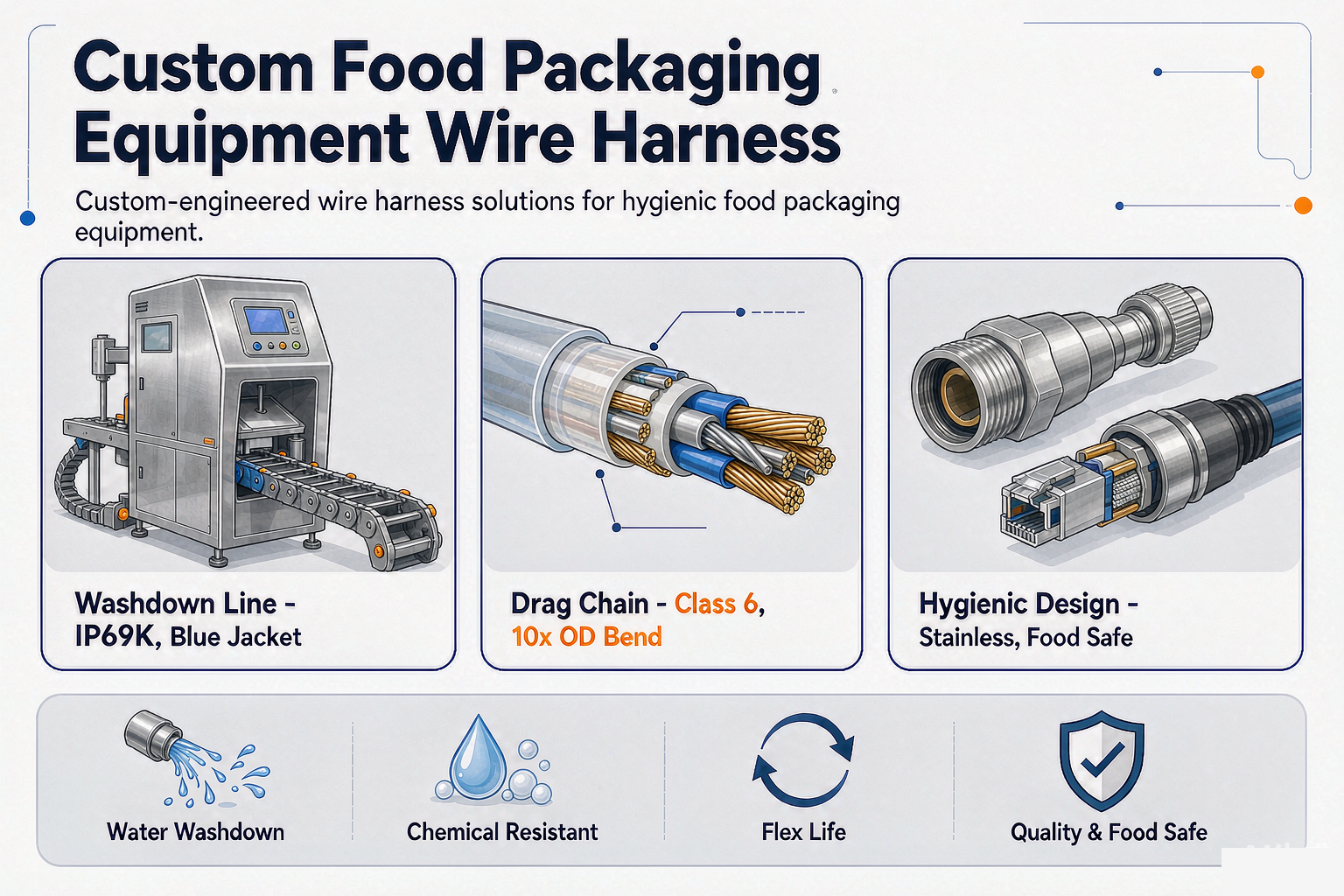
Washdown chemistry vs jacket material
This is the table we send back with almost every food packaging RFQ, because "chemical resistant jacket" without a chemical list is not a specification.
Ask your sanitation team for the actual products and concentrations used on that line. Not the category — the products, the concentration, the temperature, and the contact time. Then compare against this:
| Jacket material | Alkaline (NaOH, pH 11–13, 60–80 °C) | Acidic (nitric / phosphoric, pH 2) | Chlorinated (NaOCl, 100–200 ppm) | Peracetic acid (100–2000 ppm) | Cold flex / drag chain | Practical note |
|---|---|---|---|---|---|---|
| PVC | Poor | Poor | Poor | Poor | Fair | Cheapest and the reason we get most of our repair work. Plasticizer extraction and embrittlement. Do not put it on a packaging machine. |
| Polyurethane (PUR) | Good | Fair | Fair | Fair | Excellent | The workhorse for drag chains. Verify the specific grade — PUR formulations vary a lot in hydrolysis and hot-water resistance. |
| TPE / TPE-V | Good | Good | Fair | Good | Very good | Good balance for washdown lines. Check the hot-water and chlorine performance with the actual supplier grade. |
| Silicone | Good | Fair | Fair | Poor | Fair | Excellent temperature range and cold flex. Poor with peracetic acid and mechanically weak. Also a contamination concern in some food plants — ask before assuming it is acceptable. |
| FEP / PTFE | Excellent | Excellent | Excellent | Excellent | Poor | Chemically the answer to almost everything, and stiff, expensive, and awkward in a drag chain. Usually overbraided with stainless for abrasion. |
| XLPO / cross-linked polyolefin | Good | Good | Good | Fair | Fair to good | Common in chemical and washdown environments. Verify the flex rating before you put it in a chain. |
| ETFE | Excellent | Excellent | Excellent | Excellent | Poor | Thin-wall and tough, better flex than FEP, still not a drag chain material. Good for sensor leads in aggressive zones. |
Two things worth saying plainly.
One: the ratings above are relative, not a warranty. Every one of them depends on concentration, temperature, and contact time, and on the exact compound, not the polymer family. There are PUR grades that survive 1000 hours in peracetic acid and PUR grades that fall apart in a month. We test candidate materials by immersion at the plant's real concentration and temperature before we commit a program to them, and we keep the samples.
Two: chemical attack is not the only mechanism. A jacket can be perfectly chemically resistant and still fail because the washdown water gets in through the connector and the failure is electrical, not material. The table above tells you about the jacket. It says nothing about the connections, and the connections are where we see the most failures.
What "food safe" and "hygienic design" actually require
"Food grade" on a cable datasheet has no single legal meaning. What it usually means is that the jacket material appears in a positive list somewhere and the manufacturer has a letter on file. That is a starting point, not a compliance position.
Depending on where your machine is installed, you are probably dealing with some combination of these:
FDA 21 CFR 177.2600 for rubber articles intended for repeated use, and 21 CFR 177.1520 for olefin polymers, plus 21 CFR 178.3297 for colorants. These are the material-level bases for a US food-contact claim.
EU Regulation 1935/2004 as the framework, with EU Regulation 10/2011 for plastic materials and articles, and EU 2023/2006 for good manufacturing practice on food-contact materials.
3-A Sanitary Standards, widely specified in dairy and in US food plants generally, covering design and cleanability, not just material.
EHEDG guidelines for hygienic design and cleanability, which is where the machine-level requirement usually comes from in European plants.
EN 1672-2 for food machinery hygiene, which is what a machine builder has to satisfy and which cascades down to the components you specify.
Supplier-level requirements from the plant itself. Metal detectability, color coding, foreign object control. These are not standards but they are the ones that cause audit findings, and they cost nothing to satisfy if you know about them early.
There are a few practical requirements that come out of these, and that we build into the harness as standard when the customer tells us the machine runs in a food zone:
Blue jackets where the plant uses the blue convention. Blue is industry practice for non-food components so they are visible against food and against stainless, and so a fragment is easy to spot. If the plant specifies blue, ship blue. Do not ship black and tell them it is the same cable.
Metal-detectable components where the plant runs a metal detector or X-ray on the final product. Ties, clips, and gaskets with detectable filler. It costs a little more and it removes a whole category of foreign-object risk.
No traps, no crevices, no horizontal ledges. That is the hygienic design part, and it applies to the harness: cable routing that does not create a water-holding low point, connectors mounted so they drain, gaskets that are seated rather than squeezed.
Full material traceability. When the auditor asks for the material certificate for the cable in the food zone, you should be able to produce it against a batch number. We keep the traceability from the wire lot forward, and the document pack ships with the harness.
We are not a food safety certification body. We build to the compliant material set, keep the documentation, and tell you in the DFM where we think an auditor will look.
Continuous flex, drag chains, and torsion
This is where the money and the engineering both go, and where a lot of industrial cable is quietly not suitable.
A packaging machine with a moving carriage — a jaw assembly, a pick-place head, a film feed — routes its cable through a cable carrier (drag chain). A cable that flexes 30 times a minute, three shifts a day, five days a week is running about 2.4 million cycles a year. Standard industrial cable is not rated for that. It is rated for occasional flexing, or for static installation with a bend, and the difference is the conductor stranding and the jacket compound.
What matters, in order:
Conductor stranding class. Class 6 fine strand, or better, for anything that flexes continuously. A class 5 conductor in a drag chain will fail by strand fatigue even if the jacket survives.
Bend radius — real, not nominal. A drag-chain cable typically needs 7.5× to 10× the outer diameter for continuous flexing, and that radius has to be maintained through the whole travel, including at the chain entry and exit. Most drag-chain cable failures happen at the fixed entry point where the cable is clamped and the bend concentrates.
Jacket for abrasion. In a chain, the cable scuffs against neighbours and against the chain wall for millions of cycles. PUR is the usual answer. A jacket chosen only for chemical resistance often abrades through.
Torsion, which is not the same thing as flex. A robot arm harness that rotates ±180° per metre needs torsion-rated cable with a layered or bundled conductor construction. A flex-rated cable installed in a torsion application fails at the shield first — the shield fractures, and then the signal goes intermittent before the power fails.
Cycle life verified by test. We build the assembly and run it in a test rig at the machine's stroke, speed, and radius, and we report the cycles achieved. If a supplier tells you "10 million cycles" without telling you the radius and the speed, they are quoting a cable catalogue number, not your application.
Physical separation inside the chain. Power, servo, and network cables in the same chain need separation or at least different chain chambers. Bundling them together and zip-tying the bundle is the most common cause of EMI problems we see in packaging machines.
Here is how we translate a packaging machine's motion into a cable specification. Use it as a starting point for your RFQ, and then verify with a cycle test at your real stroke and radius:
| Motion in the machine | Conductor construction | Minimum bend radius (continuous flex) | Jacket | Cycle life to design for | Common mistake |
|---|---|---|---|---|---|
| Static routing inside the cabinet | Class 5 stranded | 4× OD once, fixed | General purpose, chemical suitability per the cleaning list | Not a flex application | Using drag-chain cable everywhere and paying for cycles you will never run |
| Occasional flex (door, panel, service access) | Class 5 stranded | 4× to 6× OD | Flexible grade with good cold performance | 10,000 – 100,000 cycles | Ignoring cold flex; the cable that flexes fine in summer cracks in a chilled packing hall |
| Drag chain, moderate cycle rate (film feed, indexing carriage) | Class 6 fine strand | 7.5× OD | PUR, abrasion-rated, chemically matched | 1 – 5 million cycles | Clamping the cable rigidly at the chain entry so the bend concentrates in one spot |
| Drag chain, high cycle rate (vertical seal jaws, high-speed HFFS) | Class 6 fine strand, bundled construction | 10× OD | PUR, high abrasion resistance | 5 – 10 million cycles | Bundling servo and network cable in the same chamber and tying them tight |
| Torsion (robot arm, rotating carriage, ±180° per m) | Torsion-rated layered construction | Per the cable's torsion spec, not a bend radius | PUR or TPE with high tear resistance | 1 – 5 million torsion cycles | Using a flex-rated cable. It fails at the shield first, and the symptom is an intermittent signal before any power fault |
| Combined flex and torsion (multi-axis pick-place head) | Torsion and flex rated, individually shielded pairs | Per cable spec, with strain relief at both ends | PUR, high tear and abrasion resistance | Program-specific; must be cycle tested | Assuming the worse of the two ratings is enough. Combined motion is a different test, and we test it combined. |
| Free-hanging cable on a moving head (no chain) | Class 6 fine strand with a supporting element if the run is long | Bend defined by the cable's own catenary | PUR, UV and chemical matched | Program-specific | Forgetting the weight. A free-hanging cable sags, and the fatigue point moves to the top clamp |
Servo, VFD, and encoder feedback wiring
Motion wiring is the family where a harness that "works" on the bench causes problems in production. Three specific issues come up over and over.
Shield termination. The correct method is a 360° clamp that bonds the shield to the machine frame or the drive housing around the full circumference, at both ends where the design calls for it. The incorrect method — which is what most harness suppliers produce by default — is a single drain wire soldered to the shield and landed on a terminal, with the rest of the shield cut off. That is a pigtail, and a pigtail is an inductor. At high frequency it does almost nothing, and the encoder noise it was supposed to prevent shows up as random position faults.
VFD cable construction. A motor cable on a PWM drive carries common-mode current on the shield. The honest solution is a VFD cable with three symmetric phase conductors plus a symmetric grounding conductor, all wrapped in an overall foil-and-braid shield, with the shield bonded at both ends. Using three separate single-core cables plus a ground wire is common practice and is also the reason some installations have bearing current problems and radiated emissions that fail EMC testing.
Encoder and feedback pairs. Encoder feedback is a low-level differential signal running alongside a switching power cable in the same machine. It needs its own shielded twisted pairs, its own route, and a defined ground reference. Where a servo cable combines power and feedback in one jacket — which is normal and fine — the pairs have to be individually shielded inside the overall shield, and the pair geometry has to survive the connector termination. We verify this with TDR on the finished assembly for higher-speed feedback.
There is also a maintenance reality to design for. On a packaging machine, the servo cable is often the first thing a technician unplugs when a joint moves. If the connector at that point is not keyed, not colour-coded, and not labelled, the machine will eventually be reassembled wrong. We add labels and keying by default on motion circuits, and we will tell you if the customer drawing does not allow for it.
Safety circuits and the directives behind them
A packaging machine harness includes the safety circuits, and the safety circuits carry legal weight. Getting them wrong is not a quality issue.
The requirements a machine builder is usually working to:
EN ISO 13849-1 for the performance level of safety-related control systems — PL d or PL e for a packaging machine with a guard door or a light curtain, depending on the risk assessment.
EN ISO 13849-2 for the validation, which is where documentation of the actual wiring matters.
EN 62061 / IEC 61508 for SIL-rated machinery, and IEC 61511 in process contexts.
EN 60204-1 for the electrical equipment of machines — conductor colours, protective bonding, emergency stop implementation, and the requirement that safety circuits are not defeated by a single fault.
EN 1672-2 for hygiene on food machinery, which ties the electrical design back to the cleanability requirements.
EU Machinery Regulation 2023/1230, which replaced the Machinery Directive for new machines placed on the EU market, with the same core safety objectives and updated conformity procedures.
What that means at the harness level, and what we build:
Redundant channels kept physically separate. Two safety channels routed in the same jacket is acceptable if they are separately insulated and separately identified. Two channels sharing a connector pin block is a single point of failure. We flag it in the DFM if the drawing does it.
Identifiable safety conductors. Consistent colour or marking, so a technician can see which circuits are safety-related without reading the drawing. Most plants have their own convention; we follow it.
Protective bonding verified by measurement. Bonding continuity from every conductive enclosure and every accessible metal part back to the PE termination. Measured on every assembly, recorded, shipped with the unit.
E-stop circuits wired for the applicable category, not "as convenient." Normally-closed circuits, and no safety circuit routed through a connector that a maintenance technician can unplug to "test something."
Documentation that survives an audit. Test records for continuity, insulation, and bonding, traceable to a batch and an operator. When the auditor or the notified body asks how you validated the safety wiring, this is the answer.
Ethernet and IO-Link on a packaging line
Modern packaging lines are networked all the way down to the sensor, and this is where the intermittent faults live. A network fault on a packaging line usually gets blamed on the controller for two weeks before somebody looks at the cable.
EtherCAT, PROFINET, EtherNet/IP, Powerlink, SERCOS. Different protocols, different cable requirements. A cable that works for 100BASE-TX general Ethernet may not meet the return-loss and impedance requirements of a deterministic protocol running at 100 Mbit/s with tight cycle times. Specify the cable against the protocol, not against "Ethernet."
Connector coding. M12 X-coded for Gigabit Ethernet, D-coded for Fast Ethernet, A-coded for IO-Link and sensors, B-coded legacy. A D-coded cable plugged into an A-coded socket is a problem you will diagnose eventually. Colour and coding discipline prevents it.
IO-Link (IEC 61131-9). Point-to-point, 24 V, up to 230.4 kbit/s, unshielded cable is allowed up to 20 m per the specification — and this is exactly why IO-Link is popular and also why plants deploy it with ordinary sensor cable and then wonder why device parameter downloads fail at 20 m in an electrically noisy cabinet. We use IO-Link-specified cable with the correct conductor cross-section regardless of whether unshielded is permitted.
Single Pair Ethernet. Coming into packaging machines now — one pair, power and data over the same cable (PoDL), much lighter and much easier to route through a joint. If you are designing a new machine, this is worth a conversation, because the harness architecture changes substantially.
Routing discipline. Network cable must not share a chain chamber with motor cable, and it must not run parallel to a VFD output for metres. Where it must cross, cross at right angles.
Verification. We do continuity and pair mapping on every network assembly, and TDR or a certification test on assemblies where the customer specifies it. A network assembly that passes continuity and fails impedance is the single most expensive kind of harness to debug in the field.
Connectors for a washdown environment
Two rules. First, an IP69K rating on a connector is only valid in the mated state with the correct mating half. Second, the cable entry is where water gets in, in almost every failure we tear down.
| Connector family | Typical use on a packaging machine | Rating achieved in practice | What to watch |
|---|---|---|---|
| M8 / M12 circular (A, B, D, X coded) | Sensors, actuators, IO-Link devices, network drops | IP67 to IP69K with the right shell and the right grade | Over-torquing the coupling nut cracks the insert. Specify a torque and use a torque wrench. Also check the mating half's rating — a washdown-rated plug into a standard socket is an IP67 system at best. |
| M12 stainless steel shell (V4A / 316L) | Product-contact zones, washdown-heavy lines | IP69K, and it survives the cleaning chemistry | The shell is stainless and the insert gasket is the weak point. Confirm the gasket material against your chemical list. |
| M23 / M40 servo connectors | Servo motor power and feedback | IP67 typical; IP69K with the right shell | Pin alignment during assembly. A bent pin in a 17-pin M23 is a repair, not an adjustment. Also: the shield must land on the shell, not on a floating contact. |
| Heavy-duty rectangular hoods (Han® style, 6B to 24B) | Panel interfaces, motor connections, multi-circuit bulkheads | IP65 to IP69K depending on the hood, seal, and cable gland | The gland is the sealing element, not the hood. A correctly sized gland on an incorrectly sized cable cannot seal, and that combination causes a lot of failures. Match the gland to the actual cable diameter. |
| 7/8" mini and Brad Harrison style | Legacy packaging equipment, motor and valve banks | IP67 typical | Still very common in North American plants. Keep spares, and be careful with the "equivalent" parts — keyway and contact arrangements differ between manufacturers. |
| Industrial RJ45 in a sealed shell | HMI and cabinet network interfaces | IP67 with the correct shell, IP20 without | A standard RJ45 in an open bulkhead in a washdown zone is an IP20 part. That is the failure. Use a sealed shell or use M12 X-coded. |
| Push-pull and bayonet circular connectors | Quick-change tooling, removable carriages | IP67 to IP69K in the mated state | Convenience is the point, and it is also the risk. Verify the latch holds under washdown and vibration, and make sure the connector cannot be mated in the wrong orientation. |
One more thing about sealing that costs almost nothing: the cable must enter the connector from above, or the connector must be mounted so it drains, or both. Water in a horizontal cable entry does not need to defeat the gasket to cause a failure — it just needs to sit there until the seal ages.
How we build and test a packaging harness
The process is not exotic. The discipline is in the sequence, and in the tests that we treat as mandatory rather than optional.
DFM review against the drawing, the cleaning chemistry, the flex cycle count, and the food zone. We check conductor sizing, jacket material against the chemical list, drag-chain bend radius, shield termination method, and safety circuit separation. Two working days, no charge. We do this whether or not we win the order.
Materials selected and locked with certificates on file. Wire lot, connector batch, gasket and seal material, food-contact documentation where applicable. Logged against the program, retained for the life of the program plus the audit period.
Cut, strip, and crimp on calibrated tooling. Crimp height records per lot. Closed-barrel crimps on every high-current termination. No hand-crimped power terminations, ever.
Pull force on every high-current and safety-critical termination. Not a sample. Thirty seconds per terminal, and it catches the one crimp that would have caused a line stoppage.
Shield termination verified by inspection, and by measurement on network and feedback circuits. 360° clamp or documented single-end drain, per the customer's EMC plan.
Assembly with sealing integrity checked as it is built. Gaskets seated, cable glands matched to the actual cable diameter, boots correctly oriented, no seal pushed out by an over-torqued shell.
100 % electrical test. Continuity and polarity, insulation resistance, hipot on power circuits, protective bonding continuity measured on every assembly. TDR on impedance-controlled pairs where specified.
Program validation. Chemical immersion of candidate materials at the plant's real concentration and temperature. Drag-chain cycle testing at the machine's real stroke and radius. Thermal cycling with the CIP and freezer extremes. IP test in the mounted orientation. Cycle test on the strain relief.
Document pack with the shipment. Test records, material certificates, traceability map, and the food-contact documentation where applicable, keyed to the batch.
| Test | What it catches | Applied to | Frequency | Acceptance |
|---|---|---|---|---|
| Continuity and polarity | Wrong pin, missing wire, swapped pair, mislabelled circuit | Every assembly | 100 % | Per customer drawing |
| Hipot / dielectric withstand | Insulation defects, contamination, creepage problems | Power and control conductors vs PE | 100 % | Per EN 60204-1 or the program-specific value |
| Insulation resistance | Moisture ingress, marginal insulation, damaged jacket | Power path and sensor circuits | 100 % | Program-specific, typically ≥ 20 MΩ at 500 V DC |
| Protective bonding continuity | High-impedance PE path, unbonded enclosure, bad shield termination | Enclosures, panels, shields, PE termination | 100 % | Below the program limit, measured and recorded |
| Pull force on crimps | Under-crimped or wrong-die terminations | High-current, safety, and control terminals | 100 % on high-current and safety circuits | Per terminal and wire combination, per the relevant standard |
| Chemical immersion of jacket and gasket materials | Jacket swelling, embrittlement, plasticizer extraction, seal attack | Candidate materials for the program | Per program, and on any material change | No significant dimensional change, no hardness shift, no cracking; dielectric test passes after immersion |
| Drag-chain cycle test | Strand fatigue, shield fracture, jacket abrasion at the chain entry | Moving carriage and jaw assembly cables | Design verification, at the machine's stroke and speed | Cycles achieved reported against the program requirement, with a documented margin |
| Torsion cycle test | Shield fracture, conductor fatigue in robot arm harnesses | Palletizer and robot arm assemblies | Design verification | Cycles achieved against requirement, no shield discontinuity |
| IP / washdown test in the mounted orientation | Water ingress at the connector, gland, and cable entry | Assembled harness as installed | Design verification and after any mechanical change | Rated IP level, tested in the orientation the machine installs it in |
| Thermal cycling with current applied | Termination relaxation, seal compression set, ampacity errors | Power and heater circuits | Design verification | No termination above the program limit; no resistance drift outside the window |
| TDR / impedance verification on data pairs | Untwisted splice sections, impedance discontinuities, wrong cable category | EtherCAT, PROFINET, EtherNet/IP, encoder feedback | 100 % where specified, otherwise design verification | Impedance and return loss within the protocol window across the full length |
| Metal-detectable component verification | Non-detectable ties or clips in a product zone | Components used inside the food zone | Per material lot | Detected by the customer's detector at the specified aperture and sensitivity |
The hipot and continuity testers are calibrated monthly, and the records are retained. Every test above generates a record that ships with the harness, with the operator identified. Not because our customers are difficult, but because when a line goes down at 2 a.m. on a Sunday, the difference between a one-day fix and a three-week argument is whether the data exists.
Failures we fix from other suppliers
These are patterns from harnesses that were returned, replaced, or pulled out of a packaging line in the last few years.
Jacket swollen to 1.4× diameter in eight months. The Dutch cheese plant case. A general-purpose industrial cable in a twice-daily foam-and-rinse cycle with an alkaline cleaner. The compound was not chemically suitable at that concentration and temperature. Fixed with a TPE jacket validated by immersion at the plant's actual cleaner, concentration, and temperature.
"Food grade, blue" that arrived black. The supplier substituted a standard industrial part without telling anyone. The plant failed an audit. Fixed by specifying the material with a certificate requirement and putting the colour in the drawing as a controlled characteristic, not a note.
M12 shells corroded inside. Stainless-rated connectors on the outside, a standard insert gasket on the inside, exposed to a chlorinated foam. Fixed with a gasket material selected against the chemical list and a torque spec for the coupling nut.
Drag chain cable failing at 1.2 million cycles. The cable was rated for "continuous flex" but was a class 5 conductor bundle with a jacket selected for chemical resistance and not for abrasion. It failed at the chain entry where the bend concentrated. Fixed with class 6 stranding, a PUR jacket, and a corrected clamping arrangement that spread the bend.
Shield terminated with a pigtail on a servo cable. Encoder position faults at random intervals, blamed on the drive for three weeks. Fixed by re-terminating with a 360° clamp at both ends. Cost of the fix: a connector backshell and an hour of labour.
Heater and thermocouple cable bundled together. Sealing temperature read stable on the bench and drifted up to 40 °C on the machine, which caused seal quality problems that took months to diagnose. Fixed by separating the sensor pair from the heater conductors and re-routing.
Network cable sharing a chain chamber with motor cable. Intermittent PROFINET dropouts that always cleared on a restart. Fixed by separating the chambers and re-terminating the shield. This is one of the most common issues we see in packaging machines and one of the cheapest to prevent at the design stage.
Standard RJ45 bulkhead inside a washdown zone. Passed IP when new and filled with water in the first month. Fixed by going to M12 X-coded through a sealed panel feed-through.
Safety channels sharing one connector pin block. A single water ingress point took out both redundant channels simultaneously, which is exactly what EN ISO 13849 is designed to prevent. Fixed with separate connectors and physically separated routing.
No service loop at the panel interface. A technician pulled the control board out during a weekend repair and tore two conductors out of a connector. Nobody could tell which, and the machine ran for a shift with a fault that appeared only at full speed. Fixed with a service loop long enough to open the panel without disconnecting.
Cable gland the wrong size for the cable. The hood was IP69K, the gland was correctly installed, and it could not seal because the cable diameter was 2 mm under the gland's range. Fixed by matching the gland to the measured cable diameter.
Not one of those eleven is exotic. Every one of them is a decision made by someone moving fast, and every one was more expensive to fix than to prevent. That is the whole case for spending real attention on a packaging machine harness at the drawing stage.
RFQ spec template
If you are putting a food packaging harness out to quote, this is what lets us give you a real number instead of a placeholder with a contingency built in.
| Item | What to send | Why we need it |
|---|---|---|
| Machine type and function | VFFS / HFFS / thermoformer / tray sealer / cartoner / filler / labeller / palletizer, plus the functions the harness serves | Sets the whole architecture: flex requirements, current levels, protocol, connector families |
| Drawing or schematic | PDF or native CAD, all connectors labelled, all circuits identified, panel layout if available | Source of truth for wire count, gauge, and routing |
| Cleaning chemistry — the real list | Product names, active ingredients, concentrations, temperatures, contact times, and washdown frequency | The single most valuable line in the RFQ. "Chemical resistant" without this is not a specification, and the jacket decision depends entirely on it. |
| Food zone classification | Which circuits are in the product-contact zone, which are in a splash zone, which are dry. Colour convention, metal-detectable requirement, hygienic design standard the plant follows | Drives material selection, colours, detectable components, and the documentation pack. Getting this wrong is what causes audit findings. |
| Motion profile | Which harnesses are in drag chains, stroke length, speed, cycles per shift, bend radius available, torsion if any | A cable flexed 30 times a minute runs 2.4 million cycles a year. The cycle life target and the conductor class come from this. |
| Electrical data | Voltages, currents, drive types, motor ratings, protocol (EtherCAT / PROFINET / EtherNet/IP / IO-Link), safety PL or SIL required | Conductor sizing, shielding approach, cable category, and the safety circuit construction |
| Connector BOM | Exact part numbers, manufacturer, mating half, coding, sealing class, stainless or plated shell | Lead time on stainless and specialist connectors is usually the long pole. "M12 equivalent" is not a part number. |
| Environment and mounting | Ambient temperature range, humidity, CIP temperature, freezer exposure, mounting orientation, drain path | Cable entry direction and gasket material. Water pooling is a mounting problem as much as a sealing problem. |
| Environmental and validation test requirements | IP level and orientation, chemical immersion, drag-chain cycle target, thermal cycling range, EMC, bonding limits | Each of these is a cost line. Send the list so the quote reflects it instead of discovering it after the PO. |
| Quantity and schedule | Prototype and sample quantity, sample date, annual volume, program life, spares requirement | Volume drives material buy, tooling amortization, and how we plan the line |
| Documentation and certification requirements | Material certificates, food-contact declarations, ISO 9001 or IATF 16949, EHEDG or 3-A references, traceability level, test reports | The document pack is part of the cost and part of your audit defence. Tell us the level up front. |
| Known problems with the current part | Field failures, return rate, photos of the failed area, service life achieved, batch numbers if available | If you are replacing a supplier, this is the most valuable thing in the RFQ. Tell us what broke and where. |
Send it to our RFQ inbox. You will get a one-page DFM and a quote back, normally within 48 hours, and the DFM will tell you where we think the risk is even when that costs us the order.
Why work with us
We are a custom wire harness and cable assembly factory in Xiamen. We build for industrial automation, medical, energy, automotive, audio, and outdoor equipment customers, and food packaging machines are one of the categories we know best because the failures are so specific.
What you get:
DFM review in 48 hours, free, every program. Including the ones we do not win. If your jacket material will not survive the cleaning chemistry on the line, we will tell you before you order the cable.
Material validation, not material claims. We immersion-test candidate jackets and gaskets at your plant's real cleaner, concentration, and temperature, and we keep the samples and the results. That test is the difference between a datasheet and a documented position you can show an auditor.
5-day ECO turnaround. Connector change, jacket change, colour change, label change. Five working days, or an explanation of exactly what is holding it up.
Drag-chain and torsion cycle testing at your machine's profile. Stroke, speed, and radius from your drawing, cycles reported against your requirement, with margin documented.
Food zone support. Blue jacket convention, metal-detectable ties and clips, hygienic routing, and the material documentation to back it up. We will also tell you if a requirement is unnecessary for your application, because over-specifying a machine is a real cost with no safety benefit.
100 % electrical test, 100 % pull force on high-current and safety terminations, 100 % bonding continuity measurement. Full test records and traceability with every shipment.
Multi-variant BOM management. Packaging machines ship in regional variants and voltage variants. We hold the variant matrix — connector, cable category, colour, label — and ship the right harness for the right machine. No universal harness and a field-fix instruction.
Low-volume friendly. MOQ for a new program is 100 pcs. Prototype and pilot batches of 10 to 50 pcs are routine, including for machine builders doing one-off specials and retrofits.
One project engineer, one account manager. The same people answer the phone when you call in six months. You will not re-explain the line to a new contact every quarter.
We will not be the cheapest supplier you talk to. We will be the one whose harness is still on the machine after the third year of three-shift washdown, and whose documentation answers the question when the auditor asks for the material certificate.
Frequently Asked Questions
Q1: What is the minimum order quantity for a custom food packaging equipment wire harness?
For a new program, MOQ is 100 pcs. For an existing program with a frozen build, we produce to your forecast with no MOQ on re-orders, and we have shipped repeat batches of 20 pcs. Prototype and retrofit batches of 10 to 50 pcs are routine, which matters if you are a machine builder shipping one-off specials.
Q2: Can you supply harnesses that meet food-contact material requirements?
Yes, at the material level. We build with jackets, gaskets, and components whose materials appear in the applicable positive lists — FDA 21 CFR 177.2600 and 177.1520 for US applications, EU 1935/2004 and EU 10/2011 for European applications — and we ship the material documentation with the harness. We are not a food safety certification body and we do not certify a machine. What we do is give you the documented material position your auditor will ask for, and tell you honestly where we think the gaps are.
Q3: How do you determine the right jacket for our cleaning chemistry?
We ask for the actual products, concentrations, temperatures, and contact times from your sanitation team — not the category. Then we immersion-test candidate materials at those conditions before we commit a program to them, and we keep the samples and results on file. A generic "chemical resistant" claim is not enough, because there are polyurethane grades that survive 1000 hours in peracetic acid and polyurethane grades that fail in a month. The compound matters, not the polymer family.
Q4: What flex life can you actually deliver for a drag chain application?
It depends on stroke length, speed, bend radius, and cable construction, and we will not quote a number without those four. What we do is build the assembly and run it in a test rig at your machine's profile, then report the cycles achieved against your target with the margin documented. As a rough guide, class 6 fine-strand conductor with a properly selected drag-chain jacket is the starting point for anything above a million cycles a year — and the failures we see are almost always at the clamped chain entry, not in the middle of the travel, so the clamping arrangement is part of the design.
Q5: Do you build harnesses for EtherCAT, PROFINET, and IO-Link?
Yes, and we treat them as three different specifications rather than one "Ethernet" category, because the impedance and return-loss requirements differ. We use impedance-controlled cable specified for the protocol, maintain pair geometry through the connector termination, keep network cable out of the same chain chamber as motor cable, and TDR-verify assemblies where the customer specifies it. IO-Link is point-to-point and the standard permits unshielded cable at some lengths — we use IO-Link-specified cable by default anyway, because the plants that deploy it with ordinary sensor cable are the ones that call us later.
Q6: Can you build the safety circuits, and what documentation do you provide?
Yes. We keep redundant safety channels separately insulated and separately identified, follow the plant's colour convention, wire E-stop circuits per the applicable category, and measure protective bonding continuity on 100 % of assemblies. Documentation is continuity, insulation resistance, hipot, and bonding measurements with test records traceable to a batch and an operator — which is the evidence your notified body or auditor asks for when they validate the safety wiring against EN ISO 13849-2 and EN 60204-1.
Q7: Can you take over a harness that is failing on a production line?
Yes, and a good share of our packaging work started that way. Send us failed units, the current drawing if you have it, and a description of the failures including where they occur and under what conditions — after a wash, after a maintenance visit, at full speed, at a specific carriage position. We do a tear-down report, identify the root cause, and propose a corrected design. Typical timeline is two to three weeks from sample receipt to the first batch of the fixed harness. We will also tell you if the failure is not in the harness — sometimes it is the routing, the chain, the gland sizing, or a maintenance practice, and it is cheaper for you to hear that from us early.
Start Your Food Packaging Harness Project
Send us the drawing, the connector BOM, the cleaning chemistry, the flex profile, and the volume you need. We will come back with a DFM and a quote, normally within 48 hours. If you do not have a drawing yet, send us the machine type, the functions the harness serves, the sanitation products used on that line, and a few photos of the routing. We will help you scope the harness and the validation plan before you spend money on a design that has to be redone.
Email: [sales5@xmkehan.com]
Typical response time: 24 hours, Monday to Friday
SEO Keywords: custom food packaging equipment wire harness, food packaging machine wiring harness, food grade wire harness manufacturer, washdown cable assembly, IP69K cable assembly, hygienic design wire harness, HACCP compliant harness supplier, FDA 21 CFR 177 cable, EU 1935/2004 cable assembly, 3-A sanitary cable assembly, EHEDG hygienic cable, blue food industry cable jacket, metal detectable cable tie, drag chain cable assembly, continuous flex cable harness, torsion rated robot harness, servo cable assembly, VFD cable assembly, encoder feedback cable, M12 stainless steel connector harness, IP69K M12 cable, Han connector harness assembly, M23 servo connector harness, IO-Link cable assembly, EtherCAT cable assembly, PROFINET cable assembly, EtherNet/IP harness, single pair Ethernet harness, EN ISO 13849 safety harness, EN 60204-1 machine wiring, VFFS machine wire harness, thermoformer wiring harness, tray sealer cable assembly, cartoner wiring harness, palletizer robot cable assembly, checkweigher cable assembly, X-ray inspection machine harness, peracetic acid resistant cable, chemical resistant cable jacket, food packaging harness manufacturer China, custom harness 100 pcs MOQ, ISO 9001 wire harness supplier, Xiamen wire harness factory.