


Wire Harness Testing & Inspection: How We Ensure Every Harness Ships Flawless
2026-05-22 16:21Wire Harness Testing & Inspection: How We Ensure Every Harness Ships Flawless
A behind-the-scenes look at our testing equipment, inspection workflow, and why 100% manual inspection is non-negotiable for custom wire harnesses
✔ 100% Electrical Test on Every Unit | ✔ Full Manual Visual Inspection | ✔ Crimp Pull-Force Verified | ✔ ISO 9001:2015 Certified Lab
 Table of Contents
Why Testing Is the Difference Between a Good Harness Supplier and a Great One
The Human Element: Why 100% Manual Visual Inspection Matters
1. Why Testing Is the Difference Between a Good Harness Supplier and a Great One
Anyone can cut wire and crimp terminals. What separates a serious wire harness manufacturer from a low-cost assembler is what happens after assembly — the testing and inspection process.
Think about it: a single missed defect in a wire harness can cause:
A payment terminal that fails during a customer transaction
A vending machine that goes dark in a high-traffic location
An industrial control panel that triggers an expensive service call
A home appliance that fails safety certification, delaying your product launch by months
These failures don't just cost money — they erode your brand reputation with every field return. That's why we invest heavily in testing equipment, operator training, and a zero-shortcut culture where every single harness that leaves our factory has been electrically tested and visually inspected by a trained technician. No sampling. No exceptions.
What most buyers don't realize: Many low-cost harness suppliers perform electrical testing on only 5–10% of units ("spot checking"). At 10,000 units per order, that means up to 9,000 harnesses leave the factory untested. When we say 100% testing, we mean it — and we have the test logs to prove it.
2. The 6 Types of Tests Every Wire Harness Should Pass
Wire harness testing isn't one thing — it's a layered quality assurance system. Here are the six test categories we apply to every harness project, with the specific equipment and pass/fail criteria for each:
| Test Type | What It Detects | Equipment Used | Pass Criteria |
|---|---|---|---|
| 1. Continuity Test | Open circuits, broken wires, miswired pins | Automated continuity tester (programmable pin mapping) | Resistance ≤ 1Ω per circuit; 100% pin-to-pin match against netlist |
| 2. Hi-Pot (Dielectric Withstand) Test | Insulation breakdown, pin-to-pin shorts, pin-to-shield leakage | AC/DC hi-pot tester (up to 5kV AC / 6kV DC) | Leakage current < 0.5mA at rated test voltage × 1.5 for 1 second minimum |
| 3. Insulation Resistance Test | Insulation degradation, moisture ingress, contamination | Megohmmeter / IR tester (500V DC) | IR ≥ 100 MΩ between all non-connected circuits |
| 4. Crimp Pull-Force Test | Weak crimps, wrong terminal size, deformed crimp wings | Digital force gauge with terminal-specific fixtures | Pull force ≥ UL 486A minimum for wire gauge (e.g., ≥ 8 lbs for AWG 22) |
| 5. Crimp Cross-Section Analysis | Internal crimp barrel deformation, strand compression %, bellmouth geometry | Digital microscope with measurement software (200× magnification) | Per IPC/WHMA-A-620 Class 2 criteria: compression 10–25%, bellmouth within spec |
| 6. Visual Inspection (100% Manual) | Missing labels, damaged insulation, incorrect routing, connector seating, foreign material | Trained human inspector under 1000-lux workstation lighting | IPC/WHMA-A-620 Class 2 visual acceptance criteria; 100% of units inspected |
3. Our Testing Equipment Arsenal
We don't outsource testing — our in-house lab is equipped to handle every test protocol required by commercial, industrial, and medical device customers. Here is the equipment we run daily:
| Equipment | Make / Model | Capability | Applications |
|---|---|---|---|
| Programmable Harness Tester | DIT-MCO / Cirris CH2 / adapted equivalent | Up to 512 test points; programmable netlist import from CAD; auto-learn mode for reverse engineering | Continuity, shorts, opens, miswires on complex multi-connector harnesses |
| AC/DC Hi-Pot Tester | Chroma 19052 / SCI equivalents | 0–5kV AC, 0–6kV DC; programmable ramp, dwell, and discharge; arc detection | Dielectric withstand for power harnesses, motor cables, high-voltage BESS interconnects |
| Digital Force Gauge | Mark-10 Series 5 / equivalent | 0–500 N range; 0.1 N resolution; terminal-specific grip fixtures for AWG 28–10 | Crimp pull-force verification per UL 486A / IPC/WHMA-A-620 |
| Digital Microscope | Keyence VHX / Dino-Lite AM7915MZT | 20–200× optical zoom; on-screen measurement; image capture and archiving | Crimp cross-section analysis; terminal deformation inspection; strand count verification |
| Insulation Resistance Tester | Fluke 1507 / equivalent | 50V/100V/250V/500V/1000V test voltages; 0.01 MΩ–10 GΩ range | Insulation quality verification; moisture contamination check; pre-hi-pot screening |
| Caliper & Micrometer Set | Mitutoyo digital series | 0.01 mm resolution; external, internal, depth, and step measurement | Wire gauge verification; terminal dimension check; insulation OD confirmation |
We calibrate all test equipment every 6 months against traceable standards. Calibration certificates are available to customers upon request. If your project requires specific test protocols (customer-defined test voltages, custom pin mapping, sequential test scripts), our engineering team can program test fixtures to your exact specification.
4. The Human Element: Why 100% Manual Visual Inspection Matters
Automated testers can verify electrical continuity and insulation resistance, but they cannot detect:
A label that is partially peeled and will fall off during shipping
A connector with slight housing flash that will cause intermittent seating
Insulation nicks too shallow to fail hi-pot today, but deep enough to propagate into a short after vibration
Routing errors where wires exit a branch point in the wrong order, causing fitment issues during installation
Foreign material (dust, wire strands, insulation fragments) trapped inside connector housings
This is why every single harness that leaves our factory is visually inspected by a trained technician under controlled lighting conditions. Visual inspection is not a sampling step — it is a mandatory, documented, 100% gate before packaging.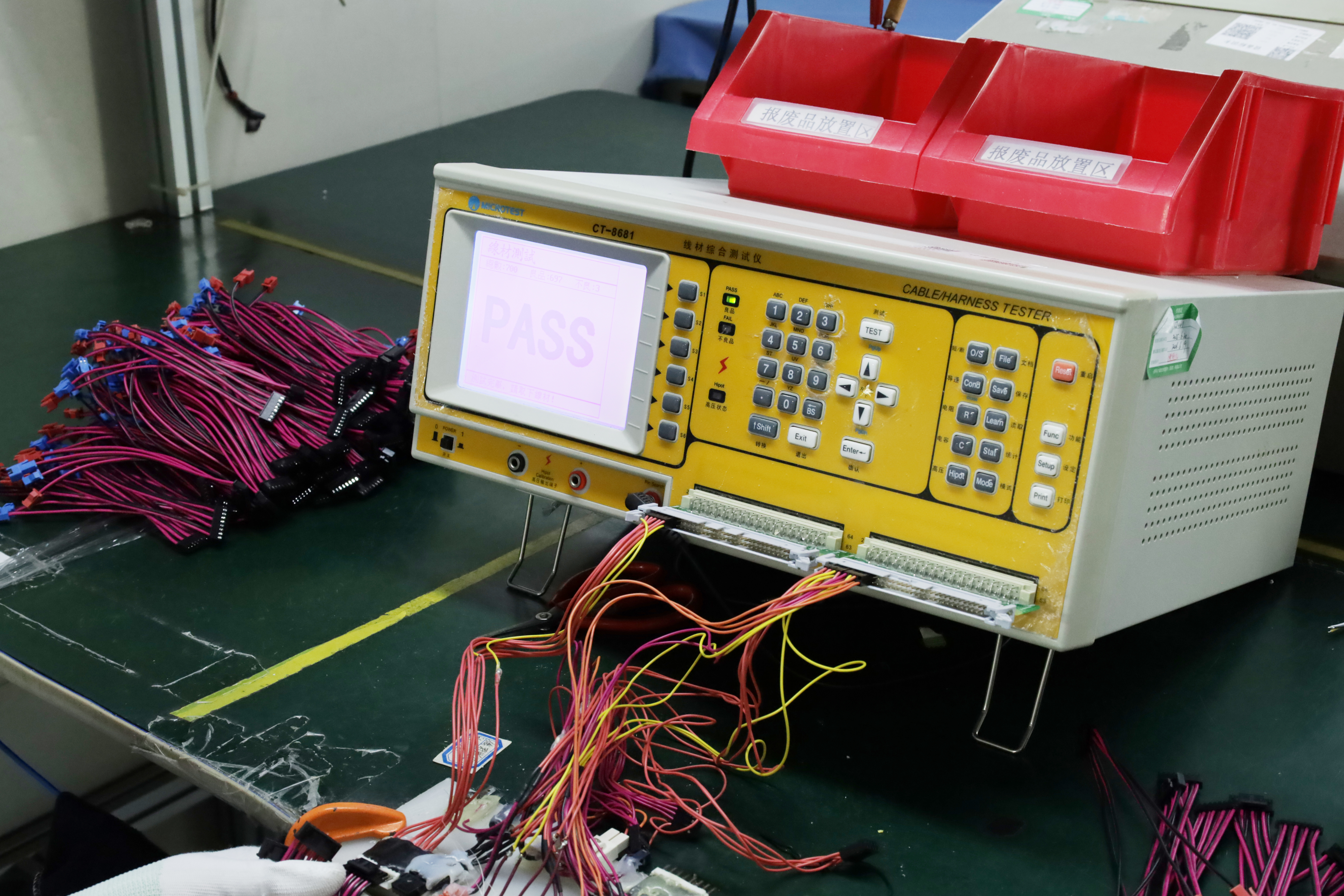
Our Visual Inspection Checklist
| # | Inspection Point | Acceptance Criteria | Defect If |
|---|---|---|---|
| 1 | Wire routing & breakout locations | Match drawing ± 5 mm on breakout position; correct branch sequence | Routing out of drawing sequence; breakout position deviation > 5 mm |
| 2 | Connector engagement | Terminals fully seated; connector lock tab engaged; no gap at mating face | Backed-out terminal; partially seated connector; lock tab not engaged |
| 3 | Insulation condition | No cuts, nicks, abrasions, or kinks anywhere along wire length | Any visible insulation damage regardless of depth |
| 4 | Crimp barrel appearance | Wing fully formed; conductor visible at inspection window; no bellmouth exceeding spec | Unformed wing; no conductor in window; insulation in crimp barrel; excessive bellmouth |
| 5 | Labeling & marking | Labels present, legible, correctly positioned per drawing; no peeling edges | Missing label; illegible print; wrong label content; peeling or wrinkled label |
| 6 | Protective sleeving | Conduit/tubing fully seated at both ends; no kinks or collapse; correct material per BOM | Conduit short of connector backshell; kinked or collapsed sleeving; wrong material type |
| 7 | Solder joint appearance (if applicable) | Shiny, smooth fillet; no cold joint; no bridging; heat shrink fully covering joint area | Dull/grainy solder (cold joint); solder bridge; exposed joint area |
| 8 | Cleanliness | No foreign material, flux residue, wire clippings, or dust on any part of the harness | Any visible contamination |
| 9 | Dimensions | Overall length and branch lengths match drawing ± tolerance (typically ± 10 mm standard) | Any dimension outside drawing tolerance |
An inspector who finds a defect marks the harness with a red reject tag, logs the defect type in our quality database, and routes the unit to rework. No harness proceeds to packaging until it has a signed-off green tag from both electrical test and visual inspection.
5. Our End-to-End Testing Workflow
Here is exactly what happens to every harness after assembly:
| Step | Process | Who Performs | Time (Typical) | Output |
|---|---|---|---|---|
| 1 | Assembly Completion Harness is completed per work instruction and traveler | Assembly operator | — | Completed harness + traveler document |
| 2 | 100% Continuity Test Harness is connected to continuity tester; all circuits verified against netlist | Test operator | 30–90 sec | Pass/Fail stamp on traveler; test log entry with timestamp |
| 3 | Hi-Pot Test (if required) Dielectric withstand test at specified voltage; all pin groups tested per test specification | Test operator | 1–3 min | Pass/Fail stamp on traveler; hi-pot test report |
| 4 | 100% Manual Visual Inspection Inspector checks all 9 inspection points under 1000-lux light | QC inspector | 2–5 min | Visual inspection checklist (signed); green tag or red reject tag |
| 5 | Crimp Pull-Force Test (sampled) 1 unit per tooling setup change or every 200 pcs; pull-force measured on all terminal sizes used | QC inspector | 5–10 min/batch | Pull-force test report with force readings per terminal |
| 6 | Crimp Cross-Section (sampled) 1 cross-section cut per terminal type per production run (or per customer requirement) | QC lab technician | 15–20 min/batch | Micrograph image with measurements; archived for 5 years |
| 7 | Final QC Gate All test reports reviewed; traveler signed off; harness cleared for packaging | QC supervisor | 1–2 min/order | Final release stamp on traveler; harness moves to packaging |
 Every test result is linked to a unique serial number or lot number. If you ever need to trace a harness back to its test records, we can pull up the continuity log, hi-pot report, visual inspection checklist, and crimp cross-section image for that exact unit or production batch. Records are retained for a minimum of 5 years.
6. Crimp Quality: The Most Overlooked Failure Point
Ask any field failure analysis engineer what the #1 cause of wire harness failures is, and they'll tell you: bad crimps. A crimp that looks fine from the outside can have internal defects that only a cross-section reveals:
Under-compression (< 10% strand deformation): Terminals loosen over thermal cycling, causing intermittent opens
Over-compression (> 25% strand deformation): Strands are crushed and weakened, creating a fracture risk under vibration
Insulation in crimp barrel: The insulation wing was set too deep, piercing the conductor wing and reducing current-carrying strands
Excessive bellmouth: The crimp barrel flares too much at the wire entry, creating a stress concentration point where strands will eventually break
Our Crimp Quality Protocol
| Control Point | Frequency | Method | Acceptance Standard |
|---|---|---|---|
| Tooling Setup Verification | Every tooling change or shift start | Crimp height micrometer + pull-force test on 5 samples | Crimp height within ±0.05 mm of qualified setting; pull force ≥ UL 486A minimum |
| In-Process Pull-Force | Every 200 pieces (or per customer spec) | Digital force gauge; 1 sample per terminal type in use | ≥ UL 486A minimum for that wire gauge |
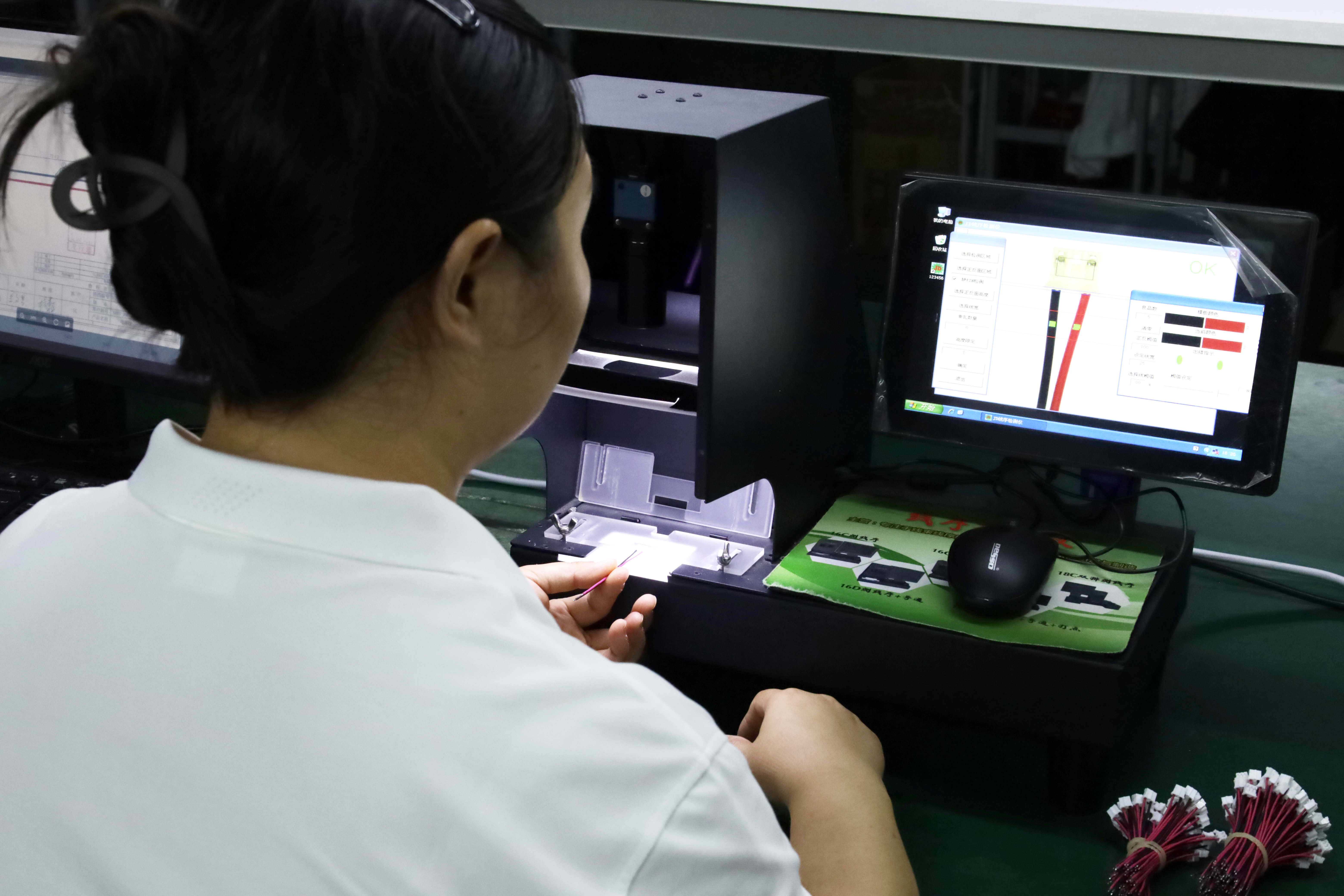
| Crimp Cross-Section | First article of new production run; then 1 per shift per terminal type | Digital microscope at 50–200×; cut, polish, image, measure | IPC/WHMA-A-620 Class 2: compression 10–25%; strands fully within crimp barrel; bellmouth within spec |
| Operator Visual Check | Every piece (100%) | Visual check: conductor visible in inspection window; insulation wing properly set; no deformed wings | Every crimp visually conformant before harness moves to test |
7. Quality Standards We Test Against
Our testing and inspection protocols are aligned with internationally recognized wire harness standards. Here is what we test to, depending on your product requirements:
| Standard | Scope | Key Requirements We Test To |
|---|---|---|
| IPC/WHMA-A-620 | Requirements and Acceptance for Cable and Wire Harness Assemblies (the global benchmark) | Class 2 (commercial/industrial) as standard; Class 3 (high-reliability) available for medical/aerospace customers |
| UL 486A / UL 486B | Wire connectors and soldering lugs for copper conductors | Pull-force minimums for each wire gauge (e.g., AWG 22 ≥ 8 lbs, AWG 18 ≥ 10 lbs, AWG 14 ≥ 15 lbs) |
| IEC 60512 | Connectors for electronic equipment — tests and measurements | Contact resistance, insulation resistance, voltage proof (hi-pot) test parameters |
| ISO 9001:2015 | Quality management systems — requirements | Our factory QMS is ISO 9001:2015 certified; documented control plans, CAPA process, and management review |
| RoHS / REACH | Restriction of hazardous substances; Registration, Evaluation, Authorisation of Chemicals | Material declarations and compliance reports available for all product families; incoming material certificates verified |
8. What Our Test Data Looks Like
We believe in transparency. Here are our actual quality metrics from recent production runs:
| Quality Metric | Our Performance | Industry Benchmark |
|---|---|---|
| Continuity First-Pass Yield | 99.97% | ~99.5% (typical) |
| Hi-Pot First-Pass Yield | 99.92% | ~99.0% (typical) |
| Visual Inspection Pass Rate | 99.85% | No standard benchmark (most suppliers don't report) |
| Crimp Pull-Force Pass Rate | 99.99% | ≥ 99.5% (UL 486A expectation) |
| Customer-Reported Field Failure Rate | < 0.05% | 0.1–0.5% (estimated) |
| On-Time Delivery (test-related delays) | 0 delays | — |
9. Frequently Asked Questions
Q1: Do you really test every single harness?
Yes. 100% continuity test and 100% manual visual inspection on every unit. No exceptions. The only tests performed on a sampling basis are destructive tests (crimp cross-section and pull-force), which by definition cannot be performed on every unit. Sampling frequency for these follows IPC/WHMA-A-620 guidelines: pull-force every 200 pieces or every tooling change, and cross-section once per production run per terminal type.
Q2: What happens when a harness fails a test?
When any harness fails — continuity, hi-pot, or visual — it is immediately quarantined with a red reject tag. The defect is logged in our quality database with the failure mode, harness serial/lot number, and operator identification. The unit goes to rework; after rework, it must pass all tests again from scratch. If we see a pattern (3+ failures with the same defect type in a shift), we trigger a CAPA (Corrective and Preventive Action) investigation: check the tooling, check the work instruction, and retrain the operator if needed — all before the next shift starts.
Q3: Can you provide test reports with our shipment?
Standard shipments include a Certificate of Conformance (CoC) confirming 100% testing was completed. For customers who need detailed test data, we offer three levels of documentation as specified in your quality agreement:
Level A: Summary report — pass/fail counts per test type, overall yield (included by default)
Level B: Detailed test log — individual test results per serial/lot number with timestamps
Level C: Full quality dossier — includes Level B plus crimp cross-section micrographs, pull-force data, and calibration certificates for test equipment used
Q4: We have specific test requirements beyond standard continuity and hi-pot. Can you handle that?
Yes. Our test engineers can program custom test sequences that include: specific test voltages, dwell times, sequential testing of connector groups, insulation resistance between specific pin groups, and customer-defined pass/fail thresholds. Send us your test specification document and we'll confirm feasibility and set up the test fixture accordingly. For complex multi-connector harnesses, our programmable tester can import your netlist directly from your CAD tool's wire list output, eliminating manual programming errors.
Q5: How do you ensure your test equipment is accurate?
All test equipment is on a 6-month calibration cycle against traceable standards. Calibration is performed by certified external laboratories or in-house using NIST-traceable reference standards. Calibration certificates are available for review. Between calibrations, we run daily verification checks using known-good and known-bad reference harnesses (golden samples) to confirm testers are correctly detecting both passes and failures before any production testing begins.
Q6: Our product needs to pass UL certification. Can your testing help?
Our in-house testing covers the same electrical and mechanical tests that UL field inspectors will verify: continuity, hi-pot, and pull-force per UL 486A. We can structure our test reports to align with UL follow-up service requirements, making your UL inspection smoother. While we cannot issue UL certifications (that requires UL's direct involvement), our test data serves as strong evidence that your harnesses meet the electrical and mechanical requirements in the applicable UL standard. Several of our customers have successfully used our test documentation as part of their UL submission packages.
Q7: What is your defect rate, honestly?
We track and report quality data transparently to all customers who request it. Our continuity first-pass yield is 99.97% — meaning approximately 3 out of every 10,000 harnesses require rework at the continuity stage. For hi-pot, first-pass yield is 99.92%. For visual inspection, it's 99.85%. Importantly, all defects are caught in-house before shipment — our outbound defect rate (defects discovered by the customer) is below 0.05%. We publish these numbers because we believe quality transparency builds trust. If a supplier won't share their defect data, that tells you something.
10. Work With a Manufacturer That Tests Every Harness Like It's Going Into Your Own Product
Whether you need 500 harnesses for a pilot run or 50,000 for mass production, the same testing rigor applies. Continuity. Hi-pot. Visual inspection. Crimp verification. Every unit, every time.
Send us your drawing, BOM, or sample harness, and include any specific test requirements. We'll respond with a quote and a DFM review within 24 hours.
 Contact Us — Free Quote & Engineering Review
© 2026 Kehan Wire Harness | Wire Harness Testing & Inspection | 100% Electrical Test | IPC/WHMA-A-620 Class 2 | ISO 9001 Certified | Crimp Pull-Force Testing | Custom Harness Quality Assurance
Keywords: wire harness testing · wire harness inspection · 100% electrical test · crimp pull-force test · hi-pot wire harness · IPC WHMA-A-620 · wire harness quality control · continuity test · wire harness crimp cross-section · custom harness quality assurance