For companies specifying custom wire harnesses for demanding applications, understanding the depth and rigor of testing protocols is essential when selecting a manufacturing partner. This guide provides comprehensive insight into how professional wire harness assembly suppliers validate every connection before it leaves the factory floor.
The Fundamentals: What Testing Accomplishes
Wire harness testing serves three interconnected purposes:
A robust testing program protects both the manufacturer and the customer, reducing warranty claims, preventing field failures, and ensuring long-term system reliability.
The Cost of Inadequate Testing
When testing protocols fall short, the consequences cascade through the entire supply chain:
Leading OEM wire harness manufacturers view testing not as an expense, but as essential insurance against these costly outcomes.
A Systematic Approach to Wire Harness Testing
Professional testing follows a structured progression through the manufacturing process:
Stage 1: Pre-Production Validation
Before mass production begins, samples undergo comprehensive evaluation to verify design assumptions and manufacturing processes. This includes:
First-article inspection against customer drawings and specifications
Material certification verification for wires, connectors, and terminals
Process capability studies to establish optimal crimping parameters
Stage 2: In-Process Monitoring
During production, ongoing checks ensure process stability:
Statistical process control (SPC) monitoring of critical parameters
Visual inspection stations at key assembly points
Automated optical inspection for high-risk connections
Stage 3: Final Acceptance Testing
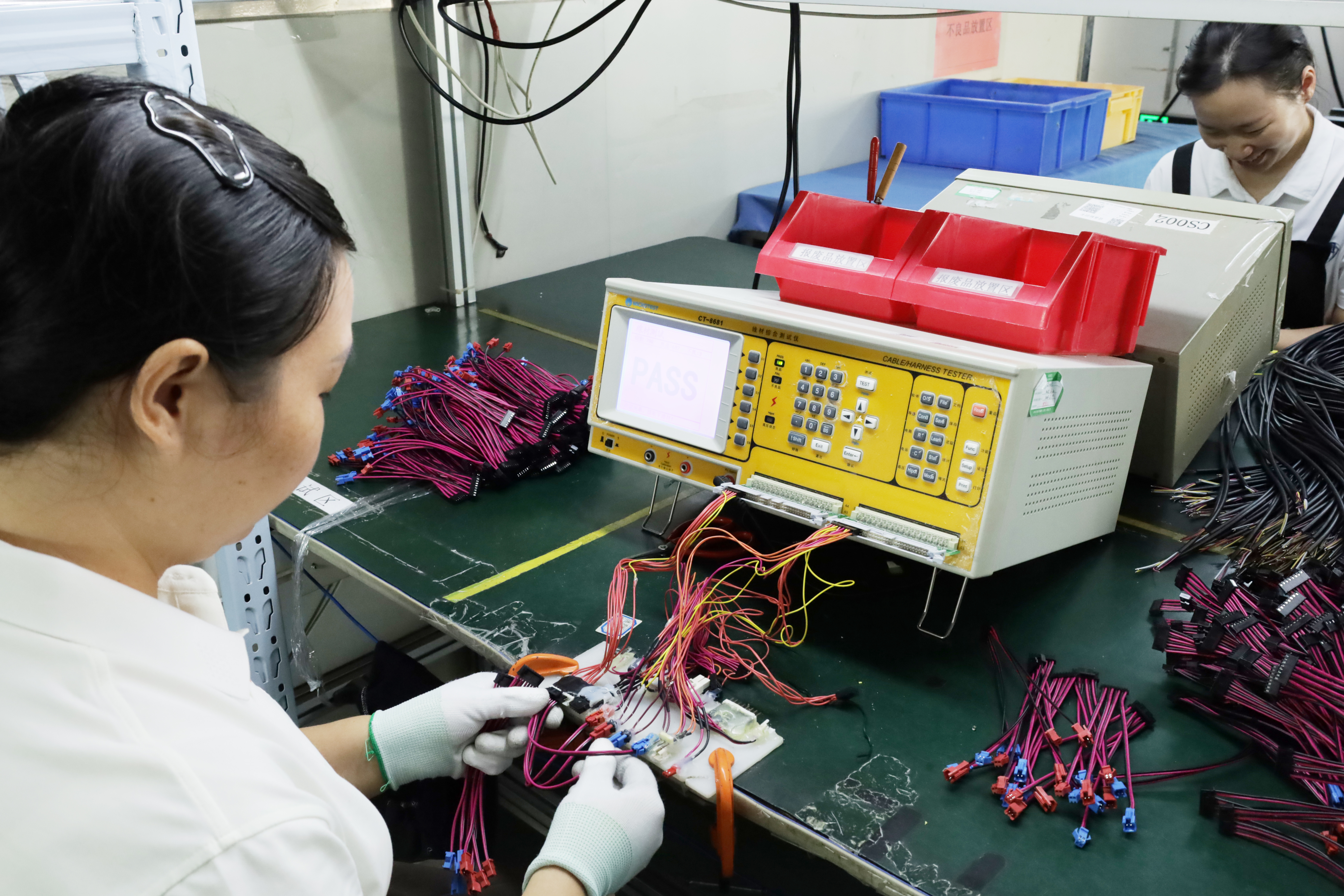
Every completed harness undergoes comprehensive electrical verification before shipment:
100% continuity testing on all circuits
Dielectric withstand (hipot) testing for insulation integrity
Resistance measurement of critical paths
Functional testing where specified
Comprehensive Testing Methodologies Explained
1. Continuity Verification
Continuity testing confirms that each intended electrical path exists and that no unintended paths (shorts) are present.
How it works: A test current is applied sequentially to each wire while the system verifies the signal appears only at the expected destination points. Advanced systems can map complete networks with thousands of test points in seconds.
What it detects:
Open circuits from broken wires or failed crimps
Shorts between adjacent circuits
Miswired connections where wires terminate incorrectly
High-resistance connections that may degrade over time
2. Insulation Integrity Assessment
High-potential (hipot) testing verifies that insulation systems can withstand normal operating voltages plus safety margins.
How it works: A voltage significantly higher than normal operating voltage is applied between isolated circuits while leakage current is monitored. The test confirms that insulation is adequate and free from defects.
What it detects:
Damaged or thinned insulation from handling or processing
Contamination that could promote current leakage
Pinched wires where insulation has been compromised
Improper clearances between circuits
3. Contact Resistance Measurement
Low-resistance connections are essential for both power delivery and signal integrity.
How it works: Using four-wire (Kelvin) measurement techniques, precision current is passed through the connection while voltage drop is measured across it. This eliminates lead resistance from the measurement.
What it detects:
Poor crimp quality with inadequate metal deformation
Corrosion at terminal interfaces
Partial conductor breaks that may pass low current but fail under load
Improper terminal selection for wire gauge
4. Crimp Integrity Validation
Pull testing provides direct evidence of mechanical connection quality.
How it works: A calibrated tensile force is applied axially to the crimped terminal until failure occurs. The peak force is recorded and compared to minimum requirements.
What it detects:
Insufficient crimp force (under-crimping)
Conductor damage from excessive force (over-crimping)
Incorrect wire insertion depth
Terminal material defects
5. Thermal Performance Verification
For high-current applications, thermal testing validates connections under load.
How it works: Rated current is applied while temperature rise is monitored using thermocouples or thermal imaging. Connections with excessive resistance generate detectable heat.
What it detects:
Marginal connections that pass low-current tests but fail under load
Inadequate conductor sizing for application requirements
Poor thermal management in densely packed assemblies
Specialized Testing for Demanding Applications
Aerospace and Defense Requirements
The aerospace sector demands exceptional reliability. Testing may include:
Thermal vacuum cycling to simulate space environments
Pyrotechnic shock testing for munitions applications
Electromagnetic interference (EMI) shielding effectiveness verification
Fluid immersion testing for hydraulic fluid resistance
Automotive and EV Applications
Modern vehicles present unique challenges addressed through specialized testing:
HVIL (High-Voltage Interlock Loop) verification for EV safety systems
Shielding continuity testing for EMI-sensitive circuits
Flex testing for harness sections subject to constant movement
Salt spray corrosion testing for underhood and underbody exposure
Medical Device Requirements
Medical applications require testing that validates:
Sterilization compatibility through autoclave cycling
Biocompatibility of materials in contact with patients
Ultra-low leakage current for patient-connected circuits
Long-term flex life for wearable and portable devices
Advanced Test Systems and Automation
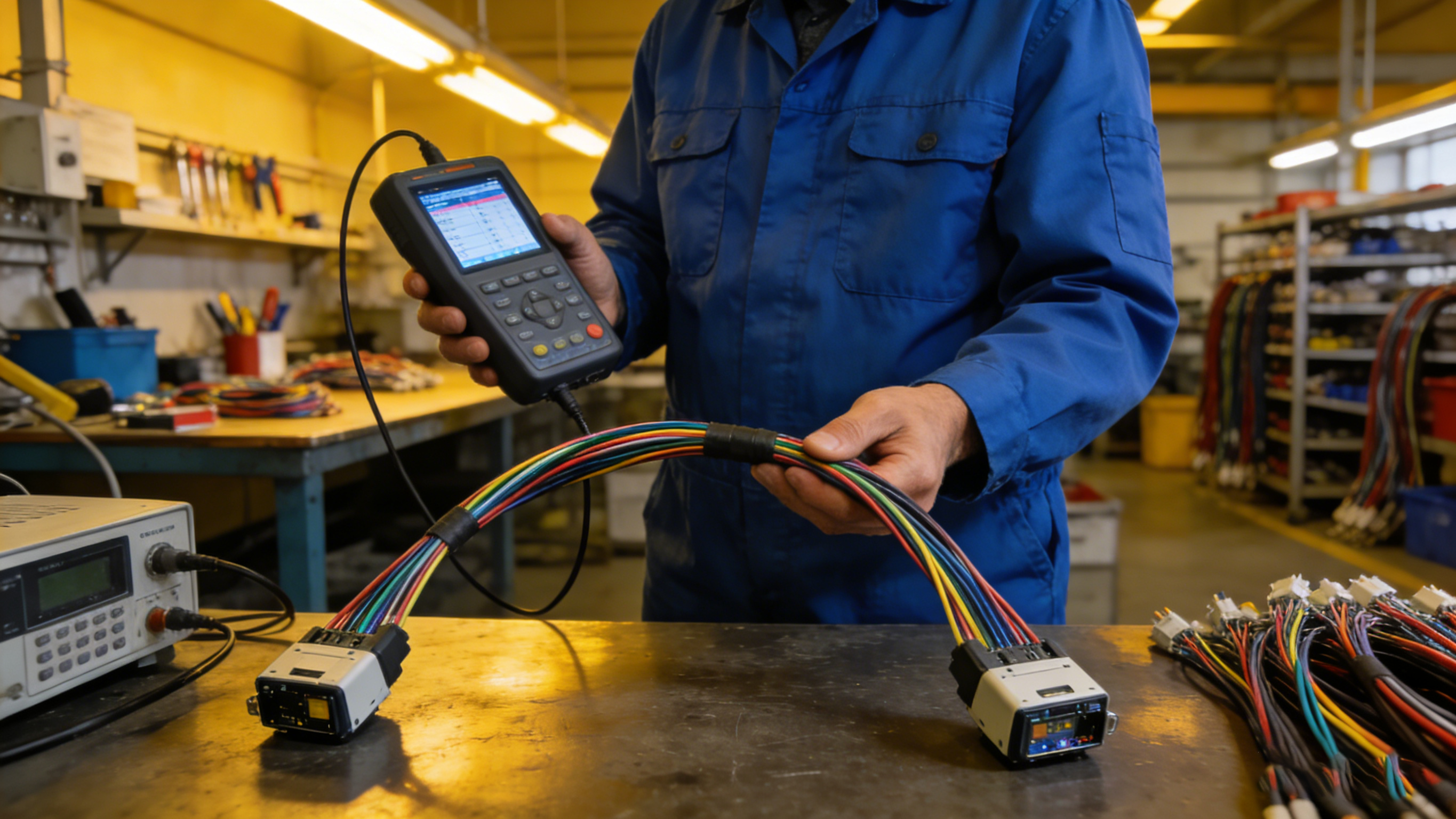
Modern wire harness assembly leverages sophisticated test equipment:
These systems integrate with manufacturing execution systems (MES) to provide:
Real-time quality dashboards for production monitoring
Traceability databases linking each harness to test results
Statistical analysis for continuous process improvement
Automated documentation for compliance reporting
Industry Standards and Compliance Framework
Testing programs must align with applicable standards. Understanding this framework helps buyers evaluate supplier capabilities.
Workmanship Standards
Product Safety Standards
Quality Management Standards
Environmental Compliance
Selecting Testing Parameters: A Risk-Based Approach
Not all applications require identical testing rigor. Professional custom wire harness manufacturers work with clients to establish appropriate testing levels based on:
Application Criticality
Class I: General Electronics (Consumer products, office equipment)
Class II: Dedicated Service (Industrial controls, commercial vehicles)
Class III: High-Performance (Medical, aerospace, safety systems)
Environmental Exposure
Indoor, controlled (Office equipment, laboratory instruments)
Outdoor, sheltered (Telecommunications, building automation)
Outdoor, exposed (Automotive, construction equipment)
Extreme environment (Underhood, aerospace, downhole)
Consequence of Failure
Minor inconvenience (simple repair)
Operational disruption (costly downtime)
Safety hazard (personal injury risk)
Catastrophic (loss of life, major environmental damage)
Documentation and Traceability
Comprehensive testing programs generate documentation that serves multiple purposes:
Certificate of Compliance (COC)
Documents that the product meets specified requirements, typically including:
Test Reports
Detailed results from electrical testing, including:
Continuity verification for all circuits
Insulation resistance measurements
Hi-pot test results with applied voltage and leakage current
Resistance measurements for critical paths
First-Article Inspection Reports
Comprehensive documentation for initial samples:
Dimensional verification against drawings
Material certifications
Test results for all requirements
Photographs of critical features
Lot Traceability Records
Links finished harnesses to:
Common Testing Pitfalls and How to Avoid Them
Even experienced manufacturers can encounter testing challenges:
Future Trends in Wire Harness Testing
The testing landscape continues to evolve with technology advances:
Industry 4.0 Integration
Smart factories are implementing:
Real-time test data analytics for predictive process adjustment
Digital twins for virtual testing before physical assembly
Blockchain traceability for immutable quality records
Advanced Diagnostics
Emerging technologies include:
Time-domain reflectometry for precise fault location
Partial discharge detection for high-voltage applications
Acoustic emission monitoring during mechanical testing
Sustainability Considerations
Environmental concerns are driving:
Reduced energy consumption in test equipment
Recyclable test fixtures and minimal waste
Remote testing capabilities to reduce travel
Selecting a Testing-Capable Manufacturing Partner
When evaluating potential suppliers for your custom wiring harness needs, consider these questions:
About Their Testing Philosophy:
Do they view testing as a value-add or a cost to minimize?
How do they determine appropriate testing levels for different applications?
What is their process for handling test failures?
About Their Testing Capabilities:
What test equipment do they maintain and how is it calibrated?
Can they perform both low-volume prototype testing and high-volume production testing?
Do they have environmental testing capabilities or partner with qualified laboratories?
About Their Quality Culture:
How are test results used for continuous improvement?
What training do test technicians receive?
Can they provide sample test reports and quality metrics?
About Their Documentation:
What documentation accompanies each shipment?
How long are test records retained?
Can they provide traceability to specific production lots?
Partnering for Testing Excellence
At KeHan Electronics, we believe that thorough testing is the foundation of customer confidence. Our comprehensive testing program integrates:
Design for testability principles applied during product development
Validated test processes aligned with applicable industry standards
Calibrated equipment maintained to ISO 10012 requirements
Trained technicians certified to IPC/WHMA-A-620 standards
Complete documentation providing traceability from raw materials to finished harnesses
Whether your application requires basic continuity verification or comprehensive environmental testing with full documentation, our team has the expertise and equipment to deliver.
Frequently Asked Questions
How do you determine which tests are necessary for my application?
We conduct a thorough review of your application requirements, including electrical parameters, environmental exposure, industry regulations, and failure consequences. This risk-based approach ensures testing is comprehensive without being excessive.
Can you provide test data with every shipment?
Yes. We offer various documentation levels, from simple certificates of compliance to detailed test reports with individual harness traceability. Our systems can provide data in formats suitable for your quality management requirements.
How do you handle test failures?
All test failures trigger our corrective action process. We document the non-conformance, perform root cause analysis, implement corrective measures, and verify effectiveness. This closed-loop system prevents recurrence and continuously improves our processes.
What certifications do your test technicians hold?
Our test technicians complete comprehensive training programs and maintain certifications in IPC/WHMA-A-620, ESD control, and equipment-specific operation. Regular competency assessments ensure consistent performance.
Can you perform testing on harnesses already in service?
Yes, we offer field testing services for installed harnesses, including continuity verification, insulation resistance measurement, and fault location. Our portable test equipment brings laboratory capabilities to your site.
Contact Our Testing Specialists
Reliable connections start with rigorous testing. Contact KeHan Electronics today to discuss your wire harness assembly requirements and learn how our comprehensive testing program can provide the confidence your applications demand.
Our engineering team is ready to review your specifications and recommend appropriate testing protocols that balance thoroughness with cost-effectiveness. Let us help you ensure that every connection performs as designed, every time.