


✍Table of Contents
What Is Wire Harness Overmolding?
Why Overmolding? Key Benefits for OEM Applications
Overmolding Materials: How to Choose the Right Resin
Step-by-Step Overmolding Process
Critical Injection Molding Parameters
Tooling Design for Wire Harness Overmolding
Quality Testing & Acceptance Criteria
Common Defects & How to Prevent Them
How to Choose an Overmolding Manufacturer
Frequently Asked Questions
1. What Is Wire Harness Overmolding?
Wire harness overmolding (also called connector overmolding, cable overmolding, or insert molding) is a manufacturing process in which a thermoplastic or thermoset resin is injection-molded directly over a pre-assembled wire harness, connector, or cable termination. The result is a seamless, integrated assembly where the plastic shell, wires, and connectors are permanently fused into a single, robust component.
Unlike traditional connector housings that are mechanically crimped or snapped onto a wire, overmolding creates a chemically and mechanically bonded interface. This eliminates gaps, entry points for moisture, and mechanical stress concentrations — making it the method of choice for demanding environments in automotive, industrial, marine, and outdoor electronics applications.
Definition: Overmolding ≠ Potting. Potting fills an enclosure with cured resin (like epoxy). Overmolding uses injection molding tooling to form a precise, repeatable plastic shape around the substrate. Overmolding offers tighter dimensional control, faster cycle times, and better aesthetics than potting.
~+125°C
2. Why Overmolding? Key Benefits for OEM Applications
Overmolding is not simply a cosmetic upgrade. It addresses multiple engineering challenges that are critical for OEM product reliability and longevity:
| Benefit | Technical Mechanism | Application Impact |
|---|---|---|
| Waterproofing & Sealing | Polymer bonds to cable jacket and connector body, eliminating all ingress paths | IP67/IP68 rating achievable without additional gaskets |
| Strain Relief | Distributes bending stress along the cable entry zone, preventing fatigue fractures | Extends flex life by 5–10× vs. bare termination |
| Vibration Resistance | Encapsulates contact points, damping micro-motion that causes fretting corrosion | Critical for automotive, rail, and industrial machinery |
| Chemical Resistance | Resin shell shields connector metal parts from oils, fuels, and cleaning agents | Essential for underhood automotive and marine applications |
| EMI Shielding | Conductive fillers (carbon black, metal fibers) can be added to the resin | Reduces radiated emissions from connector mating zones |
| Ergonomics & Branding | Custom shape, color, and texture in a single molding step | Reduces secondary operations; enables color-coded identification |
| Tamper Evidence | One-piece molded body makes unauthorized disassembly visible | Preferred in medical devices and security systems |
3. Overmolding Materials: How to Choose the Right Resin
Material selection is the most consequential decision in any overmolding project. The resin must be compatible with the cable jacket material, the operating environment, and the mechanical requirements of the application.
3.1 Most Commonly Used Overmolding Resins
| Material | Shore Hardness | Temp Range | Chemical Resistance | Best For |
|---|---|---|---|---|
| TPU (Thermoplastic Polyurethane) | 60A – 95A | -40°C to +120°C | Oils, fuels, abrasion | Industrial, automotive, outdoor |
| TPE (Thermoplastic Elastomer) | 30A – 90A | -50°C to +105°C | Moderate | Consumer electronics, general purpose |
| PA66 (Nylon 66) | Rigid (85D+) | -40°C to +150°C | Excellent (oils, fuels) | Automotive connectors, high-temp environments |
| PA12 (Nylon 12) | Rigid (85D+) | -40°C to +130°C | Very good (moisture, chemicals) | Fuel systems, marine, underhood |
| PVC | Flexible (varies) | -20°C to +105°C | Good (acids, bases) | Low-cost consumer and appliance harnesses |
| PBT (Polybutylene Terephthalate) | Rigid | -40°C to +150°C | Excellent (solvents, fuels) | High-voltage automotive, EV battery harnesses |
| LSR (Liquid Silicone Rubber) | 20A – 80A | -60°C to +200°C | Excellent (all media) | Medical, aerospace, extreme temp |
3.2 Material-to-Substrate Compatibility
Bond strength between the overmold resin and the cable jacket depends on chemical compatibility. Poor adhesion leads to delamination, ingress failure, and mechanical separation. The table below shows compatibility ratings:
| Cable Jacket Material | Best Overmold Material | Adhesion Without Primer | Notes |
|---|---|---|---|
| PVC jacket | TPE, PVC | ⭐⭐⭐⭐ Good | No primer needed; same-family bonding |
| PUR/TPU jacket | TPU | ⭐⭐⭐⭐⭐ Excellent | Chemical fusion; best choice for waterproofing |
| PA jacket | PA66, PA12 | ⭐⭐⭐⭐ Good | Nylon-to-nylon fusion bond |
| XLPE jacket | TPU (with primer) | ⭐⭐ Marginal | Mechanical interlocking + adhesion primer required |
| Silicone jacket | LSR | ⭐⭐⭐⭐⭐ Excellent | Must use LSR; no other resin adheres to silicone |
⚠️ Critical Note: Never specify an overmold material without confirming compatibility with the cable jacket chemistry. A mismatch is the #1 cause of waterproofing failures in the field — and it cannot be fixed without redesigning the tooling.
4. Step-by-Step Overmolding Process
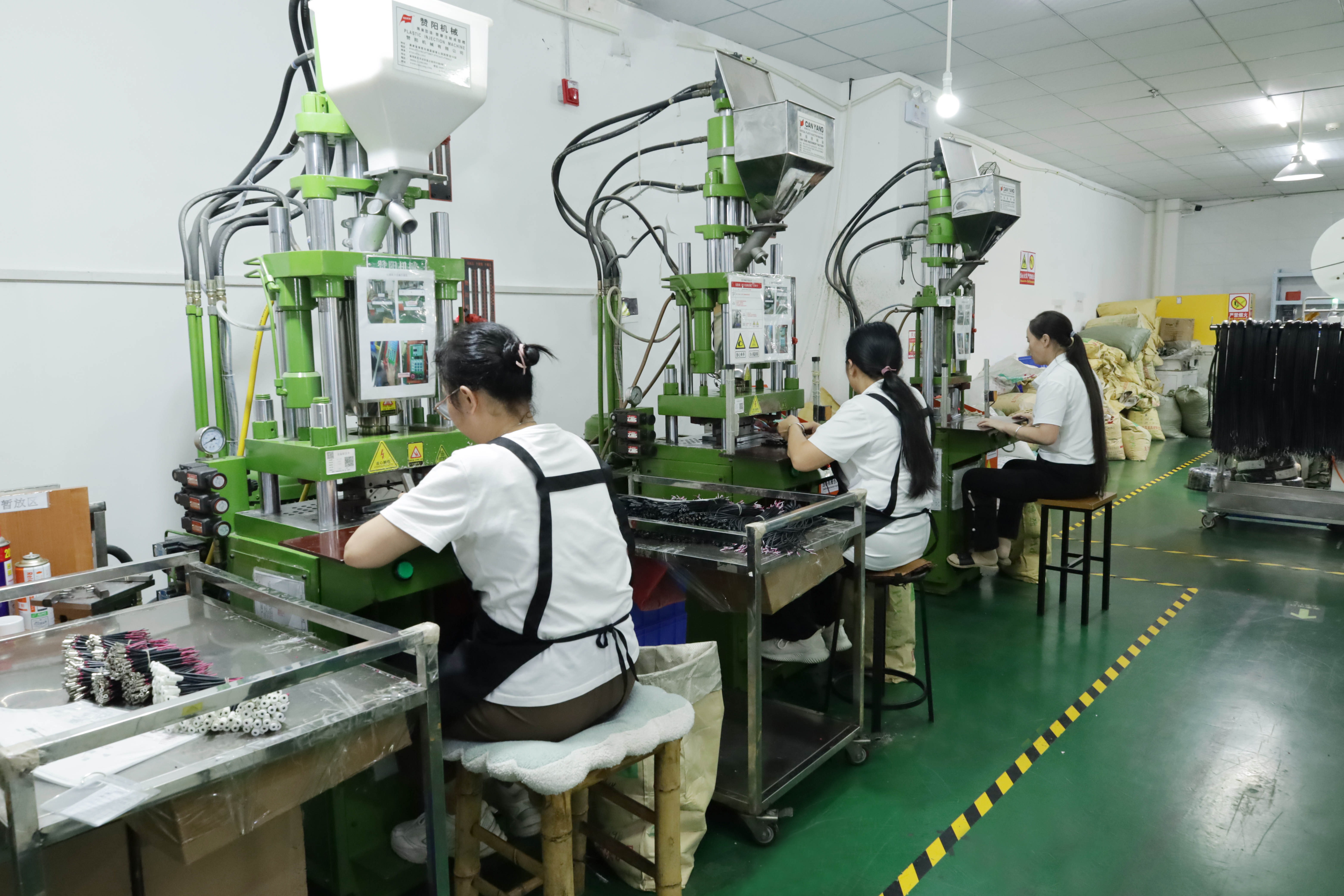
Wire harness overmolding is a precision-controlled, multi-stage process. Here is the complete workflow as executed in our factory:
1.Wire Preparation & Pre-Assembly
Conductors are cut to length, stripped, and terminated per the engineering drawing. Connector housings are loaded with crimped terminals. The fully assembled wire harness substrate is inspected for continuity, crimp quality, and dimensional compliance before proceeding to overmolding.2.Surface Pre-Treatment (If Required)
For substrates with marginal adhesion (e.g., XLPE cables, metal inserts), a chemical adhesion 3.primer is applied to the bonding zone and allowed to flash off for 5–15 minutes. Alternatively, plasma surface activation is used for high-precision medical or aerospace applications. This step is critical for achieving peel strength ≥ 5 N/mm.4.Insert Loading into the Mold
The pre-assembled harness is positioned into the lower mold cavity using a dedicated fixture that holds all cable entry points, connector body positions, and wire routing geometries to ±0.3 mm. Proper insert positioning prevents wire migration during injection — a leading cause of short circuits and sealing failures.5.Mold Clamping
The mold closes under hydraulic clamping force (typically 20–150 tons depending on part size). The clamping force must exceed the injection pressure force on the projected part area — under-clamping causes flash; over-clamping risks cracking thin-wall sections.6.Resin Drying & Plasticization
Hygroscopic resins (PA66, PA12, TPU, PBT) must be dried before molding to achieve target moisture content (<0.2% for PA; <0.05% for PBT). Undried resin causes hydrolytic degradation, resulting in splay marks, reduced molecular weight, and brittle moldings. Drying is performed at 80–100°C for 4–8 hours in a dehumidifying hopper dryer.7.Injection & Packing
Molten resin is injected into the cavity at controlled velocity (typically 20–80 mm/s screw speed). After the cavity fills, the machine switches to packing pressure (50–80% of injection pressure) to compensate for volumetric shrinkage as the part cools. Gate freeze time is monitored by weighing sequential shots until part weight stabilizes.8.Cooling
The part is held in the mold until the resin solidifies sufficiently to be ejected without distortion. Cooling time is typically 10–30 seconds, governed by part wall thickness, resin thermal conductivity, and mold coolant temperature. A conformal cooling circuit is used in high-volume tooling to minimize cycle time.9.Ejection & Demolding
Ejector pins push the part out of the cavity. Draft angles of 1°–3° per side are designed into the mold to prevent scuffing during ejection. For flexible TPU/TPE parts, zero-draft features are acceptable if the material can flex during ejection.10.Post-Mold Operations
Gate vestige is trimmed flush. Any required secondary operations (laser marking, hot stamping, ultrasonic welding of covers) are performed at this stage. Parts are placed in trays to cool uniformly and prevent warpage before electrical testing.11.100% Electrical & Seal Testing
Every finished assembly undergoes continuity testing and IP seal verification (air-pressure decay test at 30–100 kPa) before release to shipping. Failure rate benchmarks: continuity pass rate ≥ 99.95%; IP seal pass rate ≥ 99.8%.
5. Critical Injection Molding Parameters
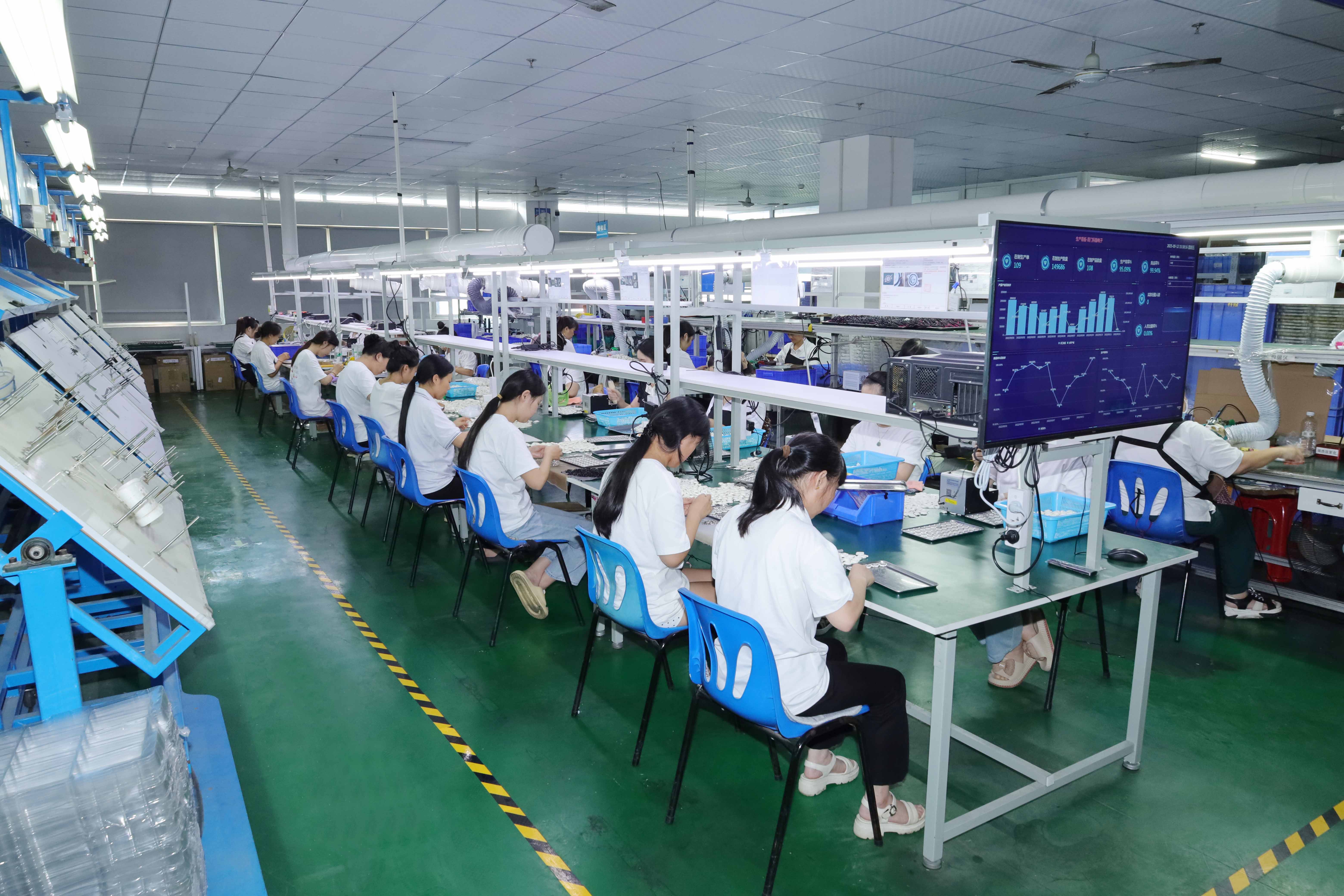
The quality of an overmolded wire harness is directly controlled by these process parameters. Our process engineers document and monitor all parameters in real time via SPC (Statistical Process Control):
| Parameter | Typical Range | Effect if Out of Spec | Control Method |
|---|---|---|---|
| Melt Temperature | TPU: 190–220°C PA66: 260–290°C PBT: 240–260°C | Too low: short shots, poor fusion bond Too high: degradation, discoloration | Barrel zone PID controllers; melt probe |
| Mold Temperature | TPU: 20–40°C PA66: 60–90°C PBT: 60–80°C | Too low: sink marks, poor surface finish Too high: extended cycle, warpage | Temperature-controlled mold cooling circuit |
| Injection Speed | 20–80 mm/s (screw) | Too fast: jetting, wire displacement Too slow: premature freeze, knit lines | Velocity-controlled injection profile (multi-stage) |
| Injection Pressure | 60–140 MPa | Too low: short shot, voids Too high: flash, over-packed inserts | Pressure transducer in cavity (preferred) |
| Packing Pressure | 50–80% of injection pressure | Too low: sink marks, dimensional shrinkage Too high: residual stress, gate blush | Pressure-time curve; weight monitoring |
| Packing Time | 2–8 seconds | Too short: shrinkage voids, poor sealing Too long: overpacking, gate fracture | Gate freeze study (sequential weight measurement) |
| Cooling Time | 8–30 seconds | Too short: distortion, dimensional instability Too long: extended cycle time | Thermal simulation (Moldflow) + empirical validation |
| Resin Moisture | <0.2% (PA); <0.05% (PBT) | Splay marks, gas bubbles, reduced MW, brittle parts | Dehumidifying hopper dryer + Karl Fischer moisture test |
6. Tooling Design for Wire Harness Overmolding
Mold design for wire harness overmolding is significantly more complex than standard injection molding because the mold must accommodate flexible, irregular substrates while maintaining precise positioning and sealing.
6.1 Core Tooling Design Principles
Cable entry seals: The most challenging aspect of harness overmolding tooling. Entry points must accommodate cable diameter variation (±0.15 mm typical) while preventing flash. Solutions include compliant silicone inserts at cable entries or spring-loaded sealing pins.
Wire positioning fixtures: Internal mold features (pins, channels) must hold wires in their designed routing geometry during fill. Displacement ≥ 1.0 mm can cause shorts, reduced pull-out strength, or sealing failure.
Gate location: Gates are positioned away from connector mating faces, sealing surfaces, and flex zones. Submarine (tunnel) gates and hot-runner systems eliminate gate vestige on cosmetic surfaces.
Parting line design: Parting lines are placed on non-sealing, non-cosmetic surfaces. Complex harness geometries often require side actions (slides) or lifters to release undercuts.
Venting: Adequate venting (0.02–0.05 mm vent depth) at the end of fill prevents burn marks (diesel effect) caused by compressed trapped air.
Cooling circuit design: Conformal cooling channels maintain uniform mold temperature, reducing cycle time and warpage — particularly important for asymmetric harness geometries.
6.2 Tooling Materials & Lead Time
| Tooling Type | Material | Cavities | Tool Life (shots) | Lead Time | Best For |
|---|---|---|---|---|---|
| Prototype / Bridge | Aluminum 7075 | 1 | 5,000–20,000 | 2–3 weeks | Design validation, first articles |
| Production (Semi-hard) | P20 Steel | 1–4 | 300,000–500,000 | 4–6 weeks | Medium-volume production |
| Production (Hard) | H13 / S136 Steel | 2–8 | 1,000,000+ | 6–10 weeks | High-volume, abrasive resins |
7. Quality Testing & Acceptance Criteria
Every overmolded wire harness leaving our facility passes through a rigorous, multi-stage quality protocol:
| Test | Method | Acceptance Criterion | Standard |
|---|---|---|---|
| IP Seal Test (Air Decay) | Pressurize assembly to 30–100 kPa; monitor pressure decay for 10–30 s | Pressure drop < 0.5 kPa (IP67); < 0.2 kPa (IP68) | IEC 60529 |
| Continuity & Hi-Pot Test | 100% electrical test on dedicated fixture | All circuits pass; insulation withstands 500–1500 V DC for 1 s | IPC/WHMA-A-620 |
| Pull-Out Force Test | Tensile test at 50 mm/min on cable entry zone | ≥ 50 N (light duty); ≥ 150 N (automotive) | USCAR-21 / Customer spec |
| Dimensional Inspection | CMM or vision system check of OAL, connector mating face, cable entry OD | All dimensions within drawing tolerance (typically ±0.3 mm) | Customer drawing |
| Visual Inspection | 100% visual under uniform lighting (500 lux min) | No flash > 0.3 mm; no sink marks, splay, or burn marks on sealing surfaces | IPC/WHMA-A-620 |
| Peel Strength Test | 90° peel test on molded-cable interface specimen | ≥ 5 N/mm for sealed applications | ASTM D903 / Customer spec |
| Thermal Shock Test | -40°C ↔ +125°C × 100 cycles, 30 min dwell each | No cracking, delamination, or sealing failure post-cycle | IEC 60068-2-14 |
| Salt Spray Test | 5% NaCl fog, 96–500 hours | No corrosion of metal parts; no delamination of overmold | ISO 9227 |
8. Common Defects & How to Prevent Them
Understanding common overmolding defects and their root causes enables faster problem resolution and first-time-right production:
| Defect | Visual Sign | Root Cause | Prevention |
|---|---|---|---|
| Flash | Thin plastic fin at parting line or cable entry | Insufficient clamp force; worn parting line; excessive injection pressure | Recalculate clamp tonnage; polish parting line; reduce injection speed |
| Short Shot | Incomplete filling of cavity | Melt temperature too low; injection speed too slow; blocked gate | Increase melt temp; optimize gate size; check for contamination |
| Sink Mark | Depressions on surface opposite thick sections | Insufficient packing pressure or packing time | Increase pack pressure; extend packing time; reduce wall thickness variation |
| Splay / Silver Streaks | Silver streaks on surface | Resin moisture too high; melt temperature too high (degradation) | Verify dryer performance; check moisture content with Karl Fischer; reduce melt temp |
| Wire Displacement | Visible wire deviation; short circuit failure | Insufficient insert fixturing; excessive injection speed displacing wires | Add wire-positioning pins to mold; reduce fill speed; validate with X-ray inspection |
| Delamination / Poor Adhesion | Overmold peels from cable jacket | Material incompatibility; contaminated substrate; primer not applied | Verify material compatibility; clean substrate; apply adhesion primer; increase mold temp |
| Burn Marks | Brown/black discoloration at end of fill | Trapped air igniting (diesel effect); insufficient venting | Add vents at end of fill; reduce injection speed at end of fill; optimize gate position |
| Seal Leakage (IP Failure) | Pressure decay test failure | Flash at cable entry; poor adhesion; wire migration creating channel | Inspect cable entry seal inserts; verify pull-out force; add secondary seal bead in mold |
? Pro Tip: For complex harnesses with IP sealing requirements, we routinely perform X-ray inspection on first-article samples to verify wire positioning without destructive sectioning. This is especially important for multi-circuit connectors where even 0.5 mm of wire displacement can cause insulation damage during packing.
9. How to Choose an Overmolding Manufacturer
Not every injection molder has the specialized capability for wire harness overmolding. Here are the seven criteria that separate qualified suppliers from general molders:
1.In-house wire harness assembly + overmolding integration — A supplier who builds the harness substrate AND performs overmolding in the same facility eliminates the #1 source of defects: substrate variation introduced during inter-factory transfer. Ask: "Do you terminate and mold under the same roof?"
2.IP sealing validation capability — Confirm they have air-pressure decay test equipment and can validate to the specific IP rating you require (IP67, IP68, IP6K9K). Ask for their standard test protocol and acceptance criteria.
3.In-house tooling design and build — Suppliers who design their own molds understand wire harness overmolding constraints (cable entry sealing, insert fixturing). Outsourced tooling design often misses critical details.
4.Material qualification process — Ask how they validate material-to-substrate compatibility. Qualified suppliers will perform peel strength tests during DV (Design Validation) and document material qualification reports.
5.SPC and process documentation — Request evidence of Statistical Process Control monitoring on critical parameters (melt temp, injection pressure, cycle time). This ensures process stability, not just first-article compliance.
6.First-article inspection (FAI) and PPAP capability — For automotive and regulated applications, the supplier should be able to deliver a full PPAP package (Levels 1–5) including dimensional reports, material certs, and process capability studies.
7.Prototype flexibility — Can they produce 10–50 pcs for design validation before committing to production tooling? Suppliers who require 10,000 pc MOQs for prototyping are not set up for the iterative development process most OEMs require.
Our Capability Summary: We offer integrated wire harness assembly and overmolding under one roof, with in-house tooling design, IP sealing validation to IP68, PPAP Level 3 documentation, and prototype runs from as few as 10 pieces. Material qualifications include TPU, PA66, PA12, PBT, TPE, and LSR.
10. Frequently Asked Questions
Ready to Start Your Overmolding Project?
Send us your drawing, sample, or IP requirement — we'll review your design and provide a complete quote including tooling and unit price within 24 hours.
✉ Request a Free Quote & DFM Review