


Is a Custom 5 Wire to 4 Wire Trailer Harness the Best Fix for Trailer Wiring Mismatch Issues?
2026-11-25 10:45A Practical Trailer Wiring Guide for Trailer Manufacturers, RV Parts Distributors and Repair Workshops
Trailer wiring compatibility is a common issue in the North American towing and trailer accessories market. Different trailer models, towing vehicles and electrical configurations may use different connector types, even when their basic lighting functions appear similar.
One typical example is the connection between a 5-wire trailer harness and a 4-wire towing vehicle connector.
A 4-way trailer connector generally supports ground, tail/running lights, left turn/brake lights and right turn/brake lights. A 5-way flat connector retains these four basic circuits but adds a fifth circuit, commonly used for reverse lights or reverse-lockout control on trailers equipped with surge brakes.
When these two wiring configurations need to work together, choosing the wrong adapter or making an improvised wiring connection can result in missing functions, incorrect signals, blown fuses or unreliable trailer lighting.
So, is a 5 wire trailer harness to 4 wire adapter sufficient, or is a custom trailer wiring harness a better solution?
The answer depends on the actual circuit configuration, connector interface and additional functions required by the trailer.
For trailer manufacturers, RV parts distributors and repair workshops, understanding these differences is essential when selecting a reliable wiring solution.
As a professional cable and wiring harness manufacturer, Xiamen Kehan Electronics Co., Ltd. provides cable and wiring harness development and manufacturing services, supporting customized wiring requirements for different application scenarios.
1. What Is a 5 Wire Trailer Harness to 4 Wire Connection?
A 5-wire to 4-wire trailer connection is an electrical interface solution that connects a five-circuit trailer wiring system to a four-circuit towing vehicle or trailer lighting system.
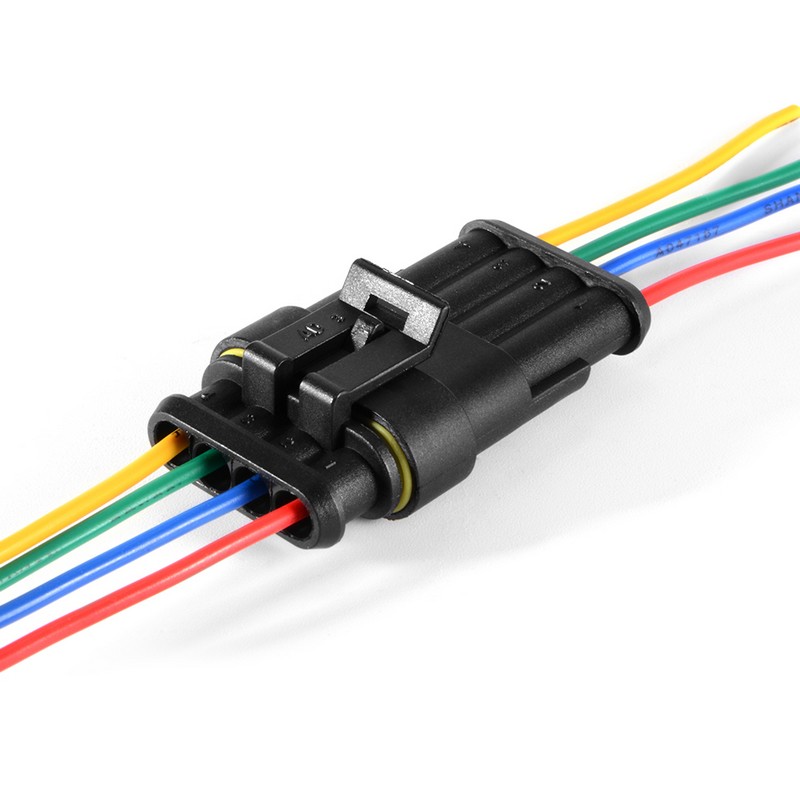
The most common North American 4-way flat connector uses four circuits:
White: Ground
Brown: Tail and running lights
Yellow: Left turn signal and brake light
Green: Right turn signal and brake light
A typical 5-way flat connector retains these four functions and adds a fifth circuit, commonly represented by a blue wire.
On many 5-way flat trailer systems, this additional circuit connects to the vehicle's reverse-light signal and activates a reverse-lockout solenoid on a surge-brake actuator.
This function allows the trailer to reverse without the surge-brake mechanism applying the trailer brakes under normal reversing conditions.
The following comparison explains the basic difference.
| Circuit | 4-Way Flat | 5-Way Flat |
|---|---|---|
| Ground | White | White |
| Tail/running lights | Brown | Brown |
| Left turn/brake | Yellow | Yellow |
| Right turn/brake | Green | Green |
| Additional function | Not available | Commonly reverse lockout |
| Typical application | Standard light-duty trailers | Trailers requiring an additional circuit |
Important: The fifth circuit is not universally assigned to the same function across every manufacturer and connector configuration. Always verify the connector pinout and electrical function before designing or connecting an adapter.
For a detailed reference, CURT and etrailer provide wiring diagrams for common 4-way and 5-way trailer connectors.
2. Why Do Trailer Wiring Mismatch Issues Occur?
Trailer wiring mismatches generally result from differences in connector configuration, circuit requirements and vehicle electrical systems.
2.1 Different Connector Pin Counts
A towing vehicle may have a 4-way flat connector, while the trailer uses a 5-way flat connector.
Although the first four lighting functions may be compatible, the fifth circuit cannot automatically be supported by a standard four-circuit connection.
2.2 Missing Reverse-Lockout Function
This is particularly important for trailers using hydraulic surge brakes.
When the trailer requires a reverse-lockout signal, connecting only the four standard lighting circuits will not provide that additional function.
The trailer may therefore experience unwanted brake engagement when reversing, depending on the actuator design.
2.3 Different Wire Assignments
Wire colors are useful identification references, but they should not be treated as universal guarantees.
Different manufacturers and connector configurations may use different assignments.
A wiring connection based only on color matching can result in incorrect circuit connections.
2.4 Different Electrical Loads
Trailer lighting systems may use different lamp quantities, LED modules and electrical components.
The selected wiring harness must account for the actual operating current, conductor size, circuit protection and connector ratings.
2.5 Poor Previous Repairs
In repair workshops, existing trailer wiring may have been modified, spliced or replaced several times.
This can create inconsistent wire colors, damaged insulation, poor grounding and unreliable connections.
For these reasons, a properly specified 5 wire trailer harness to 4 wire solution should begin with circuit identification rather than simply matching connector shapes.
3. Is a Trailer Wiring Adapter Enough, or Is a Custom Harness Better?
Both solutions have their place. The correct choice depends on the application.
Option A: Standard Trailer Wiring Adapter
A standard trailer wiring adapter is suitable when the only problem is a connector mismatch and the required electrical functions are compatible.
For example, when a 5-way trailer connector is connected to a 4-way vehicle connector, a suitable adapter can pass through the four common lighting circuits.
However, the fifth circuit will not be available unless the towing vehicle provides the required additional electrical output through a separately designed connection.
Advantages:
Simple installation
Lower initial cost
Convenient for occasional towing
Suitable for standard connector conversion
Limitations:
Additional functions may not be supported
Standard lengths may not fit every installation
Limited customization
Extra connection interfaces may introduce additional failure points
Option B: Custom Trailer Wiring Harness
A custom trailer wiring harness is a better option when the project requires vehicle-specific dimensions, connector configurations, dedicated additional circuits or standardized production.
A customized harness can be designed around:
Actual vehicle connector specifications
Trailer-side connector requirements
Wire gauge and conductor material
Circuit assignments
Harness length
Branch configuration
Sealing and protective materials
Electrical load requirements
Advantages:
Vehicle- and trailer-specific compatibility
Controlled pin assignments
Customized cable length and routing
Fewer unnecessary intermediate connections
Standardized production specifications
Better suitability for recurring repair and OEM supply programs
Which Solution Should You Choose?
| Requirement | Standard Adapter | Custom Harness |
|---|---|---|
| Basic 4-way lighting connection | Suitable | Suitable |
| Simple connector conversion | Suitable | Possible |
| Additional reverse-lockout circuit | Requires separate compatible circuit | Can be designed into the assembly |
| Non-standard wire length | Limited | Suitable |
| Specific connector requirements | Depends on available adapter | Customizable |
| Repeatable batch supply | Depends on product availability | Suitable |
| Vehicle-specific installation | Limited | Suitable |
The key distinction is that an adapter changes the physical connection arrangement, while a properly engineered custom harness can address both connector compatibility and application-specific electrical requirements.
4. How Does a Custom 5-Wire to 4-Wire Trailer Harness Work?
A properly designed conversion harness should preserve the four common lighting circuits and handle the fifth circuit according to the actual application.
For a typical North American 5-way flat configuration, the circuit relationship can be described as follows:
| 5-Way Trailer Circuit | 4-Way Vehicle Circuit | Connection Requirement |
|---|---|---|
| White – Ground | White – Ground | Connect |
| Brown – Running lights | Brown – Running lights | Connect |
| Yellow – Left turn/brake | Yellow – Left turn/brake | Connect |
| Green – Right turn/brake | Green – Right turn/brake | Connect |
| Blue – Reverse lockout | No standard 4-way output | Requires separate compatible reverse signal |
The fifth circuit must not simply be connected to another lighting wire to make all five wires appear connected.
If the towing vehicle has only a standard 4-way output, the reverse-lockout signal is generally unavailable through that connector.
For a trailer with surge brakes, the additional reverse signal may need to be obtained from the vehicle's backup-light circuit through a suitable vehicle-specific wiring solution.
If the fifth circuit is not required for the particular trailer application, it can be left electrically isolated and properly insulated, following the approved wiring design.
Engineering principle: A conversion harness should preserve compatible functions without creating unintended electrical connections.
This is especially important for avoiding short circuits, incorrect signal transmission and potential damage to vehicle electrical components.
5. Technical Parameters to Consider When Customizing a Trailer Wiring Harness
For trailer manufacturers, RV accessory distributors and repair workshops, the performance of a wiring harness depends on more than the number of wires.
The following parameters should be evaluated before production.
5.1 Conductor Material and Wire Gauge
The conductor should be selected according to the actual circuit current, cable length, voltage drop and installation environment.
Important considerations include:
Copper conductor construction
American Wire Gauge (AWG)
Conductor resistance
Insulation thickness
Operating temperature
Current-carrying requirements
A longer harness may require a larger conductor cross-section to control voltage drop.
5.2 Voltage and Current Requirements
The harness should be designed around the actual towing vehicle and trailer electrical system.
Typical checks include:
Nominal system voltage
Continuous operating current
Peak current
Voltage drop
Terminal contact resistance
Circuit protection requirements
For the fifth circuit, the reverse-lockout solenoid's electrical specifications should be confirmed before selecting the wire and connector.
5.3 Connector Compatibility
Connector selection should consider:
4-way or 5-way flat connector type
Male and female configurations
Pin arrangement
Terminal material
Contact rating
Locking structure
Connector dimensions
The vehicle-side and trailer-side connectors must match the intended connection interface.
5.4 Insulation and Environmental Protection
Trailer wiring is exposed to outdoor conditions, road vibration, moisture and temperature changes.
Depending on the application, the harness may require:
Abrasion-resistant insulation
Protective wire sleeves
Waterproof connector seals
Heat-shrink protection
Corrosion-resistant terminals
Secure branch protection
For boat trailer applications, additional attention should be paid to water exposure and corrosion protection.
5.5 Harness Length and Branch Configuration
Custom dimensions help ensure that the wiring assembly fits the trailer structure without excessive cable length or unnecessary splicing.
The supplier should confirm:
Overall cable length
Branch lengths
Connector orientation
Mounting positions
Wire exit direction
Installation clearance
A properly designed custom trailer wiring harness should be easy to install while maintaining secure routing and adequate protection.
6. How to Prevent Short Circuits and Wiring Failures
Short circuits and incorrect connections are among the major concerns when converting trailer wiring systems.
A reliable harness design should incorporate electrical protection and controlled manufacturing processes.
The following measures are important.
1. Correct Circuit Mapping
Confirm every wire's electrical function and connector pin position before assembly.
2. Appropriate Fuse Protection
Use suitable overcurrent protection according to the towing vehicle's electrical design, conductor capacity and connected load.
3. Reliable Ground Connection
The ground circuit should provide a secure, low-resistance return path.
4. Proper Terminal Crimping
Incorrect crimping can cause loose connections, increased resistance and overheating.
5. Insulation Protection
Prevent exposed conductors and unintended contact between adjacent circuits.
6. Electrical Continuity Testing
Check that each circuit connects to the correct terminal.
7. Short-Circuit Testing
Verify that unintended electrical connections between circuits are not present.
It is important to understand that a custom harness alone cannot guarantee that short circuits will never occur. Correct circuit protection, installation practices, compatible electrical loads and proper testing are all necessary.
For distributors and repair workshops, these measures can help reduce installation errors, callbacks and product-related complaints.
7. Typical Applications for Custom 5-Wire to 4-Wire Trailer Harnesses
Trailer Modification and Repair Workshops
Repair technicians frequently encounter trailers with different connector configurations.
A customized conversion harness can help resolve connector mismatches without unnecessary modifications to the existing trailer wiring.
RV Parts Distributors
RV accessory distributors need wiring products that can accommodate different towing vehicle and trailer configurations.
Custom harness solutions can support specific product combinations and replacement requirements.
Trailer Manufacturers
Trailer manufacturers may need customized wiring assemblies for different trailer models and electrical configurations.
A standardized harness design can improve assembly consistency and simplify component sourcing.
Boat Trailer Applications
Many boat trailers use surge-brake systems that require a reverse-lockout circuit.
A correctly designed 5-way connection can support the additional reverse signal required by the braking system.
Trailer Parts OEM and Wholesale Suppliers
For companies purchasing wiring harnesses in batches, customized specifications can help maintain consistent connector interfaces, wire lengths, circuit assignments and product quality.
8. Common Questions Before Purchasing a Custom Trailer Wiring Harness
Q1: Can a 5-wire trailer plug connect directly to a 4-wire vehicle?
A compatible 5-to-4 adapter can connect the four common lighting circuits. However, the additional fifth circuit will not function through a standard 4-way connection unless a separate compatible electrical output is provided.
Q2: What happens to the fifth wire when using a 4-way adapter?
It is generally left disconnected and safely insulated if the additional function is not required.
If the trailer uses a surge-brake reverse-lockout system, the fifth circuit needs an appropriate reverse signal from the towing vehicle.
Q3: Is a custom trailer wiring harness better than a universal adapter?
Not in every situation.
A standard adapter is often sufficient for a simple connector conversion. A custom harness is more appropriate when the project requires specific wire lengths, connector configurations, additional circuits or repeatable batch production.
Q4: Can a custom harness support different trailer models?
Yes. A manufacturer can develop different harness specifications based on trailer drawings, connector requirements, electrical loads and installation dimensions.
Q5: How can buyers verify trailer harness quality?
Buyers should request relevant specifications and inspection records, including:
Conductor specifications
Connector and terminal details
Wire length tolerances
Crimp quality requirements
Continuity test results
Short-circuit test results
Insulation and sealing requirements
Q6: What information should be provided when requesting a quotation?
A complete RFQ should ideally include the connector type, wiring diagram, pinout, wire gauge, cable length, circuit functions, electrical requirements and estimated order quantity.
Providing this information helps the manufacturer evaluate the design and production requirements more accurately.
9. Why Choose Xiamen Kehan Electronics Co., Ltd. for Custom Wiring Harness Manufacturing?
Choosing a wiring harness supplier is not simply about finding a factory that can connect five wires to four.
For distributors, trailer manufacturers and OEM customers, the supplier should understand the electrical requirements, connector interfaces and production specifications of the intended application.
Xiamen Kehan Electronics Co., Ltd. specializes in the research and development, manufacturing and sales of wires, cables and wiring harness products.
For customized trailer wiring harness projects, the manufacturing process can be developed around customer-specific requirements.
Drawing-Based Customization
Customers can provide wiring diagrams, product drawings, samples and connector specifications as references for customized product development.
Flexible Wiring Configurations
Wire quantity, conductor specifications, cable lengths, connector types and circuit arrangements can be defined according to the project requirements.
Application-Specific Harness Development
Different trailer applications may require different electrical functions, environmental protection and installation configurations.
Customized development helps align the wiring assembly with the actual application.
Standardized Batch Production
For wholesalers, distributors and trailer manufacturers, consistent product specifications are important for recurring orders.
A controlled production specification helps maintain consistency across production batches.
OEM and ODM Cooperation
From customized cable assemblies to finished wiring harness products, Xiamen Kehan Electronics Co., Ltd. can discuss OEM manufacturing requirements based on customer drawings and technical specifications.
10. How to Order a Custom 5-Wire to 4-Wire Trailer Harness
To improve quotation accuracy and reduce unnecessary sample revisions, buyers should prepare the following information before contacting a manufacturer.
| Information Required | Recommended Details |
|---|---|
| Application | Utility trailer, boat trailer, RV trailer or other |
| Vehicle connector | 4-way flat or other |
| Trailer connector | 5-way flat or other |
| Circuit functions | Ground, tail, left, right and fifth circuit |
| Fifth-wire function | Reverse lockout, reverse light or other |
| Wire gauge | Required AWG specification |
| Cable length | Overall and branch dimensions |
| Connector details | Manufacturer, part number or drawing |
| Environmental requirements | Moisture, abrasion and temperature |
| Order quantity | Sample, trial order or annual demand |
The recommended cooperation process is:
Requirement Confirmation → Wiring Diagram Review → Connector and Material Selection → Sample Development → Electrical Verification → Customer Approval → Batch Production → Quality Inspection → Shipment
This structured process helps buyers obtain a wiring assembly that matches the actual trailer electrical configuration instead of relying on a generic adapter.
Conclusion: Is a Custom 5 Wire Trailer Harness to 4 Wire the Best Fix?
A 5 wire trailer harness to 4 wire conversion is a practical solution when a trailer and towing vehicle use different connector configurations.
For simple lighting applications, a standard trailer wiring adapter may be sufficient.
However, when the project involves reverse-lockout functionality, vehicle-specific connector requirements, customized cable lengths, additional electrical protection or standardized batch supply, a custom trailer wiring harness provides greater design flexibility.
The most important consideration is not simply reducing five wires to four. It is ensuring that every required electrical function is correctly identified, connected and protected.
For trailer modification companies, RV parts distributors, repair workshops and trailer manufacturers, working with an experienced wiring harness manufacturer can help simplify product customization and improve supply consistency.
Xiamen Kehan Electronics Co., Ltd. provides customized wire, cable and wiring harness manufacturing services for customers seeking application-specific wiring solutions.
Looking for a reliable custom trailer wiring harness manufacturer? Contact Xiamen Kehan Electronics Co., Ltd. with your wiring diagram, connector specifications, cable dimensions and order requirements to discuss your OEM or wholesale project.