


Custom Wire Harness Solutions for 3D Printer
2026-06-18 17:07Custom Wire Harness Solutions for 3D Printer Manufacturers: FDM, SLA, and Industrial Additive Manufacturing
Precision-engineered wiring harnesses for desktop 3D printers, industrial FDM systems, SLA/MSLA resin printers, and large-format additive manufacturing platforms — built to your exact specs, from prototype to mass production.
✓ ISO 9001:2015 Certified | ✓ High-Flex Cable Rated for 10M+ Cycles | ✓ 100% Electrical Testing | ✓ OEM / ODM Available
 Table of Contents
1. Why 3D Printer Wiring Is Harder Than It Looks
3D printers present a unique set of wiring challenges that most general wire harness suppliers are not equipped to handle. The combination of continuous motion axes, high-temperature hotend environments, EMI-generating stepper motors, and precise thermistor signal routing demands a harness partner who understands additive manufacturing hardware — not just wire assembly.
The most common field failures we see in 3D printer harnesses supplied by non-specialist manufacturers:
Cable fatigue failure on X/Y/Z axis drag chains — standard PVC cables crack within weeks under continuous flexing
Thermistor signal noise from unshielded cables running parallel to stepper motor wires
Hotend connector melt/deformation from using standard nylon connectors near 250–300°C heat blocks
Intermittent continuity on improperly terminated crimp connections at high vibration points
Ground loop interference in heated bed circuits affecting probe accuracy
Key Insight: A 3D printer's X/Y gantry harness may complete 50,000–200,000 flex cycles per year depending on print volume. Only high-flex rated cable (UL 20234, igus CF series or equivalent) can survive this duty cycle. Standard PVC wire fails in weeks.
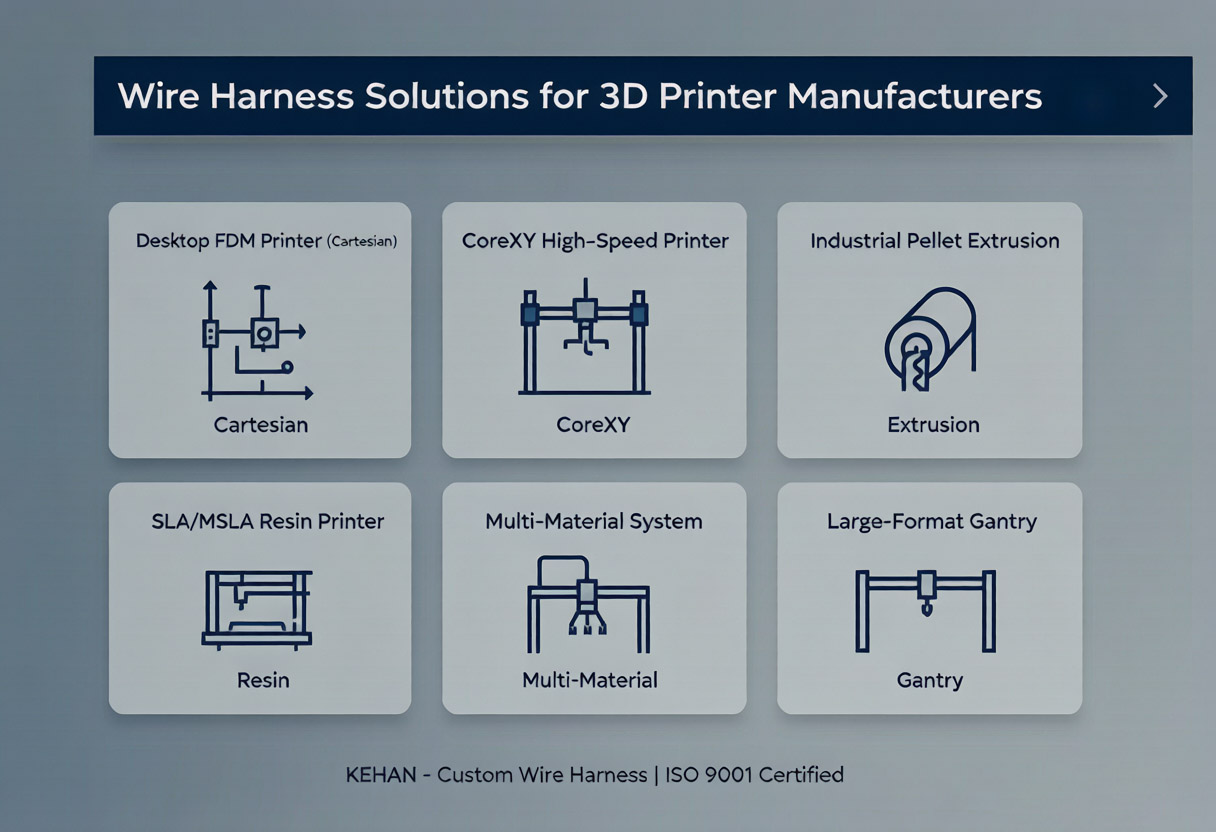
We have designed and manufactured wire harnesses for desktop FDM printers, CoreXY and Cartesian platforms, industrial pellet extrusion systems, SLA/MSLA resin printers, and large-format multi-material machines. Our engineering team reviews every new 3D printer harness project with the motion architecture and thermal environment in mind — not just the connector pinout.
2. Wire Harness Types for 3D Printers
A typical FDM printer contains 6–12 distinct wire harness assemblies. Here is how they break down by function and the key engineering requirements for each:
| Harness Assembly | Function | Key Engineering Requirements | Critical Failure Mode |
|---|---|---|---|
| Toolhead / Printhead Harness | Powers hotend heater, thermistor, part cooling fan, probe, extruder motor | High-flex cable; high-temp connectors near heater block; signal shielding for thermistor | Cable fatigue fracture; thermistor noise; connector heat damage |
| X/Y Axis Drag Chain Harness | Routes toolhead wiring through cable drag chain on motion axes | 10M+ flex cycle rating; controlled bend radius; minimum outside diameter for chain slot | PVC jacket cracking; conductor fracture at fixed end clamp |
| Z Axis / Bed Harness | Powers heated bed, bed thermistor, Z-axis motors, auto-leveling probe | High-current heater circuit (10–20A); shielded thermistor pair; silicone insulation near bed | Heater circuit voltage drop; thermistor ADC noise; strain at bed pivot |
| Stepper Motor Harness | Connects mainboard stepper drivers to X/Y/Z/E motors | 4-conductor shielded; adequate wire gauge for coil current; strain relief at motor | EMI coupling to adjacent signal wires; connector fretting at vibration points |
| Main Board Power Harness | AC input filtering, PSU output distribution to mainboard and peripherals | IEC 60227 / UL 62 rated; proper conductor sizing for load; secure terminal connections | Overheating at undersized conductors; terminal loosening from vibration |
| Endstop / Sensor Harness | Connects limit switches, filament sensors, nozzle probes to mainboard | Shielded for noise immunity; small OD to route through tight chassis spaces | Signal glitches from stepper EMI; connector mis-seating in tight space |
| Display / UI Harness | Connects LCD/touchscreen, encoder, USB, SD card to mainboard | ESD protection on data lines; ribbon or round cable per display type | ESD damage to display; signal integrity on long ribbon runs |
| Multi-Material Unit Harness | Filament switching motors, sensors, LED indicators (on multi-material upgrades) | Modular connector system; plug-and-play installation; cable ID labeling | Installation error; connector confusion during field service |
3. Technical Specifications Overview
The table below summarizes the key electrical and mechanical specifications we apply to 3D printer wire harness projects:
| Parameter | Specification | Notes |
|---|---|---|
| Wire Gauge Range | AWG 28 (thermistor/signal) to AWG 14 (heated bed power) | Sized by load current with 125% de-rating per NEC |
| Insulation Types | Silicone (near hotend, ≥200°C rated), PVC, PTFE, XLPE | Silicone specified for any harness within 50mm of heater block |
| High-Flex Cable Standard | igus CF series / UL 20234 / UL 20276 or equivalent | Rated for 10M+ flex cycles at bend radius ≥ 7.5× cable OD |
| Operating Temperature | –40°C to +200°C (silicone zones); –20°C to +80°C (standard zones) | Per IEC 60228 / UL 758 temperature ratings |
| Connector Series (Common) | Molex Micro-Fit 3.0, JST-XH/PH/SH, Dupont 2.54mm, XT30/XT60 power | Can match any existing BOM connector; alternatives available with approval |
| Shielding | Foil + drain wire, braided shield, or unshielded per circuit type | Thermistor and probe cables always shielded; stepper motor cables optionally shielded |
| Voltage / Current Ratings | Signal: 5V/12V/3.3V DC | Power: 12V/24V/48V DC, up to 20A (heated bed) | Mixed signal/power in one harness tree with physical separation and shielding |
| Flex Life Target | ≥ 10,000,000 cycles at specified bend radius | Verified by drag chain flex test report from cable supplier |
| Compliance | RoHS, REACH; UL listed wire options; CE-compatible construction | Full material declarations and test reports provided on request |
4. High-Flex Cable: The Core Challenge in 3D Printer Harnesses
If there is one single factor that separates a reliable 3D printer harness from a field-failure harness, it is the selection of cable for the drag chain and moving axis runs. This is where most budget harnesses fail — and where we invest the most engineering attention.
Why Standard PVC Cable Fails in Drag Chains
Standard PVC-insulated wire (the type used in most general industrial applications) has a copper conductor strand count optimized for installation flexibility, not continuous dynamic flexing. In a 3D printer drag chain, the cable is flexed at a defined bend radius continuously, often thousands of times per day. PVC insulation work-hardens and cracks. Standard stranded conductors suffer fatigue fractures at individual strands, leading to intermittent continuity — the worst possible failure mode in a printer mid-print.
What We Specify Instead
| Cable Property | Standard PVC Wire | High-Flex Cable (Our Spec) |
|---|---|---|
| Conductor Stranding | 7–19 strands (Class 2/3) | Fine-strand Class 5/6 (100–2000+ strands) |
| Insulation Material | Standard PVC | Special PVC, TPE, or PUR (high-flex grade) |
| Rated Flex Life | ~100,000–500,000 cycles | ≥ 10,000,000 cycles |
| Min. Bend Radius | 10–20× cable OD | 7.5–10× cable OD (tighter routing possible) |
| Failure Mode | Conductor fracture, insulation cracking | Graceful wear — no sudden failure |
| Test Standard | No drag chain test | Per UL 20234 / igus test methodology |
Common Mistake: Many 3D printer brands specify silicone wire for their drag chain harnesses because silicone is flexible. Silicone is an excellent choice for static high-temperature applications (near the hotend), but it is not rated for continuous dynamic flexing in drag chains — the outer jacket tears and the fine strands still fatigue. The correct solution is a proper high-flex rated cable (PUR or TPE jacket, fine-strand conductor) for the motion runs, and silicone wire only in the static high-temperature zone near the heater block.
5. Harness Solutions by Printer Type
| Printer Type | Typical Harness Complexity | Key Considerations | Our Experience |
|---|---|---|---|
| Desktop FDM — Cartesian (Ender-style) | Medium (8–12 harness assemblies) | Cost-sensitive; JST/Dupont connectors; bed thermistor cable routing; Z-axis strain relief | High-volume OEM supply; can match Creality/Prusa BOM exactly or improve on it |
| Desktop FDM — CoreXY (Voron, Bambu-style) | High (12–18 assemblies, longer drag chain runs) | Long X/Y drag chain runs require excellent flex life; high-current 48V systems; CAN bus toolhead cable | CAN bus shielded cables; high-flex 26–28 AWG multi-core for toolhead |
| Industrial FDM / Pellet Extrusion | Very High (20+ assemblies, large machine footprint) | High-power heaters (240V AC, 10–30A); industrial connectors (Harting, Deutsch); machine-rated wiring | Full electrical system design support; UL listed wire; industrial connector assembly |
| SLA / MSLA Resin Printer | Medium-Low (6–10 assemblies) | UV LED array power harness; stepper for Z axis only; FEP film sensor; minimal moving harness | High-current UV LED power distribution harnesses; flat flex compatible |
| Multi-Material / Multi-Nozzle FDM | Very High (15–25 assemblies per tool head count) | Multiple hotend circuits in one toolhead harness; modular plug system; clear circuit labeling | Modular harness tree design; subsystem isolation for serviceability |
| Large-Format / Gantry Systems | Very High (long cable runs, cable management critical) | Cable chain spans of 500–2000mm; proper cable support; EMI management over long runs | Custom cable chain harness assemblies; point-to-point length control ±5mm |
6. Our Custom Capabilities for 3D Printer OEMs
We are a dedicated custom wire harness manufacturer — not a catalog supplier. Every harness we build is engineered to your specific printer platform, motion architecture, and production requirements.
| Capability | Details | Why It Matters for 3D Printer OEMs |
|---|---|---|
| High-Flex Cable Sourcing | igus CF series, UL 20234, UL 20276, HELUKABEL, Lapp or equivalent; verified flex life certification | Eliminates drag chain fatigue failures — the #1 cause of field returns in FDM printers |
| Silicone Wire for Hotend Zones | UL3135 silicone insulated, 200°C rated; available in AWG 28–18 | Survives proximity to heater block without insulation damage or off-gassing |
| Shielded Signal Cables | Foil + drain for thermistor/probe circuits; overall braid for stepper motor cables (optional) | Eliminates thermistor noise spikes and probe mis-trigger from stepper motor EMI |
| Connector Expertise | Molex Micro-Fit 3.0, JST XH/PH/SH/ZH, Dupont 2.54/1.27mm, XT30/XT60, Würth WR-MPC series, custom | Match your existing BOM exactly; no need to change your PCB footprint or assembly process |
| CAN Bus / UART Toolhead Cables | Twisted pair, 120Ω termination option, foil shield + drain; compatible with EBB/Huvud/Nitehawk toolhead boards | Correct electrical construction for reliable CAN bus communication in CoreXY printers |
| Length Control | Cut length tolerance ±5mm; custom lengths for any machine variant | Prevents cable sag, snag, or interference in tight cable chain routing |
| Installer-Friendly Labeling | Heat-shrink markers on every connector; circuit ID labels; color coding per customer scheme | Reduces your final assembly time; eliminates mis-wiring errors during production |
| Kitting Service | All harness assemblies for one printer kitted into a single bag with checklist | Eliminates picking errors on your assembly line; reduces BOM management complexity |
| ECO Support | Engineering change order response ≤ 5 business days for first-article samples | Critical for fast-moving 3D printer development cycles with frequent hardware revisions |
7. Quality Control & Testing
Every wire harness we ship for 3D printer applications goes through a multi-stage quality inspection process with 100% human inspection on final assembly. We do not sample-test — every unit is checked.
| Test / Inspection | Method | Coverage |
|---|---|---|
| 100% Continuity Test | Dedicated electrical test fixture per harness SKU; tests every conductor end-to-end | 100% of units |
| Crimp Pull-Force Test | Tensile test per UL 486A on first setup and every tooling change; minimum pull force per wire gauge | Every tooling changeover; random audit during production |
| Visual Inspection | Per IPC/WHMA-A-620: wire insulation damage, connector seating, strain relief, labeling correctness | 100% of units by trained inspector |
| Connector Seating Verification | Manual tactile check + visual: all contacts fully seated and locked; no partial insertion | 100% of units |
| Cable Length Check | Length gauge for critical dimension cables; tolerance ±5mm | First article + random sampling during production |
| High-Pot / Insulation Resistance | Applied for AC power harnesses ≥ 50V; 1500V DC hi-pot; insulation resistance ≥ 100MΩ | 100% of AC mains harnesses |
| First Article Inspection Report (FAIR) | Dimensional check, wire gauge verification, pull-force data, continuity trace for every new SKU | Every new design and major ECO |
Our Track Record: First-pass electrical test yield ≥ 99.95% | Customer field return rate < 0.05% | Zero safety-related field incidents reported across all 3D printer harness programs to date.
8. From Drawing to Delivery: How We Work
Technical Intake (Day 1–2)
Send us your harness drawings, BOM, or a sample unit. Our engineering team reviews the design, identifies any flex life, thermal, or EMI concerns, and returns a DFM report with specific recommendations. No charge at this stage.DFM Review & Quotation (Day 2–4)
We return a detailed quote covering: unit price at your target volume, any NRE/tooling charges, sample lead time, and production lead time. For 3D printer harness programs, quotes typically include a cable flex life confirmation based on your drag chain specs.Prototype Build (Week 2–3)
We produce 5–20 prototype units, perform 100% electrical testing, and deliver with a First Article Inspection Report. For drag chain harnesses, we also provide the cable manufacturer's flex life data sheet for your records.Design Iteration (as needed)
3D printer hardware evolves fast. We accommodate design changes throughout the qualification process at no additional tooling charge if within the original design envelope. ECO response time: ≤ 5 business days.Production Qualification (Week 3–4)
We set up dedicated fixtures and run a qualification batch (typically 100–500 pcs) before full production release. This step verifies process stability and catches any variation before it ships.Mass Production & Delivery
Standard lead time: 15–25 days for production orders. Minimum order: 500 pcs per SKU (negotiable for multi-SKU programs). Shipping: FOB Xiamen by sea/air, or DDP to your warehouse. All shipments include electrical test records and material traceability documentation.
9. Frequently Asked Questions
Q1: We're designing a new printer platform. How early in the development process should we bring you in?
The earlier the better. Harness design is much cheaper to optimize at the PCB layout and mechanical design stage than after the chassis is tooled. If you bring us in during schematic/layout review, we can flag harness routing constraints, connector placement recommendations, and cable type selections that will prevent field failures and reduce your assembly cost. We offer DFM review at no charge for serious development programs.
Q2: Can you match the exact connector part numbers in our existing BOM?
Yes, that is standard practice. We maintain tooling and crimp dies for all major connector families used in 3D printer applications — Molex Micro-Fit 3.0, JST XH/PH/SH/ZH, Dupont 2.54mm, XT30/XT60, and many others. If you specify a connector that is less common, we source it and qualify it before production begins. We do not substitute connectors without your explicit written approval.
Q3: What cable do you recommend for a CoreXY printer with a 400mm X-axis drag chain?
For a 400mm drag chain on a CoreXY system, we typically specify a multi-conductor high-flex cable with PUR or high-flex PVC jacket, Class 5 fine-strand conductors, rated for ≥ 10M cycles at the design bend radius. We size the cable OD to fit your drag chain slot, and we verify the bend radius in your chain geometry meets the cable's specification. For CAN bus toolhead cables, we use shielded twisted pair within the same cable assembly to ensure signal integrity.
Q4: Do you support very low MOQs for startup 3D printer companies?
Yes. For prototype and early development runs, we accept orders from 10–50 pieces. For production orders, our typical MOQ is 500 pcs per SKU, though this is negotiable for programs with multiple SKUs or a clear production ramp trajectory. Many of our 3D printer customers started with a 20-piece prototype order and grew to 10,000+ units per year — we scale with you.
Q5: We're an open-source printer project (like Voron). Can you help us source harness kits for the community?
Absolutely. We have worked with open-source printer communities and self-sourcing kit projects. We can produce a complete wiring harness kit designed to the community's BOM and tolerance standards, sold in smaller batches (100–500 pcs). If you are a community organizer or group buy coordinator, contact us to discuss pricing and logistics for community kit runs.
Q6: How do you handle engineering changes during a product's lifecycle?
We process ECOs with first-article samples returned within 5 business days of receiving your updated drawing. For minor changes (wire color, label text, connector orientation), we can often implement in the next production run without a new first article. For changes that affect circuit function, pull-force, or flex life, we re-run the full FAIR process before production release. All ECO history is documented and retained for the life of the program.
Q7: What certifications can you support for our printer's regulatory compliance?
We can provide UL listed wire options, RoHS material declarations, REACH compliance documentation, and IPC/WHMA-A-620 workmanship compliance for our assemblies. For printers requiring FCC Part 15 or CE EMC compliance, we can engineer shielding and grounding into the harness design to support your EMC test campaign. We have supported several 3D printer OEMs through CE and FCC testing — our harness documentation is accepted by accredited test labs without issue.
Ready to Build a Better Harness for Your 3D Printer?
Whether you're building a desktop FDM printer, a high-speed CoreXY platform, an industrial pellet extrusion system, or an SLA/MSLA resin machine — if it has wiring, we can engineer and manufacture it to a standard that won't fail in the field.
Send us your drawing, BOM, or sample, and get a full quote + DFM review within 24 hours. No commitment required at inquiry stage.
 Contact Us — Free Engineering Review & Quote
© 2026 Kehan Wire Harness | Custom 3D Printer Wire Harness | FDM Printer Wiring Harness | CoreXY Cable Assembly | Industrial Additive Manufacturing Harness | ISO 9001 Certified Wire Harness Manufacturer
Keywords: 3D printer wire harness · custom wire harness for 3D printer · FDM printer wiring harness · CoreXY drag chain cable · high flex cable 3D printer · additive manufacturing wire harness · 3D printer cable management · thermistor cable 3D printer · hotend wiring harness