


Custom Energy Storage & Solar Wire Harness Solutions — Built for BESS, ESS, and Photovoltaic Systems
2026-05-29 14:34Custom Energy Storage & Solar Wire Harness Solutions — Built for BESS, ESS, and Photovoltaic Systems
OEM/ODM Wire Harness Manufacturing for Battery Energy Storage Systems, Off-Grid Solar, Residential ESS, and Commercial PV Installations
✓ UL/TÜV Listed Wire Options | ✓ IP67/IP68 Sealed Connectors | ✓ High-Voltage Rated up to 1500V DC | ✓ ISO 9001:2015 Certified
 Table of Contents
1. Why ESS & Solar Applications Demand Specialized Wire Harnesses
Energy storage and photovoltaic systems operate under conditions that standard wire harnesses are simply not designed for: high DC voltages up to 1500V, sustained high current loads, wide temperature cycles from −40°C to +90°C, outdoor UV and moisture exposure, and in many cases, continuous 24/7 operation over a 20–25 year product life.
A harness failure in a battery rack or an inverter cabinet is not just a warranty claim — it can mean a thermal event, a system shutdown, or a safety incident. This is why serious ESS and PV system integrators do not use generic wire assemblies. They specify harnesses built to IEC 62619, UL 9540, TÜV 2 PfG 1169, and IPC/WHMA-A-620 Class 3 standards — and they work with manufacturers who understand the engineering requirements, not just the assembly labor.
 The core
 challenge: ESS and PV harnesses must simultaneously handle high-voltage DC safety (arc flash prevention, insulation integrity over decades), environmental sealing (IP67/IP68 for outdoor and battery enclosure applications), and thermal management (proper current de-rating for continuous load profiles). All three requirements must be engineered together — not addressed independently.
We have supplied wire harness assemblies to battery storage system manufacturers, solar inverter OEMs, residential ESS cabinet builders, and commercial PV installation companies across the United States, Germany, Australia, and Southeast Asia. Every harness we build for these applications is designed to last as long as the system itself.
2. Energy Storage System (ESS / BESS) Wire Harnesses
Battery energy storage systems — from residential wall-mount units to utility-scale BESS containerized systems — require wire harnesses throughout the power conversion, battery management, and thermal management subsystems. We manufacture custom harnesses for every layer of the ESS architecture.
2.1 Battery Module & Cell Harnesses
At the cell and module level, harnesses carry cell voltage sensing, temperature sensing (NTC/thermistor), and balancing circuits to the Battery Management System (BMS). These harnesses must maintain precise impedance matching across all sensing channels and are typically routed in extremely tight spaces between prismatic or pouch cell stacks.
Voltage sensing harnesses: 24–48 channel multi-tap harnesses for lithium iron phosphate (LFP) and NMC cell stacks; AWG 22–26 signal wire with low-smoke zero-halogen (LSZH) insulation
Temperature sensing harnesses: NTC thermistor pigtails with molded strain relief; ±0.5°C accuracy maintained through controlled wire length and termination resistance
BMS communication harnesses: CAN Bus, RS-485, and SMBus interfaces between cell modules and master BMS controller; shielded twisted pairs with 100% continuity and impedance testing
2.2 Battery Rack & Cabinet Power Harnesses
Between battery racks and the inverter or power conversion system (PCS), harnesses carry high current at system voltage — typically 48V–800V DC, with continuous currents from 50A to 500A+. Proper current de-rating, terminal selection, and insulation class are critical.
High-current power cables: AWG 2 to AWG 4/0 (35mm² to 120mm²) with cross-linked polyethylene (XLPE) or silicone insulation; rated for 90°C continuous operation
Anderson SB / TE Connectivity RADSOK / Amphenol terminals: Specified for high-current DC applications; all crimp terminations pull-force tested per IEC 60352
Interlock & safety harnesses: Service disconnect interlock harnesses, e-stop wiring, and pre-charge relay control cables; function-tested before shipment
2.3 Inverter & PCS Internal Harnesses
Inside inverter enclosures and power conversion system cabinets, harnesses interconnect control boards, gate drivers, cooling fans, DC bus sensors, and communication modules. Space is tight, temperatures are elevated, and the wiring must survive the vibration and thermal cycling of continuous switching operation.
| Harness Type | Typical Specs | Key Requirements |
|---|---|---|
| Gate Driver Harnesses | AWG 22–26, shielded, ≤300mm | EMI shielding; controlled impedance; no cross-coupling |
| DC Bus Sensor Cables | AWG 22–24, twisted pair, 600V rated | Voltage isolation; shielded; differential pair matched length |
| Cooling Fan Harnesses | AWG 18–22, 105°C rated | Vibration resistance; 105°C insulation; PWM signal shielding |
| Communication Bus | CAN / RS-485 / Ethernet, shielded | Noise immunity; ±120Ω termination; connector sealing |
| AC Output Harnesses | AWG 8–14, 600V/1000V rated | Phase labeling; current de-rating at 105°C; strain relief |
3. Photovoltaic (PV) Wire Harnesses & Solar Cable Assemblies
Photovoltaic systems present a unique set of harness challenges: the wiring must survive 25+ years of outdoor exposure including UV radiation, temperature cycling, moisture ingress, and mechanical stress from wind and installation handling. At the same time, PV harnesses must meet increasingly stringent electrical safety requirements as system voltages have risen to 1000V and 1500V DC for utility-scale installations.
3.1 String Combiners & Array Junction Box Harnesses
String combiner harnesses connect multiple solar panel strings to the combiner box, where strings are paralleled and fused before the DC output feeds the inverter. These are typically outdoor harnesses exposed to full weather conditions.
PV wire / USE-2 / RHW-2: Cross-linked polyethylene (XLPE) insulation with rated voltage 600V or 1000V; UL listed and TÜV certified options available
MC4 compatible connectors: We assemble with Stäubli, Amphenol H4, and compatible MC4 connectors; all connectors are crimp-and-test per manufacturer specification, not hand-twisted
IP68 sealed terminations: All outdoor junction and combiner box connections use IP68-rated connectors or cable glands with full sealing integrity test
3.2 Trunk & Branch Cable Harnesses
For commercial and utility PV systems, we manufacture trunk cable and branch cable (Y-cable / T-cable) assemblies that allow multiple strings to be combined in the field without requiring junction boxes. These simplify installation and reduce balance-of-system (BOS) costs.
3.3 Inverter Input & Output Harnesses
String inverter and central inverter DC input harnesses connect the array DC output to the inverter MPPT inputs. AC output harnesses connect inverter output to the grid interconnection point. Both must handle continuous rated current at elevated temperatures inside inverter enclosures.
| PV Harness Type | Voltage Rating | Wire Type | Connector Options |
|---|---|---|---|
| Panel String Harness | 600V / 1000V / 1500V DC | PV Wire, USE-2, XLPE | MC4, H4, Amphenol utility |
| Y-Cable / Branch Combiner | 1000V / 1500V DC | PV Wire UL listed | MC4 compatible, IP68 |
| Inverter DC Input | Up to 1500V DC | XLPE, Silicone, 90°C rated | Custom per inverter OEM BOM |
| Inverter AC Output | 480V / 690V AC | THWN-2, RHW-2, XLPE | Lugs, bus bar connectors |
| Monitoring / Communication | Signal level | Cat5e, RS-485 shielded | RJ45, terminal block |
3.4 Tracker & Mounting System Wiring
Single-axis and dual-axis solar tracker systems require flexible harnesses that can withstand continuous mechanical flexing as the array rotates to track the sun. We supply drag chain-compatible continuous flex cables with PVC or TPU insulation rated for 10 million+ flex cycles.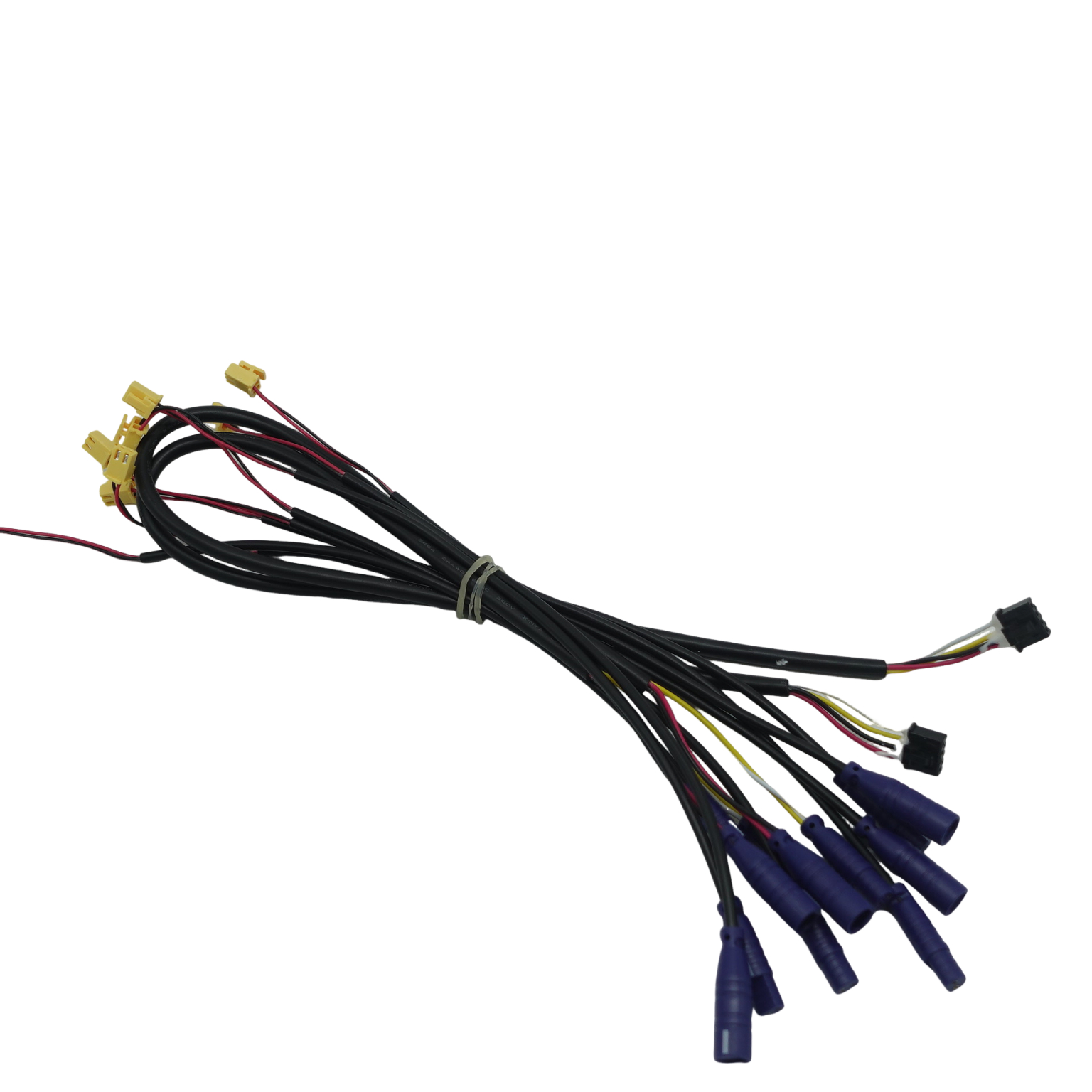
4. Technical Specifications & Material Standards
| Parameter | ESS Harnesses | PV / Solar Harnesses |
|---|---|---|
| Voltage Rating | 48V–1000V DC (high-voltage up to 1500V available) | 600V / 1000V / 1500V DC; 480V / 690V AC |
| Current Range | Signal (mA) to high-current power (500A+) | Up to 600A DC (utility combiner) |
| Temperature Rating | −40°C to +125°C (silicone); −20°C to +105°C (XLPE) | −40°C to +90°C (outdoor PV wire standard) |
| Insulation Material | XLPE, silicone, LSZH, PTFE (high-temp) | XLPE (PV wire), THWN-2, RHW-2, USE-2 |
| Conductor Material | Bare copper, tinned copper | Bare copper, tinned copper (per UL 4703) |
| IP Rating | IP54–IP67 (per enclosure requirements) | IP67–IP68 (outdoor connector assemblies) |
| Connector Brands | Anderson, TE RADSOK, Amphenol, Molex, JST | MC4/H4 (Stäubli, Amphenol), custom |
| Flame Rating | UL 94 V-0; IEC 60332-1 (LSZH available) | UL 4703 (PV wire); IEC 62930 (EN 50618) |
| Certifications Supported | UL 9540, IEC 62619, UL 508A | UL 4703, TÜV 2 PfG 1169, IEC 62852 |
5. Application Scenarios
| Application | System Type | Typical Harness Requirement |
|---|---|---|
| Residential ESS | Wall-mount home battery (5–20 kWh) | BMS sensing harness, AC/DC power harness, compact routing in sealed cabinet |
| Commercial BESS | Rack-mount battery system (100–500 kWh) | High-current inter-rack cables, CAN bus BMS harness, IP54 cabinet sealing |
| Utility-Scale BESS | Containerized storage (1 MWh+) | 1500V DC rated cables, full cable management system, IEC 62619 compliance |
| Residential Solar | Rooftop PV (5–20 kW) | MC4 string harnesses, inverter input cables, IP68 outdoor connectors |
| Commercial Solar | Rooftop / carport PV (50–500 kW) | Y-cable combiners, 1000V string harnesses, trunk cables, monitoring wiring |
| Utility Solar Farm | Ground-mount PV (1 MW+) | 1500V DC combiner harnesses, tracker flex cables, central inverter input wiring |
| Solar + Storage Hybrid | PV + BESS integrated system | Complete harness set covering PV array, battery, inverter/charger, and grid interconnect |
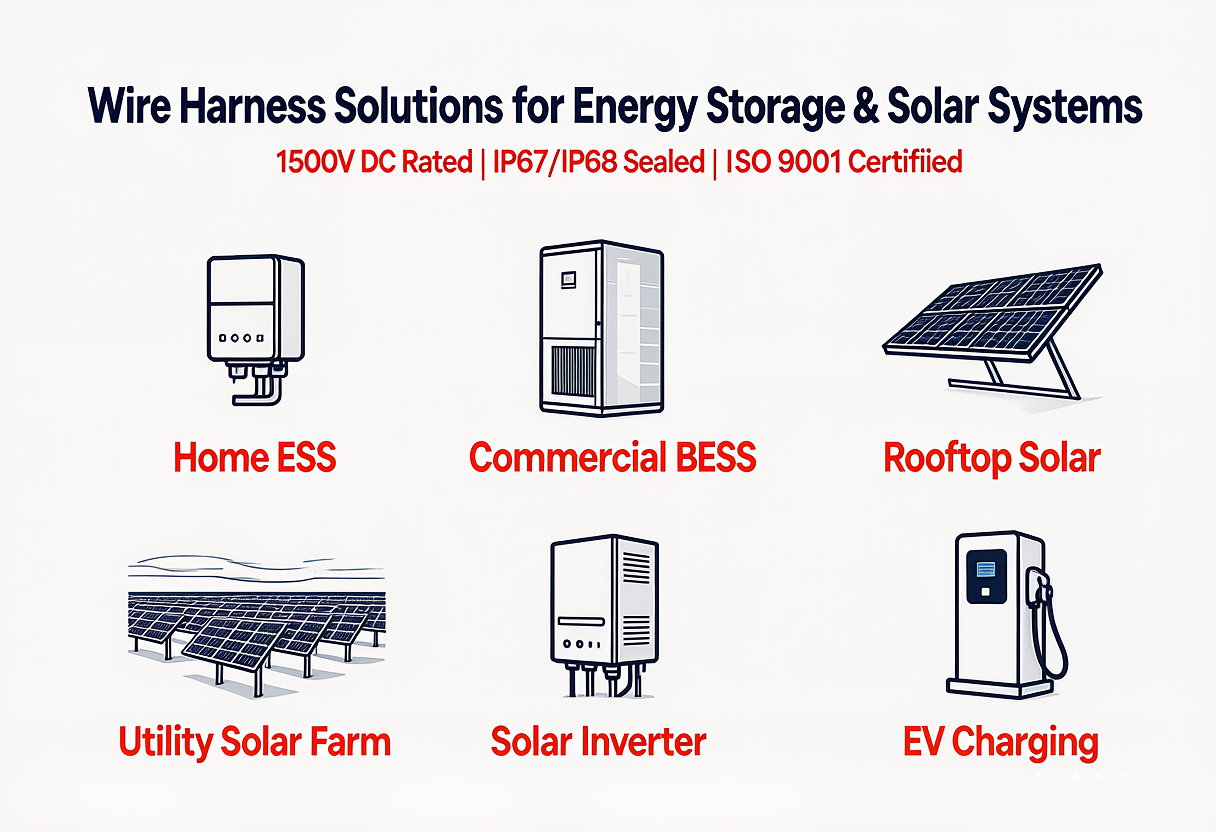
| EV Charging Station | DC fast charger (50–350 kW) | High-voltage DC power harnesses, CCS/CHAdeMO cable assemblies, 1000V rated |
6. Our Custom Manufacturing Capabilities
We are a dedicated custom wire harness manufacturer — not a distributor, not a catalog supplier. Every harness we produce for ESS and PV applications is engineered to your specific design, manufactured under controlled production conditions, and 100% electrically tested before shipment.
| Capability | Specification | Why It Matters for ESS/PV |
|---|---|---|
| High-Voltage Rated Assemblies | Up to 1500V DC; hi-pot tested at 2× rated voltage + 1000V | Required for utility-scale PV and grid-scale BESS applications |
| High-Current Crimping | AWG 2 to 4/0 (35mm² to 120mm²); servo-controlled crimp press with 100% pull-force test | Ensures reliable low-resistance connections at 200A–500A continuous load |
| IP67/IP68 Sealed Assemblies | Overmolded connectors, sealed cable glands, potted junction boxes | Essential for outdoor PV wiring and battery enclosure penetrations |
| Continuous Flex Cables | TPU / PVC flex-rated, 10M+ cycle tested | Required for solar tracker systems with daily rotation cycles |
| Multi-Conductor Harness Trees | Up to 200+ conductors per harness assembly; 3D wire form routing | Handles complex BMS sensing harnesses with 24–96 cell tap points |
| Shielded Cable Assemblies | Foil + braid, 85–96% coverage; drain wire with 360° termination | Critical for BMS CAN bus and inverter gate driver signal integrity |
| LSZH / Halogen-Free Materials | IEC 60332-1 flame test; zero-halogen on all insulation and jacketing | Required for battery room installations per IEC 62619 and fire codes |
| Custom Labeling & Traceability | Heat-shrink markers, laser-etched labels, QR code per harness | Supports field service, installation safety, and your certification documentation |
| Volume Range | Prototype: 10–50 pcs | Small batch: 200–2,000 pcs | Mass production: 5,000–100,000+ pcs/year | Supports all stages from R&D prototype through full production ramp |
7. Quality & Compliance Standards
ESS and PV harnesses are safety-critical components. A single insulation failure in a battery cabinet can initiate a thermal runaway event. A connector failure in a 1500V PV string creates a potentially lethal arc fault. Our quality system is built with these consequences in mind.
| Quality Element | Our Standard |
|---|---|
| Quality Management System | ISO 9001:2015 certified; dedicated control plans for high-voltage harness families |
| Workmanship Standard | IPC/WHMA-A-620 Class 3 for ESS/PV harnesses (highest level — typically reserved for military/aerospace, applied here for safety-critical energy applications) |
| 100% Hi-Pot Testing | Every unit tested at 2× rated voltage + 1000V DC for 1 minute; pass/fail logged per serial number |
| 100% Continuity Testing | Dedicated test fixtures for every SKU; all conductors, shields, and grounds verified |
| 100% Manual Visual Inspection | Every harness inspected by a dedicated QC operator — not sampling, not automated camera only. Human eyes on every unit covering 9 inspection categories. |
| Crimp Pull-Force Test | Per IEC 60352-2; tested at every tooling setup, every die change, every 500 crimps in production |
| Insulation Resistance | 500V DC megohmmeter test on all high-voltage harnesses; ≥100MΩ pass threshold |
| IP Sealing Verification | Air pressure decay test on sealed connector assemblies; IP67/IP68 conformance verified by test, not only by connector selection |
| Traceability | Full material traceability from wire lot and connector lot to finished shipment; records retained 10 years (extended for energy storage customers) |
| RoHS / REACH Compliance | Material declarations and third-party test reports available for all ESS/PV harness families |
What "100% manual inspection" means in our factory: Each harness is inspected by a dedicated QC operator against a laminated inspection checklist specific to that SKU. The checklist covers: wire routing path, connector seating and locking, insulation condition, labeling accuracy, overall length, sleeve/conduit coverage, and connector IP sealing. No harness leaves the production floor without a QC pass stamp and operator ID recorded on the traveler document.
8. From Prototype to Mass Production
Energy storage and solar projects often involve long product development cycles with multiple engineering iterations before production release. Our process is designed to support your timeline, whether you're at early-stage prototype or scaling to full production volume.
Technical Intake & DFM Review (Day 1–3)
Submit your drawing, BOM, or sample harness. Our engineering team performs a full DFM review covering voltage ratings, current capacity, insulation class, connector selection, IP sealing requirements, and applicable standards. We return a written DFM report with any recommendations — at no charge, no commitment required.Quotation (Day 2–4)
Detailed quote covering unit price at your target volume, NRE tooling costs if applicable, prototype lead time, and production lead time. For standard ESS/PV harness types, quotes are returned within 48–72 hours of receiving complete documentation.Prototype Production (Week 2–4)
First article samples produced with 100% electrical testing and a First Article Inspection Report (FAIR). Includes hi-pot test results, pull-force data, IP sealing test records, and dimensional conformance. Rework iterations are accommodated at no additional tooling charge within the agreed design envelope.Production Qualification (Week 4–6)
Qualification batch (typically 50–200 pcs) produced to verify process repeatability before production release. Statistical process control data collected on crimp force, pull-force, and hi-pot results. Process FMEA completed and filed.Mass Production (Ongoing)
Standard production lead time: 15–25 days for orders up to 50,000 pcs. Shipment includes lot records, electrical test reports, and Certificate of Conformance. FOB Xiamen or DDP to your warehouse.Long-Term Support
A dedicated account engineer supports ECO processing (≤ 5 business days for first-article samples), annual requalification, and quality issue response. For energy storage customers, we maintain a 24-hour response commitment for quality escalations.
9. Frequently Asked Questions
Q1: Do your harnesses comply with UL 9540 and IEC 62619 requirements for energy storage systems?
We manufacture harnesses to the wiring standards referenced in UL 9540 and IEC 62619 — specifically IPC/WHMA-A-620 Class 3 workmanship, UL-listed wire materials, and voltage ratings appropriate for the system voltage. We do not certify the complete ESS system (that is your system integrator's scope), but we provide all wire and connector compliance documentation needed for your system certification submission. Our harnesses have been incorporated into systems that successfully passed UL 9540 and IEC 62619 certification.
Q2: Can you build harnesses rated for 1500V DC for utility-scale PV?
Yes. We build harnesses rated for 1500V DC using UL 4703-listed PV wire, TÜV-certified connectors, and hi-pot testing at 4000V DC (2 × 1500V + 1000V). All 1500V harnesses receive insulation resistance testing at 1000V DC with a ≥ 100MΩ pass threshold. We recommend discussing the specific application with our engineering team so we can confirm the correct wire type, connector selection, and test protocol for your jurisdiction.
Q3: We need MC4-compatible connectors. Do you use genuine Stäubli MC4 or compatible alternatives?
Both are available. We can assemble with genuine Stäubli MC4 (Stäubli Electrical Connectors), genuine Amphenol H4 utility connectors, or qualified MC4-compatible connectors from approved manufacturers that meet TÜV 2 PfG 1169 requirements. We will always confirm the connector source with you before ordering materials — interoperability between MC4 brands is a real field concern, and we take it seriously.
Q4: Our BMS harnesses have 48 cell tap points. Can you handle that complexity?
Yes — multi-tap BMS sensing harnesses are one of our specialties. We have built harnesses with up to 96 sensing taps in a single assembly. Key engineering controls we apply: precise wire length matching across all tap channels (±2mm), dedicated test fixtures that verify all 96 channels simultaneously, and physical labeling of each tap with the cell number to prevent mis-routing during installation. We can also supply these as pre-formed harnesses that drop directly into your battery module without additional routing work at your assembly line.
Q5: Do you supply flex cables for solar tracker applications?
Yes. Solar tracker harnesses use TPU or PVC-jacketed continuous-flex cables rated for ≥ 10 million flex cycles at the tracker's bend radius. We specify cables that are tested to IEC 60228 Class 6 (finest stranding for maximum flex life) and can supply pre-terminated assemblies with the appropriate connector for your tracker actuator and controller. We recommend sharing your tracker specification so we can confirm the correct flex life rating and temperature range for your deployment geography.
Q6: What is your hi-pot test procedure for high-voltage harnesses?
For harnesses rated 600V–1500V DC, our hi-pot test procedure is: (1) connect all conductors under test to positive terminal, all shields and grounds to negative terminal; (2) ramp voltage to 2× rated voltage + 1000V DC (e.g., 4000V for a 1500V-rated harness); (3) hold for 60 seconds; (4) pass criterion: < 1mA leakage current, no breakdown. Test results (voltage applied, leakage current, pass/fail) are logged per unit serial number and included in shipment documentation.
Q7: We're a startup building our first residential ESS product. Can you support early-stage prototype quantities?
Absolutely. We accept prototype orders from 10 pieces for new ESS/PV harness designs. For startups and first-time ESS manufacturers, we actually recommend starting with a paid DFM review + 10-piece prototype run before committing to production tooling — this is the most cost-effective way to identify design issues before they become production problems. We've supported several ESS startups from their first prototype through their first production run, and we understand the importance of moving quickly without sacrificing safety.
Ready to Build Your ESS or PV Harness?
Whether you manufacture residential home batteries, commercial rack storage systems, utility-scale BESS, rooftop solar inverters, or solar farm combiners — we have the engineering depth, production capability, and quality infrastructure to support your project from prototype to volume production.
Send us your drawing or BOM and receive a full quote + DFM review within 24 hours. No minimum commitment for the initial engineering review.
 Contact Us — Free DFM Review & Quote for ESS/PV Wire Harnesses
© 2026 Kehan Wire Harness | Custom Energy Storage Wire Harness | BESS Wiring Harness | Solar Wire Harness | Photovoltaic Cable Assembly | 1500V DC Harness Manufacturer | ISO 9001 Certified
Keywords: energy storage wire harness · BESS wiring harness · ESS harness manufacturer · solar wire harness · photovoltaic wire harness · 1500V DC harness · battery storage cable assembly · custom ESS wiring · solar panel harness manufacturer · BMS sensing harness